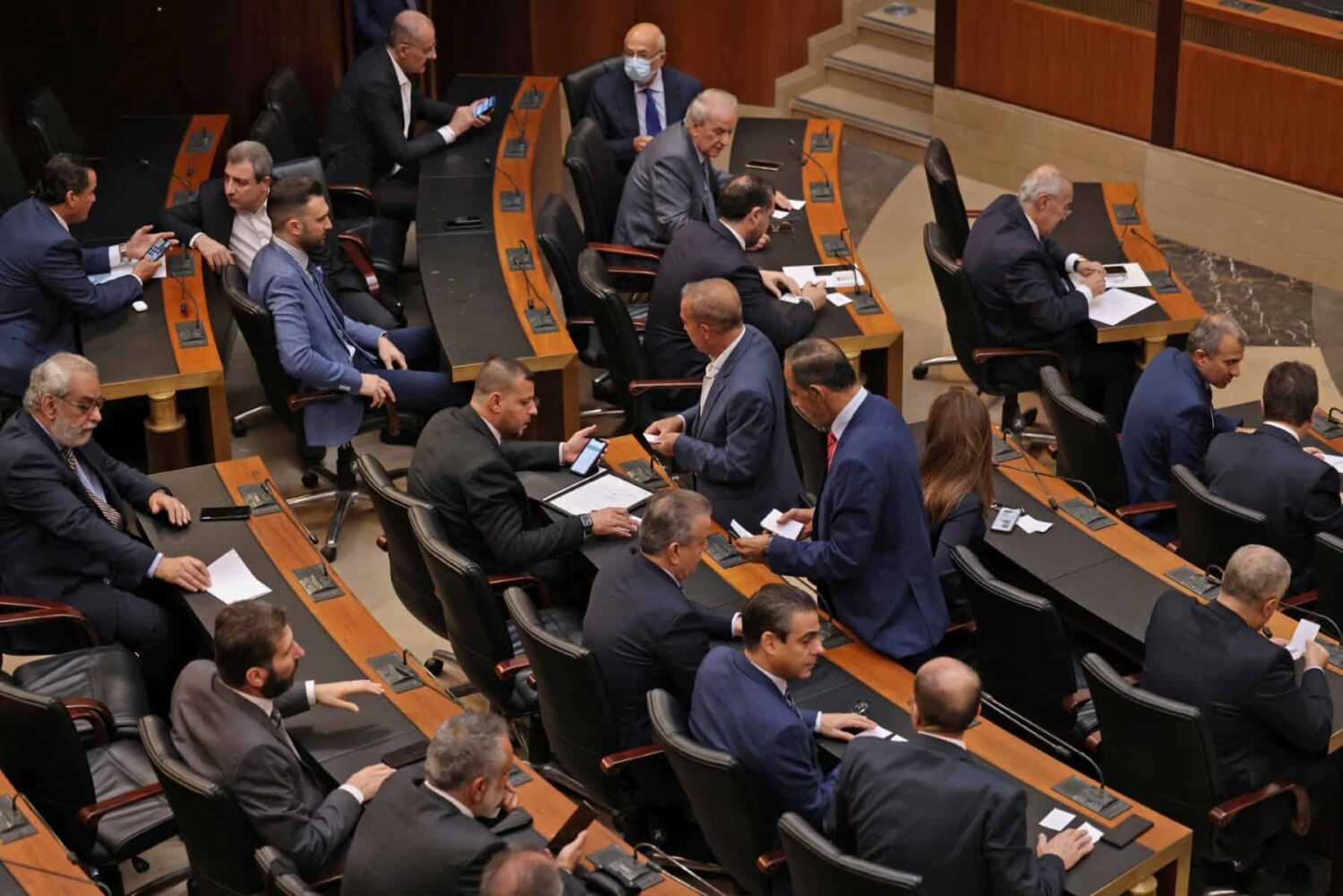

BEIRUT, LEBANON – Lawmakers in crisis-hit Lebanon failed to elect a new president on Thursday for an eighth time, despite the deepening impact of the political deadlock on the country’s economic woes.
Lebanon has been without a head of state for a month after president Michel Aoun left office at the end of October with no successor.
Parliament is split between supporters of the powerful Iran-backed Hezbollah movement and its opponents, neither of whom have a clear majority.
Lawmaker Michel Moawad, who is seen as close to the United States, won the support of 37 lawmakers Thursday – well short of the required majority – while 52 spoilt ballots were cast, mainly by pro-Hezbollah lawmakers.
Only 111 of parliament’s 128 lawmakers showed up for the vote.
Some MPs wrote in mock choices on their ballots, with one vote cast for Brazil’s leftist president-elect Luiz Inacio Lula da Silva.
Parliament is “not shouldering its responsibilities”, charged lawmaker Antoine Habchi of the Lebanese Forces, a Christian party opposed to Hezbollah.
Electing a president, naming a prime minister and forming a government can take months or even years of political horse-trading.
Lebanon can ill-afford a prolonged power vacuum as it grapples with a financial crisis dubbed by the World Bank as one of the worst in modern history, with a currency in free fall, severe electricity shortages and soaring poverty rates.
The country’s caretaker government is unable to enact the sweeping reforms demanded by international lenders as a condition for releasing billions of dollars in bailout loans.
Hezbollah opposes Moawad’s candidacy, and the Iran-backed group’s leader Hassan Nasrallah called last month for a president ready to stand up to the United States.
Moawad has good relations with Washington and has repeatedly called for the disarming of Hezbollah — the only faction to keep its weapons after the end of Lebanon’s 1975-1990 civil war.
Former president Aoun’s own election in 2016 followed a more than two-year vacancy at the presidential palace as lawmakers made 45 failed attempts before reaching a consensus on his candidacy.
By convention, Lebanon’s presidency goes to a Maronite Christian, the premiership is reserved for a Sunni Muslim and the post of parliament speaker goes to a Shiite Muslim.
Parliament is expected to convene for a new attempt to elect a president on December 8.