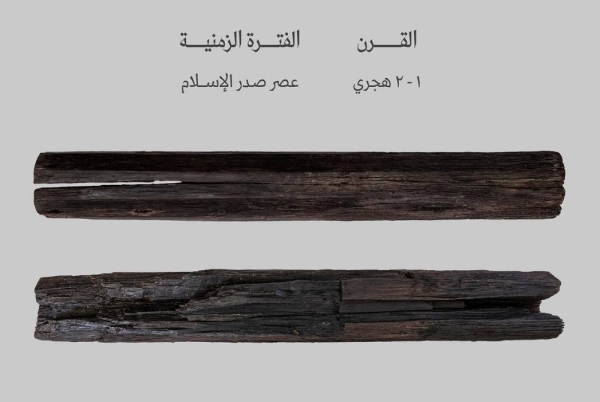

Jeddah, Saudi Arabia – The Jeddah Historic District Program has announced the discovery of the two ebony wood poles at the historic site of Othman bin Affan Mosque, dating back over 1200 years to the first and second centuries AH (7th and 8th centuries AD). They have been identified as among the oldest artifacts discovered at the site to date.
Laboratory analyses suggest that these poles likely originate from the early Islamic era, with scientists speculating that they were incorporated into the mosque’s construction as decorative elements during its initial phases.
Conducted at the German Archaeological Institute in Berlin, scientific studies indicate that the ebony wood used for these poles is of the finest quality, originally sourced from the island of Ceylon (now Sri Lanka) in the Indian Ocean. Furthering their investigation, archaeologists have sent over 250 wooden samples from 52 historical buildings to specialized international laboratories for analysis to determine their origins and ages.
The ongoing exploration of the Othman bin Affan Mosque has revealed a fascinating seven chronological phases of architectural development. Preliminary findings suggest that the oldest segment of the mosque dates back to the 3rd and 5th centuries AH.
This discovery is part of a broader array of archaeological findings announced by the Jeddah Historic District Program, marking the culmination of the first phase of their archaeological project. In total, 25,000 fragments of artifacts from four archaeological sites in Historic Jeddah have been unveiled, offering valuable insights into the cultural evolution of the city. The initiative aims to preserve and enhance the historical significance of these sites, contributing to a deeper understanding of Jeddah’s rich heritage.