
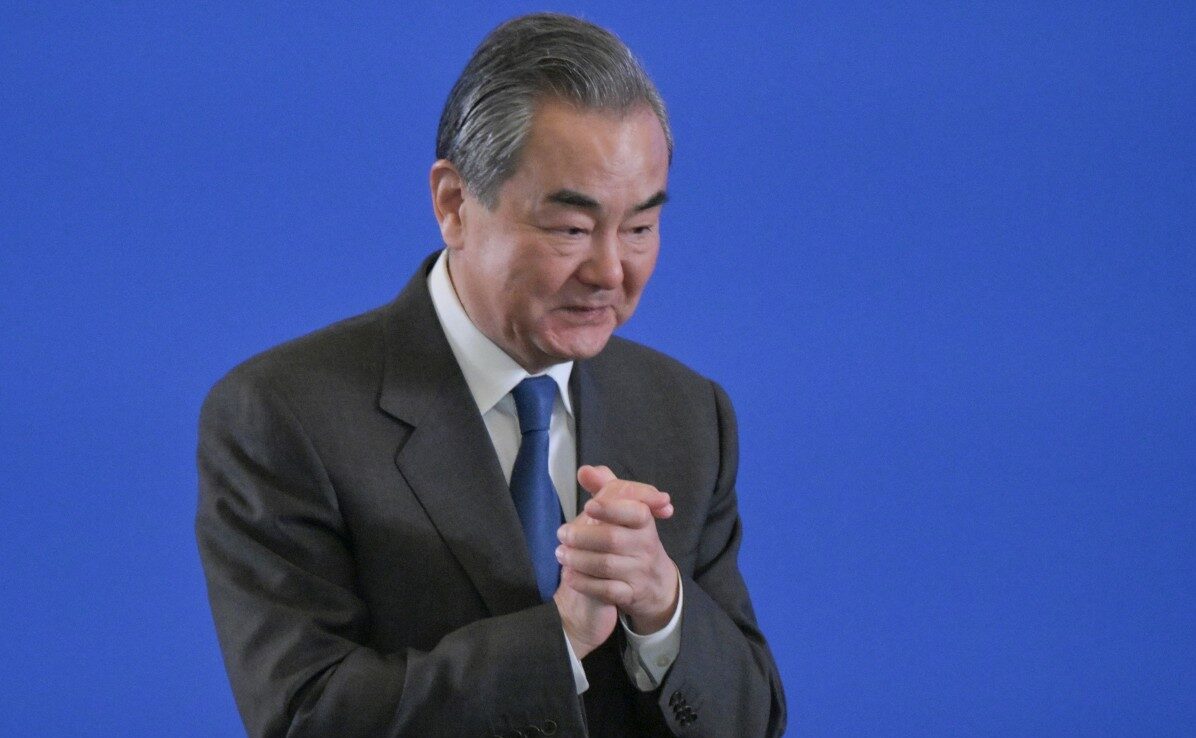


China’s foreign minister Wang Yi said the conflict involving Iran “should never have happened” and warned against a return to the “law of the jungle”, while stopping short of directly criticising Donald Trump.
“A strong fist does not mean strong reason. The world cannot return to the law of the jungle,” Wang said on Sunday while speaking on the sidelines of China’s annual parliamentary and political meetings known as the Two Sessions in Beijing.
The senior diplomat said the war in the Middle East “should never have happened” and warned that attempts at regime change — a key stated aim of Trump as the United States and Israel continue attacks on Iran — “will find no popular support”.
Despite the criticism, Wang struck a conciliatory tone toward Washington and avoided mentioning Trump directly.
He said China remained “committed to a spirit of mutual respect” in relations with the United States and described recent talks between Xi Jinping and Trump as “heartening”.
Wang added that 2026 was a “big year for China-US relations” and urged both sides to “treat each other with sincerity and good faith.”
Iran says it can sustain six-month war as Trump demands unconditional surrender
Iran’s Revolutionary Guards said on Sunday that the country could sustain an “intense war” with the United States and Israel for at least six months, signalling Tehran’s readiness for a prolonged regional conflict as fighting escalates across the Middle East.
“The Armed Forces of the Islamic Republic of Iran are capable of continuing at least a six-month intense war at the current pace of operations,” Guards spokesperson Ali Mohammad Naini said, according to the Fars news agency.
The statement came as Iran launched fresh waves of missiles and drones toward Israel and across the Gulf region, while Israeli and US forces expanded their strikes inside Iranian territory.
Other major developments:
Majority consensus reached on Iran’s next supreme leader
A majority consensus over a successor to Iran’s slain Supreme Leader Ayatollah Ali Khamenei has more or less been reached, Assembly of Experts member Ayatollah Mohammadmehdi Mirbaqeri said, according to Mehr news agency.
He said, though, that “some obstacles” need to be resolved regarding the process, according to the report.
Iranian media said the body tasked with appointing Iran’s supreme leader had a minor disagreement over whether their final decision must follow an in-person meeting or instead be issued without adhering to this formality.
Bahrain says three people injured by missile debris
Falling missile debris injured three people and damaged a university building in Bahrain, the interior ministry said, as Iran pressed its air campaign against neighbouring Gulf states.
“As a result of the blatant Iranian aggression, 3 people were injured and material damage was inflicted on a university building in the Muharraq area after missile fragments fell,” the ministry said in a statement, referring to an island area northwest of Manama.
Iran ‘will be forced to respond’ if attacked from neighboring country, says president
Iranian President Masoud Pezeshkian said his country “will be forced to respond” to any attack or invasion attempt from a neighbouring country, in remarks aired by state TV on Sunday.
If Iran’s enemies “try to use any country to attack or invade our land, we will be forced to respond to that attack. Responding does not mean we have disputes with that country or wish to harm its people — we would be responding out of necessity,” said Pezeshkian.
On Saturday the president apologised to neighbouring countries hosting US military bases for attacks on their territory.
He said his remarks were “misinterpreted by the enemy that seeks to sow division with neighbours”.
Sirens sounded across Israel
Air raid sirens sounded across northern and southern Israel early Sunday as Iranian missiles were detected heading toward the country. Israeli air defences intercepted multiple projectiles, the military said, ordering residents in several areas to seek shelter before later lifting the alerts. No casualties were immediately reported.
Iran has also widened its attacks beyond Israel, targeting Gulf states hosting US military assets. Qatar’s defence ministry said a dozen missiles were fired toward the country on Saturday, with most intercepted and others landing in territorial waters or uninhabited areas.
Saudi Arabia said it intercepted a drone targeting the diplomatic quarter in Riyadh, while Kuwait’s military reported engaging “hostile missile and drone attacks” after Iranian drones penetrated its airspace. Kuwaiti authorities said fuel tanks at the country’s international airport were among the targets.
UAE intercepts missiles
The United Arab Emirates said its air defence systems were intercepting incoming missiles and drones on Sunday, adding that explosions heard in parts of the country were caused by interceptions.
Meanwhile, the conflict expanded further into Lebanon after an Israeli drone strike hit a hotel in Beirut’s Raouche district, a seaside tourist area not known as a Hezbollah stronghold. Lebanon’s health ministry said four people were killed and ten were wounded.
The strike hit a room in the Ramada Hotel early Sunday, according to local media. Israeli authorities did not immediately identify the intended target.
Israel has said it is carrying out strikes on Hezbollah infrastructure across Lebanon after the Iran-backed group launched rockets and drones toward northern Israel earlier in the week.
Inside Iran, the war reached a new phase late Saturday when flames rose above a fuel storage facility in Tehran after strikes attributed by Iranian state media to the United States and Israel.
The attack marked the first reported strike on Iran’s oil infrastructure since the conflict began. The targeted depot lies near a major refinery, though the ILNA news agency said the refinery itself was not damaged.
Israeli forces also said they struck 16 aircraft belonging to Iran’s Islamic Revolutionary Guards Corps during overnight operations at Tehran’s Mehrabad airport.
Israeli Prime Minister Benjamin Netanyahu vowed to continue the campaign.
“Israel will continue the war with all our force,” Netanyahu said, describing the offensive as part of a “systematic plan to eradicate the Iranian regime”.
The Israeli military said it had carried out about 3,400 strikes on Iran since the war began a week ago.
Trump seeks Iran’s surrender
US President Donald Trump, however, suggested Washington is not seeking negotiations with Tehran and instead wants Iran to capitulate.
“We’re not looking to settle,” Trump told reporters aboard Air Force One on Saturday. “They’d like to settle. We’re not looking to settle.”
Trump said the conflict could end only when Iran no longer has a functioning military or leadership capable of continuing the war.
“At some point, I don’t think there will be anybody left, maybe to say ‘We surrender’,” he said, raising the prospect that the campaign could continue until Tehran’s leadership structure collapses.
The US president also said Kurdish forces in the region had offered to join the campaign against Iran but that he had rejected the idea, saying their involvement would further complicate the conflict.
“The war is complicated enough without getting the Kurds involved,” Trump said.
The intensifying hostilities have drawn international concern. China’s top diplomat Wang Yi said the conflict “should never have happened” and warned that global politics cannot return to “the law of the jungle”.
HRW calls for probe into Iran school strike
Human Rights Watch also called for an investigation into a strike on a primary school in the southern Iranian city of Minab on Feb. 28 that reportedly killed dozens of civilians, including children.
“A prompt and thorough investigation is needed into this attack,” said Sophia Jones, a researcher at the organisation.
Neither the United States nor Israel has claimed responsibility for the school strike, though Tehran has blamed both.
With attacks spreading across Iran, Israel and several Gulf states, the conflict has rapidly evolved into one of the most volatile regional confrontations in years, raising fears of a wider Middle East war.