
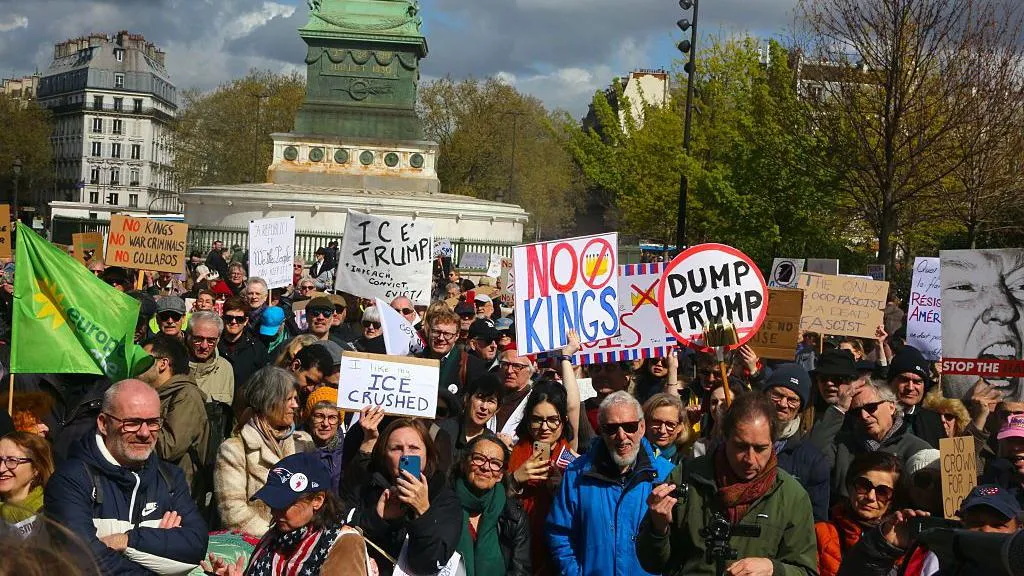


Dubai, UAE — Millions of Americans took to the streets across all 50 states on Saturday in coordinated “No Kings” protests against President Donald Trump, marking one of the largest single-day demonstrations in US history, according to multiple media reports.
More than 3,000 rallies were held nationwide, with participation estimates ranging from several million to as many as eight million people, reports said. The protests, organized under a decentralized movement opposing what demonstrators describe as authoritarian governance, also drew support in more than a dozen countries.
Broad grievances drive turnout
The protests were not centered on a single issue but reflected a wide range of grievances, including US military involvement in Iran, immigration enforcement policies, healthcare cuts and economic concerns such as inflation.
Demonstrators carried signs reading “No war, No ICE, No kings” and chanted slogans defending democratic values, with large turnouts reported in cities such as New York, Los Angeles, Boston and Washington.
Minnesota emerged as a focal point, where around 100,000 people gathered at the state capitol in one of the largest single events of the day.
Movement gains scale but lacks central leadership
The “No Kings” movement, launched in 2025, has grown rapidly into a nationwide protest network, organizing thousands of events through grassroots groups and coalitions.
Its decentralized structure has allowed it to mobilize millions but has also drawn criticism for lacking clear leadership and policy demands, raising questions about its long-term political impact.
Organizers say the broad coalition is intentional, aiming to unite diverse concerns under a common message of resisting executive overreach and defending democratic institutions.
Mostly peaceful protests with isolated clashes
While most demonstrations remained peaceful, clashes were reported in several cities, including Los Angeles, Dallas and Portland, where confrontations between protesters, counterprotesters and law enforcement led to arrests and the use of tear gas.
In New York, however, large crowds gathered without major incidents, underscoring the largely nonviolent nature of the nationwide mobilization.
Sector-specific protests highlight policy concerns
In Maryland, around 1,000 demonstrators rallied outside the National Institutes of Health to protest proposed cuts to medical research funding, highlighting concerns about political interference in science.
Speakers at the event emphasized the importance of federal funding for public health and warned of long-term consequences for research and innovation.
Political implications ahead of elections
The scale of the protests signals renewed momentum among critics of Trump and could have implications for upcoming elections, analysts say.
Despite dismissal from the White House and some Republican leaders, the turnout reflects rising political engagement across both urban and rural areas, with participation spanning age groups and communities.
Organizers have framed the protests as part of a sustained movement rather than a one-day event, pledging continued mobilization in the months ahead.