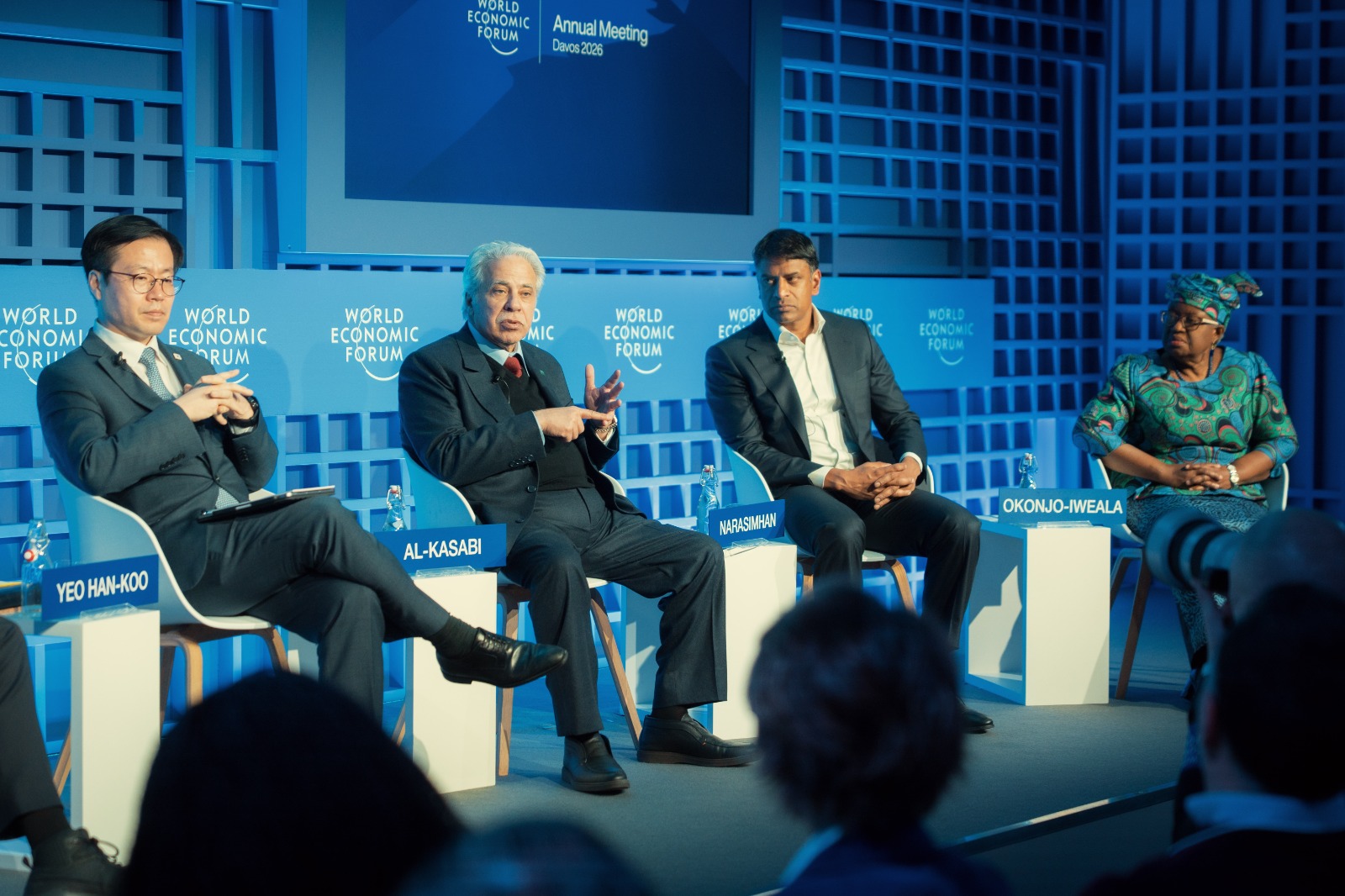

Davos, Switzerland: Saudi Arabia is seeking to leverage changes in global trade and supply chains to position itself as a “connector economy,” linking Africa, Europe and Asia, senior Saudi ministers said during discussions at the World Economic Forum (WEF) Annual Meeting 2026 in Davos.
Speaking at a session titled ‘Many Shapes of Trade’, Commerce Minister Majid A. Alkassabi said global trade was moving toward a more regulated framework, presenting new opportunities for the Kingdom.
“Trade today is definitely shifting from fair trade to a managed and rule-driven trade model. For us in Saudi Arabia, we have a strategic location, we have a lot of resources, we could become a bridge economy. We could become a connector economy where we can connect with Africa, with Europe, with Asia, becoming a logistic hub,” Alkassabi said.
Tourism Minister Ahmed A. Alkhateeb highlighted the growth potential of global travel during a session titled ‘The New Geography of Travel: Elevating Destinations, Expanding Opportunity’. Citing projections from UN Tourism, he pointed to expanding opportunities for the Saudi tourism sector.
“UN Tourism is projecting the number of tourists to grow to 2 billion by 2030, which means adding 500 million. This is a lot, and this is very encouraging for Saudi Arabia – for its hotel operators, investors, technology providers. This is an industry of amazing potential,” Alkhateeb said.
Finance Minister Mohammed A. Aljadaan underscored the importance of economic stability and predictability for private sector growth.
“Our role as policymakers is to ensure that a predictable environment is provided for businesses, and we are doing so by strengthening the resilience of our economy and giving the private sector the confidence it needs,” he said.
In the technology space, Communications and Information Technology Minister Abdullah A. Alswaha addressed the Kingdom’s ambitions in artificial intelligence during the session ‘Converging Technologies to Win’.
“In AI, the Kingdom is tackling the energy wall and the memory wall. We’re issuing a call to our partners, that in the Intelligence Age, you need a partner that can accelerate AI, but more critically adopt AI; and the Kingdom stands as your partner of choice,” Alswaha said.
Industry and Mineral Resources Minister Bandar I. Alkhorayef spoke on international cooperation in minerals during the session ‘A Collective Voice on the Future of Minerals: Aligning Policy, Investment and Supply’.
“The Kingdom adopts a multilateral approach to international cooperation, creating platforms that enable dialogue and partnership. The Future Minerals Forum stands at the forefront, now a global convening platform uniting governments, industry, finance, academia, and technology leaders,” Alkhorayef said.
Meanwhile, Economy and Planning Minister Faisal F. Alibrahim emphasized collaboration amid global uncertainty during the session ‘Redefining Economic Partnerships: From Dialogue to Delivery’.
“I believe there is a world where every country can unlock its economic potential and still keep dialogue open,” he said, adding, “There has never been a more blank canvas or a wider opportunity for us to design the future.”
On Thursday, the Global Innovation Platform — a partnership between Saudi HoldCo and GoldenPoint Global — launched the Saudi–U.S. Innovation Partnership, aimed at accelerating collaboration in life sciences, artificial intelligence and advanced manufacturing. Anchored in Riyadh and Austin, the initiative seeks to link two major innovation ecosystems.
In addition, Amplifai Health was announced as a winner of the second cohort of the WEF’s MINDS – AI Global Alliance initiative.