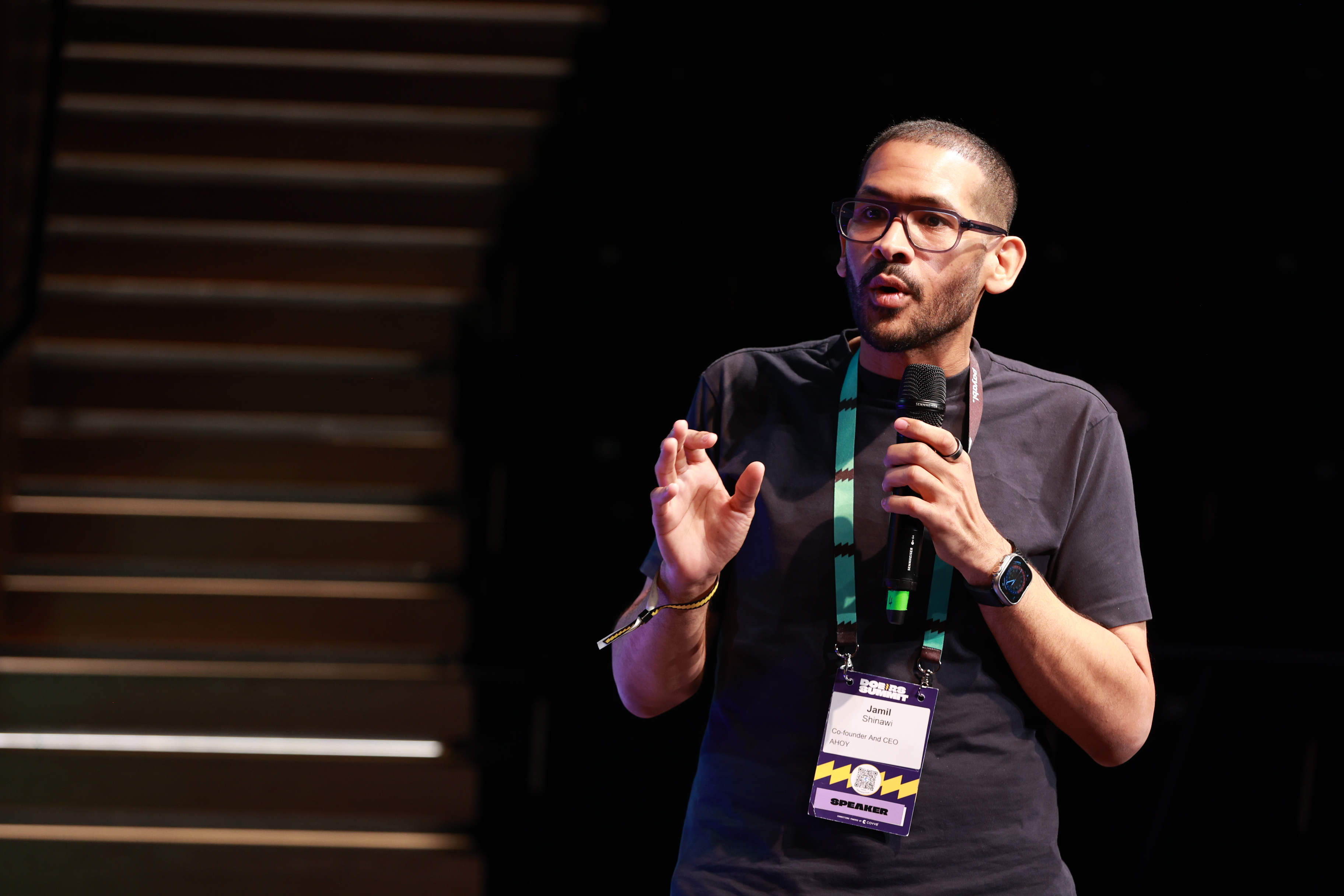

Jamil Shinawi, CEO and Co-founder of AHOY, a core-tech infrastructure company focused on redefining movement, mobility, logistics, and AI-enabled spatial systems across MENA, speaks to Velina Nacheva of TRENDS about how operating on both sides of the table reshapes risk, capital efficiency, and why truly scalable ideas in the region must be built for execution, not familiarity. Jamil is also the co-founder of Actual VC, a venture fund launched in 2024.
You operate simultaneously as a deep-tech founder and a venture investor. How does sitting on both sides of the table change the way you evaluate risk, timing, and capital efficiency in the MENA context?
From what I’ve seen, we’re plagued by superficial investors disconnected from real building and tech, focusing on sales propositions and hype rather than breakthroughs. Only outstanding ideas yield significant returns in the risk/reward paradigm. Investing in familiar territory won’t unlock the full potential of the venture industry. AHOY’s success stems from active ecosystem engagement, where we build on strong relationships with bold founders and spot ideas early. As both founder and investor via AHOY and ACTUAL VC, I gain a unique perspective on risk, timing, and capital efficiency in this region. MENA offers immense potential with local talent and dynamics that enhance my approach to building and investing. While ACTUAL VC operates globally, I know the global south and MENA are crucial for transformative change.
Deep-tech and infrastructure-led startups are capital-intensive and long-cycle by nature. How realistic is the current MENA funding landscape for these companies, and where does it still fall short compared to global markets?
Thinking that deep-tech is always capital-intensive and has a long cycle is a misconception that holds us back. Even SaaS companies burn funds for years before going public. However, AHOY is a profitable deep-tech company, achieving more than 200 times growth, with 50 percent plus positive EBITDA and annual sales surpassing $100 million.

In MENA, funding often favors “low-hanging fruit” over deep-tech startups. AHOY is working to change this with thought leaders from the global south, seeking partnerships with governments and investors focused on innovation, though gaps remain. We must foster the belief that local innovation can thrive beyond just emerging from the West or the East.
What signals about the region are resonating most with international investors today, and what do founders often misunderstand about global investor appetite?
Global investors are zeroing in on MENA’s growth, strategic location, and rapid tech progress, but there’s still a gap between what local founders expect and what investors are looking for: scalability, sustainability, and solid fundamentals. The key is bridging that gap by showing how startups leverage regional strengths that align with global market standards. The GCC is leading the way by being a neutral place from AI sovereignty, a haven for top talent lifestyle, and a place where global partnerships initiate, setting new benchmarks for innovation. AHOY contributes to this through our cutting-edge stack, advancing data privacy and responsible AI not just on the screen but into daily and tactical realities while turning regional potential into global impact.
The GCC has no shortage of ambition, from AI cities to next-gen logistics. Where does execution typically break down between national vision and startup scalability?
The GCC represents a new world renaissance, and I completely believe that. The challenge isn’t a lack of ideas, but aligning speed, regulation, and infrastructure with the pace of innovation. At AHOY, we’ve learned that execution falters when systems can’t adapt quickly to new technologies. Our operations research shows that policy agility and interoperable infrastructure can close gaps from days to milliseconds. As the GCC evolves, responsive frameworks will transform vision into scalable success, to set a global benchmark for innovation. We’ll make it happen.
Many ecosystems focus on accelerators, capital, and talent. What types of infrastructure are most urgently needed for the next wave of startups?
Ideas matter more than accelerators and capital, but they need the right infrastructure for success. Traditional accelerators waste entrepreneurial talent, which is why our non-profit has introduced a pro bono solution called “Cultivation” to reinvent acceleration. The bottleneck for innovation stems from daily support, primarily belief and adoption, while resources are abundant. At AHOY, through Trouve Labs and AHOY Tech, we see firsthand how belief influences whether ideas remain in labs or reach the market. We’re well on our way to enhancing tech ecosystems and streamlining regulatory pathways so startups in this region set global innovation standards.
You touch AI, logistics, energy, urban planning, and construction tech. How should investors think about sector convergence in MENA, and where are the most underpriced opportunities emerging?
We’re seeing real momentum at the intersection of industries—AI enhancing logistics, data transforming urban planning, and energy systems becoming smarter and more decentralized. What’s often undervalued in MENA is actionable data, solutions that connect sectors and unlock efficiency across infrastructure, mobility, and services. That’s where long-term value will be created, and where the next wave of globally competitive ventures will emerge.
But catching up just means settling for second place. Actionable data alone isn’t sufficient, which is why AHOY is advocating for a future where AI-orchestrated systems enable us to translate data into action and results in milliseconds, focusing on being proactive rather than reactive.
For founders raising seed or Series A today, what has fundamentally changed in expectations around traction, defensibility, and timelines compared to even two or three years ago?
Early-stage investors now expect founders to show real traction, not just potential, proving their model works and can scale. Angel investing and family support are the main pre-revenue funding sources. Defensibility through technology or unique execution is crucial, with timelines shortened for quick progress and clarity. It’s more about tangible momentum than the pitch deck. Unfortunately, many investors overlook true innovation; while buzzwords can secure funding, neglecting substance can lead to failure.
The GCC is evolving into multiple specialized hubs rather than a single ecosystem. How should founders strategically use cities like Dubai, Riyadh, Doha, or emerging hubs to accelerate scale rather than fragment operations?
Each city in the GCC brings something distinct to the table; hence, maybe they are specialized in investment but not in market reality, the GCC is one market. Investment should follow here, not lead or shape. The key is to treat them as parts of one connected ecosystem rather than separate markets. Founders who map their growth across these hubs can scale faster, tapping into local strengths without duplicating effort or fragmenting focus.
Through initiatives like AHOY’s founder network and Madinah-Tech, you’ve leaned heavily into ecosystem building. Where do you think the private sector must step in because traditional venture capital alone is not enough?
Venture capital fuels growth, but it’s not enough alone. The private sector must provide capital, thought leadership, talent building, and operational partnerships. AHOY’s non-profit initiatives like 24six9 and SourceHive, along with Gingo’s programs like Madinah-Tech, show that startup strength lies in hands-on collaborations. The next leap in entrepreneurship will arise from private-sector leadership actively shaping the ecosystems they rely on.