


Iran’s Islamic Revolutionary Guard Corps (IRGC) has threatened to invade any country that attacks it, announcing a shift from a defensive military posture to an “offensive and asymmetrical” doctrine as tensions mount across the Middle East.
“We say if a country attacks us we will respond to it and we will invade,” IRGC spokesman Hossein Mohebi told the Student News Network.
“Iran’s defence doctrine was purely defensive in the past,” he said, adding that Tehran would now attack adversaries in ways intended to make them understand the intensity of its response.
Mohebi also warned the United States over its naval blockade of the Strait of Hormuz, saying the economic and political repercussions could affect the Republican Party ahead of US midterm elections.
The remarks came as Israeli Prime Minister Benjamin Netanyahu issued fresh threats against Iran’s Supreme Leader Mojtaba Khamenei, saying Tehran had not learned its lesson from the war.
Netanyahu said Israel had completed “90 percent of the job” against Iran and the groups it backs, but argued that preventing Tehran from rebuilding its capabilities remained a challenge.
He also accused Iran and its allies of exploring ways to influence Israel’s elections scheduled for the following week, threatening a forceful response if Tehran interfered.
Araghchi signals conditional return to diplomacy
Iranian Foreign Minister Abbas Araghchi has said Tehran is prepared to give diplomacy another chance if Washington provides evidence that it genuinely wants a negotiated settlement.
“Iran is prepared to give diplomacy another chance,” Araghchi said in excerpts from an opinion article published in the Financial Times and shared on X.
He said Iran wanted a just solution and the rebuilding of trust, while warning that choosing war over diplomacy would produce an even greater strategic failure for the United States.
Araghchi’s comments indicate that Tehran has not ruled out negotiations despite its military warnings and the continuing confrontation over the US blockade and Iran’s nuclear programme.
French President Emmanuel Macron and Qatar’s Emir Sheikh Tamim bin Hamad Al Thani also called for diplomatic efforts to address the conflict during Macron’s visit to Doha.
In a joint statement, they condemned Iranian military attacks against regional countries and backed efforts to establish verifiably peaceful conditions for Iran’s nuclear programme. They also called for freedom of navigation through the Strait of Hormuz without restrictions or fees.
The two leaders agreed to intensify consultations and coordinate diplomatic efforts to contain regional tensions and prevent further escalation.
Uranium stockpile remains central to nuclear dispute
Iran’s enriched uranium stockpile and future enrichment capacity remain major obstacles to an agreement with Washington.
Iranian security chief Mohsen Rezaei has rejected demands to transfer the country’s nuclear material abroad, insisting that “even a particle of enriched uranium will not exit Iran at all”.
The United States wants Tehran to make a long-term, verifiable commitment not to rebuild its nuclear weapons capabilities. Vice President JD Vance has called for meaningful reductions in Iran’s enrichment capacity.
A June memorandum of understanding between the two countries proposed reducing enrichment levels under international supervision but left important questions unresolved, including the amount of nuclear material involved and the levels to which enrichment would be reduced.
Tehran maintains that uranium enrichment is its right under the Nuclear Non-Proliferation Treaty, while Washington demands guarantees that Iran cannot develop nuclear weapons.
The dispute comes as Israel continues to threaten further action against Iran’s military and nuclear capabilities.
Tehran challenges US blockade at United Nations
Iran has asked the United Nations to condemn the US naval blockade of Iranian ports in the Strait of Hormuz and the Gulf.
Iranian ambassador Gholamhossein Darzi urged the UN secretary-general and the president of the Security Council to demand that Washington stop military aggression and lift the blockade, according to Iran’s official IRNA news agency.
Darzi said Iran would exercise its right to self-defence in response to any act of aggression.
The blockade has become a central source of friction between Washington and Tehran, with the United States saying in August that restrictions on maritime trade entering and leaving Iran had been fully implemented.
Iran, meanwhile, said its exports to Africa had increased by 28 percent despite restrictions on trade routes, according to Masoud Barahman, head of the Iran-Africa Joint Chamber of Commerce. He did not specify the period covered by the increase or provide trade values.
Washington announced new Iran-related sanctions targeting five individuals, four companies and nine vessels. The US Treasury’s Office of Foreign Assets Control said the measures included five people holding Panamanian citizenship.
The sanctions follow President Donald Trump’s threat to punish countries doing business with Tehran.
Israeli jets conduct training near Iran’s borders
Dozens of Israeli fighter jets flew over Syria and Iraq to reach Iran’s western border on Monday as part of a training exercise intended to demonstrate strength, US media outlet Axios reported.
According to the report, Israel informed Trump administration officials that the exercise was intended to deter future Iranian attacks.
US officials told Axios they believed Israel might have hoped Iran would target the Israeli aircraft, potentially providing justification for retaliatory action.
The report emerged amid renewed threats from Netanyahu against Iran’s leadership and uncertainty over whether diplomatic efforts can prevent another escalation.
Iran’s Fars news agency also reported explosions in Sirik, in southern Iran. The cause of the blasts was not immediately known.
Separately, Iran confirmed the identities of four Iranian soldiers held in Kuwaiti custody. Brigadier-General Mohammad Baqerzadeh, chief of the army’s Missing Persons Committee, said they should be registered as prisoners of war under the Geneva Convention.
Iran’s ambassador to Kuwait had met the soldiers, while the International Committee of the Red Cross was working on their welfare and eventual release. The circumstances of their detention remained unclear, and Kuwaiti authorities had not commented.
Iranian and Chinese officials also discussed regional peace and closer cooperation. Their discussions included Chinese President Xi Jinping’s proposal for common security in the Middle East, with Beijing saying it would make every effort to promote peace talks.
Gulf attacks raise security concerns and oil prices
The war’s regional fallout has intensified as Saudi Arabia reported attacks involving drones and critical infrastructure, prompting Washington to order the departure of non-emergency diplomatic staff and their families from Saudi Arabia.
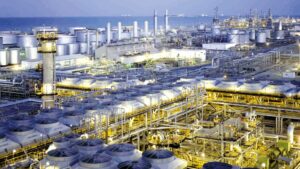
Saudi Arabia’s Energy Ministry said debris from a drone intercepted while targeting Aramco’s Shaybah oilfield killed one Filipino national and one Nepali national and wounded two others, identified as Pakistani and Indian citizens. A contractor’s vehicle caught fire, but operations at the facility were unaffected.
Saudi authorities also reported an attack on King Fahd International Airport in Dammam that killed one person and injured eight, with material damage under assessment.
The Saudi-led coalition said its air defences had intercepted drones heading towards the kingdom, including four in the Eastern Province. The US State Department said its ordered departure applied to non-emergency government employees and their families in Saudi Arabia.
Oil prices rose amid the latest attacks and concerns about regional security. Brent crude futures gained 1.2 percent to $110.11 a barrel, while US West Texas Intermediate rose 1 percent to $98.12.
Qatar, Turkiye, Pakistan and Indonesia signed a defence industry agreement in Doha to develop cooperation between their defence industries and jointly produce military equipment and defence systems.
The agreement comes amid heightened regional security risks and efforts by participating countries to strengthen domestic defence capabilities.
Yemen fighting intensifies as Houthis target Saudi Arabia
Fighting between Yemen’s internationally recognised government forces and the Iran-backed Houthis has intensified around Taiz, where shelling and clashes have damaged infrastructure and killed civilians.
Yemen’s Interior Ministry said Houthi artillery, rocket fire and sniper attacks killed two civilians, including a young girl, and wounded five others in Taiz governorate on Wednesday.
Government forces said they had repelled Houthi attacks on the western front of Taiz and that Saudi-backed warplanes had struck Houthi fighters, vehicles and a missile launchpad in several areas.
Air strikes also targeted Houthi fighters and vehicles in the al-Maafer district south of Taiz, according to a Yemeni government force source cited by Al Jazeera.
The internationally recognised government’s Defence Ministry warned civilians against attending Houthi-organised gatherings for tribal mobilisation and recruitment, saying such gatherings could be considered legitimate military targets.
Amnesty International called on the Houthis to reopen the main road linking Taiz to Aden, saying the closure had put hundreds of thousands of people at risk by restricting access to food, water and healthcare.
The organisation said at least 32 civilians, including 14 children, had been killed across Taiz governorate between August 1 and October 19. It also reported that food prices had risen by about 50 percent and cooking gas had become largely unavailable in besieged areas.
Yemeni government forces accused the Houthis of repeatedly targeting al-Rayyan airport in Mukalla, while military officials reported missile attacks on Aden International Airport and a factory in Taiz.
The Saudi-led coalition’s interceptions and the attacks on Saudi infrastructure have added to concerns that the Yemen conflict could further widen the regional confrontation.