

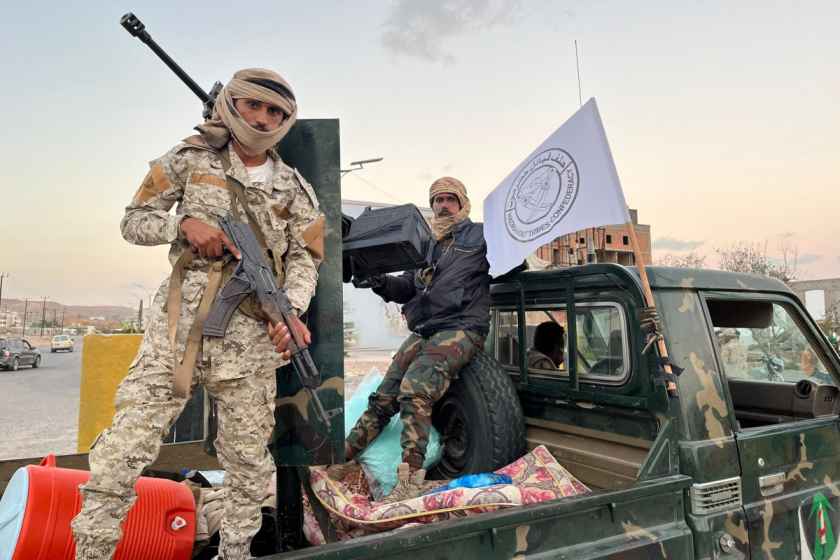

Saudi-led coalition forces have struck the Houthi-controlled Red Sea port of Hodeidah and targets in two northern Yemeni governorates, marking another escalation in the widening regional conflict involving Iran and its allies.
The coalition said on Wednesday that it had targeted what it described as operational capabilities at Hodeidah, while also destroying several targets in Saada and Amran governorates near the Saudi border.
The strikes followed an evacuation warning issued to civilians ahead of the operation. Houthi military spokesman Yahya Saree had earlier threatened to target all Saudi Red Sea ports, including Jeddah, if Hodeidah came under attack.
The port is a critical economic lifeline for Yemen, with more than 90 percent of the country’s imported goods entering through the facility, according to Al Jazeera. Yemen’s internationally recognised government has accused the Houthis of using the port as a military hub and facilitating the smuggling of Iranian weapons.
The latest strikes come amid intensified Houthi attacks on Saudi Arabia, including a reported attack on Riyadh’s Financial District Tower on Tuesday. India said two of its nationals were injured in the incident and condemned attacks on civilian infrastructure.
Saudi air defences have intercepted 209 aerial threats launched by the Houthis between September 24 and November 24, according to the Saudi embassy in Washington. The embassy said the attacks had targeted civilian infrastructure and energy facilities across several regions, including areas near Makkah and Madinah.
The Saudi-led coalition also announced the interception of four drones over Ras Tanura in the Eastern Province on Wednesday. Fragments fell following the interceptions, but no casualties were reported.
Strait of Hormuz: Tankers hit naval mines
The maritime situation in the Strait of Hormuz has deteriorated further, with two oil tankers suffering explosions and engine-room fires after striking naval mines, according to Iran’s state broadcaster IRIB, citing the Islamic Revolutionary Guard Corps (IRGC) Navy.
The IRGC Navy said the vessels had attempted to navigate an unauthorised route with their navigation and positioning systems switched off.
The Strait of Hormuz Traffic Control Centre warned ship crews against operating with disabled navigation systems, saying statements by US authorities would not protect vessels from naval mines.
Separately, Iran’s army claimed its forces had destroyed a US-made MQ-9 Reaper drone over the eastern Strait of Hormuz. The announcement was carried by IRIB.
The developments underscore the growing risks to international shipping through one of the world’s most strategically important energy corridors, as the US naval blockade of Iranian ports and coastal areas continues.
US-Iran confrontation: Trump signals prolonged war
US President Donald Trump has said the war against Iran is funded through January, warning congressional Democrats against attempting to force an end to the military campaign.
In an interview with the New York Post, Trump acknowledged that his military options could become constrained when Democrats take control of Congress in January. He nevertheless expressed confidence that the US had achieved a military victory and could end the war whenever it chose.
Trump said he was primarily seeking to prevent Iran from acquiring nuclear weapons, adding that regime change had never been his objective. He also described Israel’s goal of ending the Islamic Republic as potentially achievable.
However, David Des Roches, a senior international affairs fellow at the National Council on US-Arab Relations, warned that a major US-Iran military confrontation was increasingly likely because of the continuing naval blockade.
Speaking to Al Jazeera, Des Roches said Iran would not indefinitely accept the economic and strategic pressure imposed by the blockade and could eventually seek to break out of the situation.
He added that Trump could respond by resuming major air strikes.
Gaza and Lebanon: Israeli attacks continue
Israeli military operations have continued in Gaza and southern Lebanon despite the regional ceasefire arrangements.
An Israeli helicopter attack on an apartment in the Shati refugee camp, west of Gaza City, killed a man, his wife and two of their children, according to Al Jazeera. Six others were injured, three of whom were in critical condition.
At least 14 Palestinians were killed across Gaza over the preceding 24 hours, according to the broadcaster’s correspondent in the territory.
Separately, medical sources at Nasser Medical Complex reported that Israeli forces shot a Palestinian girl in Khan Younis, outside areas under Israeli control.
In southern Lebanon, Israel shelled Buyut al-Sayyad in the Tyre district, while machinegun fire was reported in Wadi al-Saluki and Baraachit in Bint Jbeil, according to Lebanon’s National News Agency.
The attacks have continued despite an April ceasefire. Lebanon and Israel reached a US-brokered framework agreement in June covering Hezbollah’s disarmament, the gradual withdrawal of Israeli forces from southern Lebanon and the deployment of the Lebanese army.