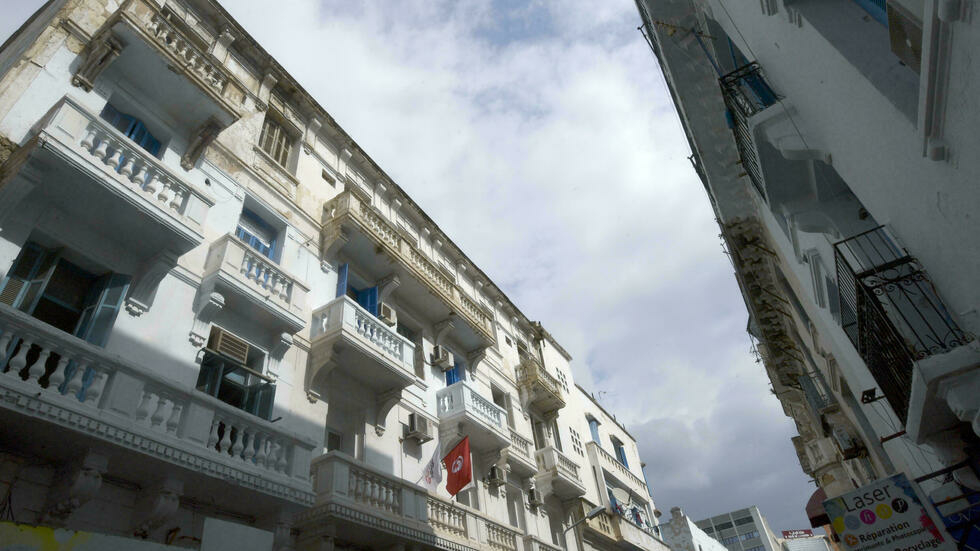

In the centre of Tunisia’s capital, dilapidated colonial-era art deco and art nouveau buildings face demolition as heritage preservation falls prey to a lack of planning and eager developers.
Imed Tahenti is the only remaining tenant of a building surrounded by Haussmann-style architecture just a stone’s throw from Tunis’ main thoroughfare.
Since 1956, his family has rented the ground floor apartment, an art deco gem featuring high ceilings, artisanal tiling and winding staircases.
Tahenti is the last resident to have resisted the pressure to leave.
A broker recently announced he now wants the building vacated ahead of selling it, after buying it decades ago.
“I’ve held out for a long time,” said Tahenti, a baker in his 60s, expressing fear that the owner would demolish the building and put up offices.
Tahenti said he should have been informed about the sale, adding that under the law he would have had priority to buy his apartment as a resident.
Two sides of the city
Built just outside Tunis’s traditional Arab medina during the French colonial period of the 19th and 20th centuries, such buildings were meant to “modernise” the city.
Their original inhabitants were mainly colonial residents or Jewish Tunisians, many of whom left after the country’s independence in 1956 and the 1967 Israeli-Arab conflict.
Built by Italian and French architects and businesspeople, such buildings are associated with colonialism.
But “you can’t talk about the Arab city without evoking at the same time the European city that makes up the centre of Tunis,” said architect Dhouha al-Jalasi.
At least 160 dilapidated buildings that belonged to foreigners are at risk of collapse across the country, according to the last official survey in 2019.
Some residents have carried out repairs that have changed buildings’ architectural heritage, while others are used as squats or rubbish dumps.
In Tunis, neighbourhoods have also been threatened by a draft law that sought to destroy dilapidated buildings, potentially affecting some 5,000 structures.
The legislation was presented to parliament in 2018, but civil society pressure eventually led to a deferral.
‘Not a priority’
Europeans made up a large part of the Tunisian population at the start of the 20th century.
The 1857 constitution allowed them to own land and buy houses, and European neighbourhoods developed in several cities.
In the capital, these included the Lafayette and Monfleury areas, and what is now the iconic Habib Bourguiba Avenue, named after the father of Tunisian independence.
There are 12,305 foreign-owned properties in Tunisia, according to official statistics, with 7,645 of them ceded to the state under French-Tunisian property contracts.
Local associations have called for strategies to “preserve the historic architectural landscape”.
Amel Zribi, head of a government agency for heritage and culture, said it would be a “crime” not to look after places that are part of the “collective memory”.
But the prospects are bleak at a time when Tunisia is facing one of the worst economic and political crises in its history.
Bertrand Ficini, from French development agency AFD, is also pessimistic.
Fundraising for heritage initiatives has been low in recent years, he said.
Built by Italian and French architects and businesspeople, decades-old buildings in the Tunisian capital bear the weight of their association with colonialism, with many neglected and turned into garbage dumps
Built by Italian and French architects and businesspeople, decades-old buildings in the Tunisian capital bear the weight of their association with colonialism, with many neglected and turned into garbage dumps Fethi Belaid AFP
Late last year, the agency committed 12 million euros ($14 million) for a restoration project involving old cities, including European neighbourhoods, Ficini told AFP.
All the same, “the preservation of heritage, particularly European, is not a priority for our partners”, he lamented.