
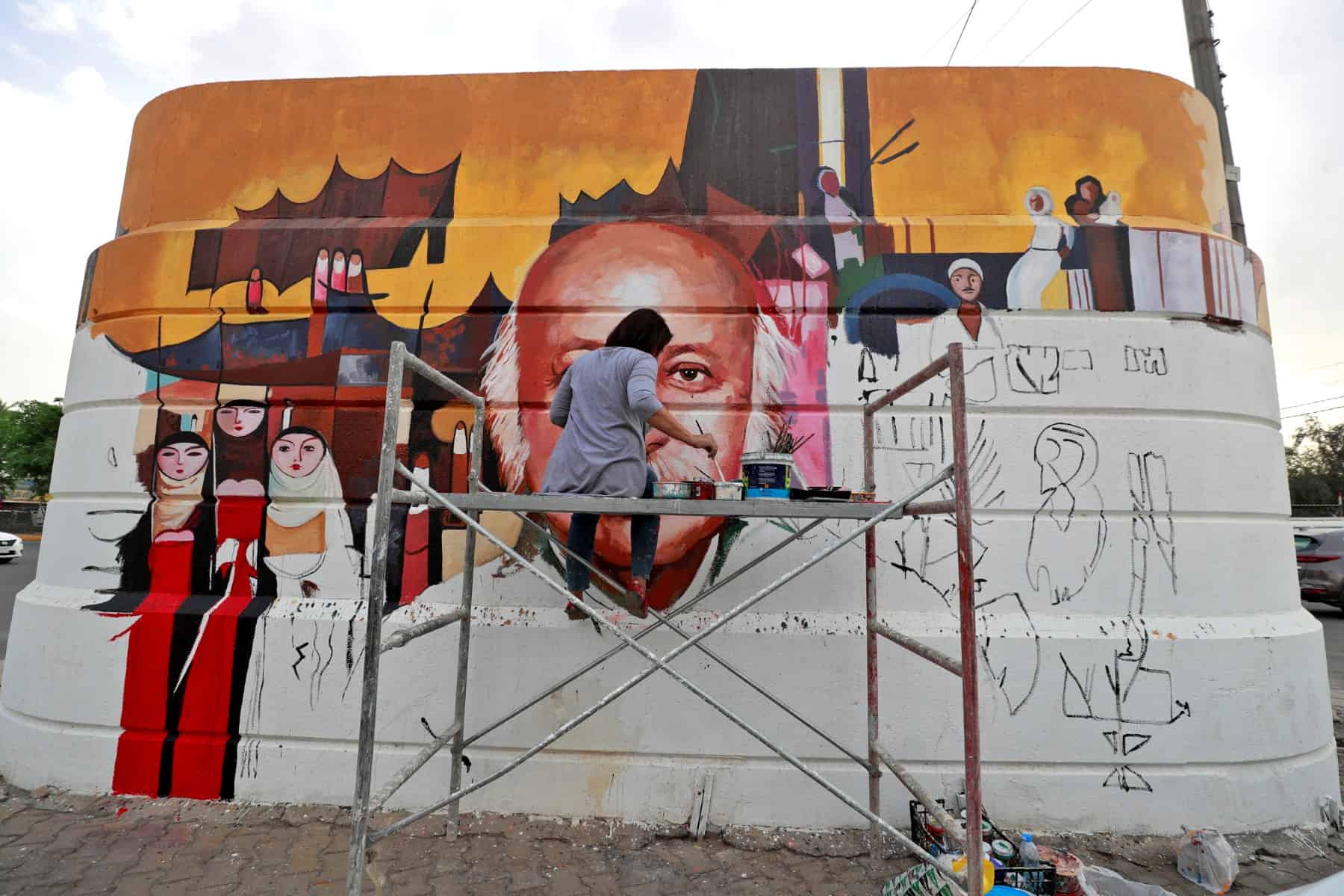


Iraqi artist Wijdan al-Majed is transforming Baghdad’s concrete jungle into a colour-filled city with murals depicting well-known figures from the war-scarred country and abroad.
Perched on a scaffold at a busy intersection, the 49-year-old artist and instructor at the Baghdad College of Fine Arts is adding final touches to a mural dedicated to celebrated Iraqi poet Muzzafar al-Nawab.
Peasant women in traditional dress adorn the background of the mural, commissioned by Baghdad mayor Alaa Maan.
He launched the initiative nine months ago in a bid to “bring beauty to the city and move art to the streets to get rid of the grey and dusty colours” that hang over Baghdad.
Majed, an artist more accustomed to exhibiting her work in the cosy and reflective settings of galleries, at first had helpers to create the street art.
But she has turned to working alone, undaunted by the “huge challenges” she faces as a woman in a largely conservative, male-dominated society.
“Sometimes I work late into the night,” said Majed, wearing jeans and shoes splattered with paint.
“The street is scary at night, and it’s not easy for a woman to be out so late,” she said.
Motorists and passers-by often slow down or stop to watch the woman on her scaffold, paintbrush in hand and hard at work.
‘Iraqis accepted me’
Disparaging comments are sometimes fired her way.
“I learn to live with it and ignore them,” she said.
“People have become used to seeing a woman paint. Iraqi society has accepted me.”
Many Iraqis are happily surprised by the transformation of their capital.
“This is the most beautiful Muzaffar,” a motorist shouted as he drove past Majed while she touched up the poet’s mural.
Nicknamed the “revolutionary poet”, Muzaffar al-Nawab, who spent years in jail for writing about successive repressive regimes in Iraq, holds a special place in the hearts of many Iraqis.
At least 16 murals have been painted across Baghdad, with one devoted to Jawad Salim, considered the father of Iraqi modern art and a celebrated sculptor, and another to the late, world-famous Iraqi-British architect Zaha Hadid.
German sociologist Max Weber and Catholic saint Mother Teresa are among the foreigners celebrated on Baghdad’s new murals.
Maan, the mayor and an architect by profession, chooses the subjects which Majed paints in vivid colours — a jarring contrast with the rest of the city.
‘Bringing joy’ to the city
Baghdad’s infrastructure was laid to waste by a 13-year international embargo against the regime of late dictator Saddam Hussein, the 2003 US-led invasion that toppled him and the subsequent years of sectarian violence, culminating in the rise and fall of the Islamic State jihadist group.
Maan acknowledges that much needs to be done to rehabilitate the city, which once stood as a beacon of Arab culture but now struggles like most of Iraq with corruption and mismanagement.
“The city is the first victim: any problem elsewhere in the country is reflected here,” Maan said.
“When unemployment soars, you will see street vendors… and when the housing crisis flares, slums emerge.”
Graffiti covers many buildings and facades in Baghdad — including political messages dating back to bloody anti-government protests that rocked the country for months from late 2019.
Cables from private electricity generators — desperately needed to make up for chronic power cuts — add to the disfigurement of the capital.
For Majed, painting murals “brings joy” across the city of nine million people.
In the teeming Al-Sadriya neighbourhood, known for its popular market, a mural depicting two men selling watermelons has won hearts.
“This is a slice of Baghdad’s heritage,” said textile merchant Fadel Abu Ali, 63.
The mural is a reproduction of a work by late artist Hafidh al-Droubi, who often portrayed Baghdad daily life.