


Hong Kong, China – Asian markets largely fell on Tuesday after China set an ambitious five percent annual growth target and Wall Street shares dropped ahead of the release of key US economic indicators.
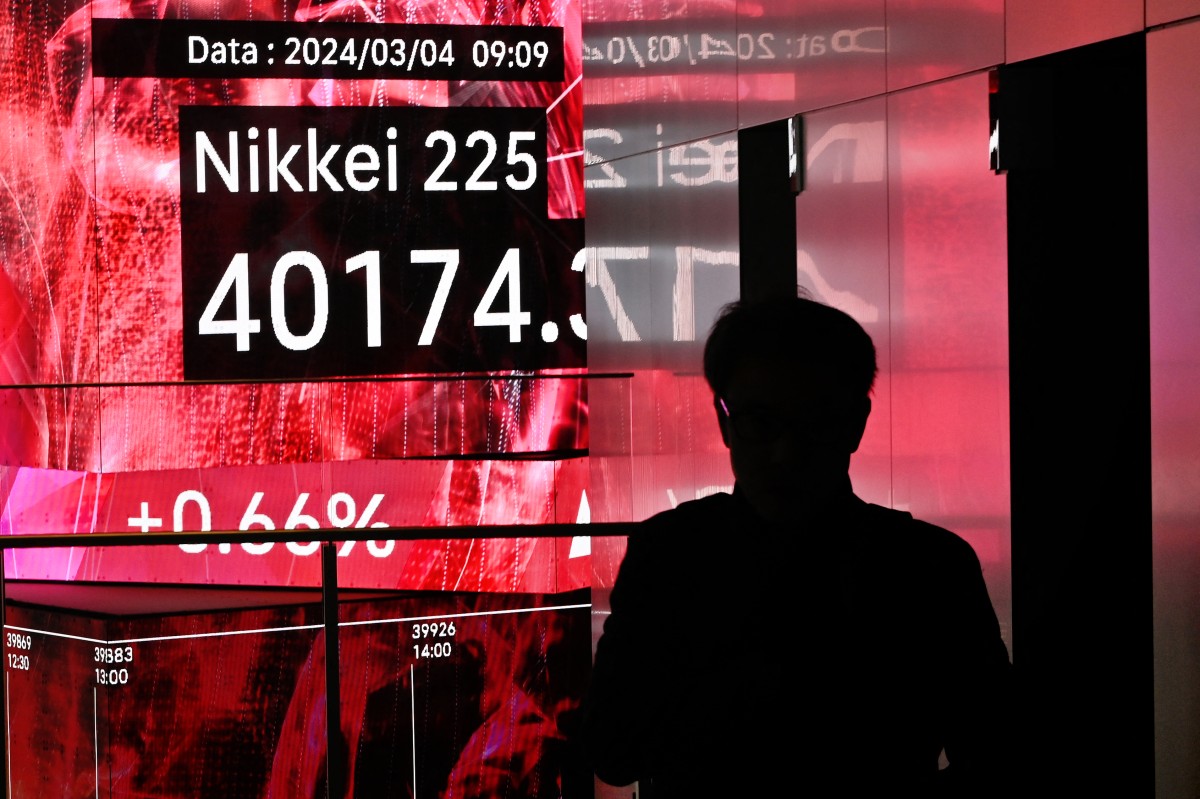
Tokyo finished flat, a day after Japan’s benchmark Nikkei index hit a record high, closing above 40,000 points for the first time.
Wall Street retreated on Monday as investors locked in profits after recent rallies fueled by tech optimism.
In China on Tuesday, leaders set a 2024 growth target of five percent, in line with last year’s GDP gains but well off the double-digit expansion that for years drove the world’s second-largest economy.
At the National People’s Congress, an annual rubber-stamp legislative session, the focus this week will be on China’s struggling economy, which is beset by a prolonged property sector crisis, record youth unemployment, and a global slowdown that is hammering demand for Chinese exports.
“Beijing is setting a status quo GDP target in a down market to project confidence and slow the downward economic spiral,” Drew Thompson, a former Pentagon official and senior fellow at the Lee Kuan Yew School of Public Policy in Singapore, told Bloomberg.
“Without major consumer-centric stimulus or market liberalization policies, foreign businesses in China will continue to face challenges.”
While experts have repeatedly called for stronger stimulus measures from the government, the conclave this week is not expected to unveil big-ticket bailouts.
The NPC so far “fell short of altering economic or policy trajectories, leaving some disappointed, particularly those hoping for a larger fiscal deficit-to-GDP target”, Stephen Innes of SPI Asset Management said in a note.
China’s estimated three percent fiscal deficit for 2024 shows officials are “balancing growth and risk prevention”, Bruce Pang, chief economist for Greater China at Jones Lang LaSalle Inc, said earlier.
“The deficit will continue to be mostly shouldered by the central government, which will step up transfer payment to local governments to help prevent and resolve local debt risks,” he told Bloomberg.
China has said it will cut tariffs on advanced technology and open fresh channels for foreign trade, as well as raise the military budget to 7.2 percent, government documents seen by AFP on Tuesday showed.
On Wall Street, analysts attributed the pullback to a wait-and-see attitude to a heavy news week that includes US jobs data, congressional testimony from Federal Reserve boss Jerome Powell, and a European Central Bank decision.
“Ahead of a bevy of potentially market-moving events highlighted by Chair Powell’s speech on Capitol Hill and the forever closely monitored US Non-Farm Payroll, the US market rally stalled to begin the week,” Innes said.
Most expect highly anticipated US rate cuts to start later this year, as Fed officials have voiced caution about trimming too soon while they await further inflation data.
The European Central Bank is expected to keep interest rates unchanged again at a regular meeting on Thursday, analysts said, as officials want to ensure inflation is on a clear downward path.
Hong Kong stocks closed down 2.6 percent and Shanghai finished higher on Tuesday.
Sydney, Seoul, Mumbai, Jakarta, Bangkok, Singapore, Manila and Kuala Lumpur were down, while Taipei and Wellington were up.
London, Frankfurt and Paris opened lower.