
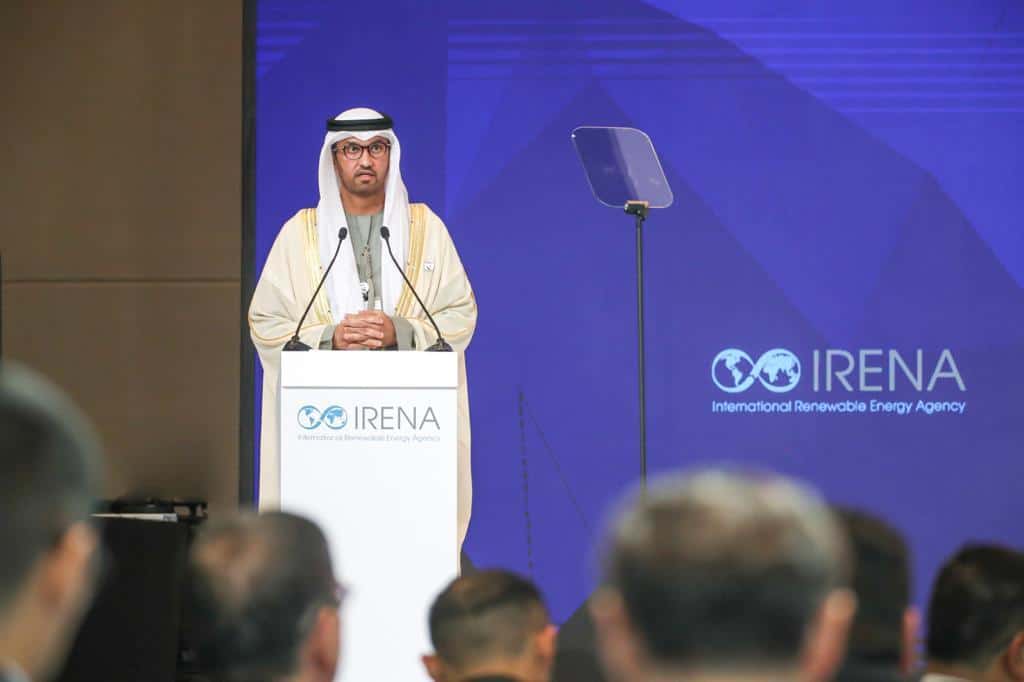


There is a need to reform international financial institutions and partner with private sector leaders, to unlock trillions of dollars in climate finance to enable climate action, Minister of Industry and Advanced Technology and COP28 President-designate, Dr Sultan bin Ahmed Al Jaber said at a panel discussion on Wednesday, organized by the Rockefeller Foundation and on the sidelines of the World Bank and IMF Spring Meetings.
Dr Al Jaber was joined on the panel by Mia Mottley, Prime Minister of Barbados; Amina J. Mohammed, Deputy Secretary-General of the United Nations and Chair of the United Nations Sustainable Development Group; Bruno le Maire, Minister of Economy, Finance and Recovery of France; and John Kerry, the United States Special Presidential Envoy for Climate. The event was moderated by Foreign Policy publisher, Andrew Sollinger.
Responding to a question on the reform of International Financial Institutions and Multilateral Development Banks, Dr. Al Jaber emphasized the need to increase the affordability, availability, and accessibility of climate finance to accelerate climate action and a just energy transition.
“While the world united in Paris around the goal of stopping global temperatures from rising 1.5 degrees above pre-industrial levels, our actions have not kept pace with our commitments. We have just seven years left to catch up. That’s a small window to make a massive course correction. A key factor for success is capital and finance. But not enough is getting to the people and places that need it most.”
Dr. Al Jaber noted that climate finance is essential for each workstream of the Paris Agreement, from mitigation to adaptation, and that these resources are particularly needed in the Global South, which has historically received an insufficient share of available resources.
“The world needs to triple the amount of money that is available for cleantech investment, adaptation finance, and a just energy transition in emerging and developing countries. Only twenty percent of clean tech investments went to developing economies that make up over 70 percent of the global population. And the least developed countries receive less than 2 cents on every dollar spent.”
The COP28 leadership team, including the President-designate, has been on a global listening tour to gather inputs and chart an inclusive path forward. Dr. Al Jaber emphasized that climate finance was mentioned time and again throughout these discussions.
“What I hear over and over again is the fact that climate finance is nowhere near available, affordable or accessible enough. In terms of availability, we need to turn billions into trillions. When it comes to affordability, we need to deploy climate finance without burying the developing world in more debt. And on accessibility, we need to remove the bureaucratic hurdles that keep recipient countries waiting way too long to access the funds they desperately need.
“We need fundamental reform of IFIs and MDBs to achieve both climate and development goals. We need substantially more concessional finance that can lower risk in lower-income countries and attract private capital at a multiple. And we need to explore new instruments to drive private sector finance more effectively and more efficiently to emerging and developing states,” Dr. Al Jaber said.