
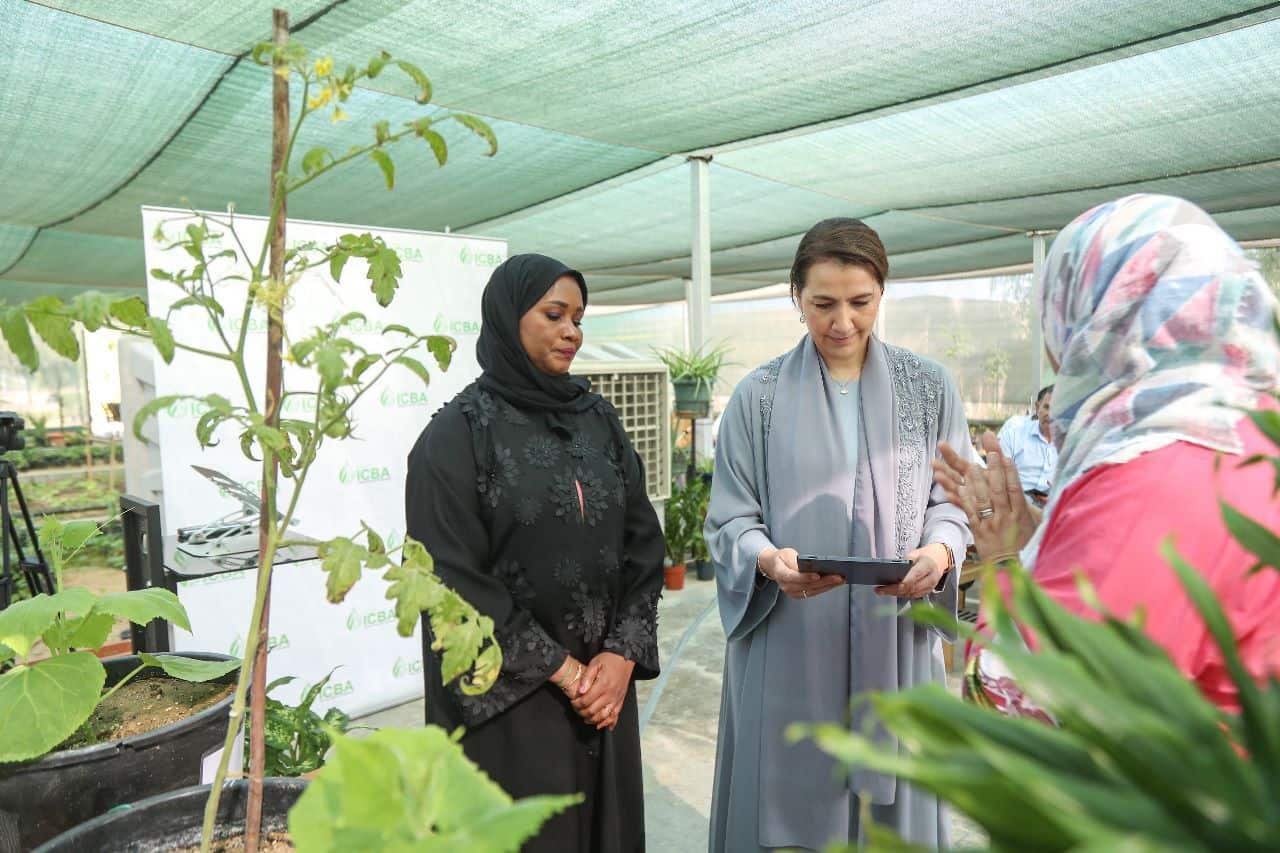


Dubai, UAE – A new AI-powered mobile application for detecting crop disorders was unveiled on Tuesday by Mariam bint Mohammed Almheiri, Minister of Climate Change and the Environment, during a ceremony at the headquarters of the International Center for Biosaline Agriculture (ICBA).
Called Dr. Nabat, the application is a result of collaboration between the ICBA and the University of Barcelona, Spain, under a project titled “Developing a user-friendly mobile application for smallholder farmers to detect plant disorders”.
Created with the support of local partners in Egypt, Tunisia, and the UAE, the application is designed to aid smallholder farmers and extension specialists in spotting crop disorders at early stages, and thus minimising yield losses and improving incomes.
It can identify 18 different common disorders affecting tomato, capsicum, and cucumber. These cash crops are considered important for smallholder farmers who practice protected agriculture.
“This app is a prime example of how we can harness the power of technology to address pressing concerns. In the face of ever-rising challenges, with climate change at the forefront, we believe that technological interventions will optimise agricultural practices, enhance harvest quality and quantity, and notably improve the lives of farmers,” Almheiri said. “We are confident the app will prove to be a game changer for smallholder farmers, providing them with early diagnosis at the click of a button and helping them save their crops.”
Speaking on the occasion, Director General of the ICBA, Dr. Tarifa Alzaabi, said that smallholder farmers are on the frontlines of food security.
“They are the backbone of many agricultural economies, yet they often lack access to information about pests and diseases,” he said. “We have developed this mobile application to help bridge this gap and put knowledge in their hands.”
As part of the project, ICBA collected raw data from the three countries for training the AI model which was developed by the University of Barcelona.
The application was field-tested, and 414 smallholder farmers and extension specialists were trained and provided their feedback on the beta version from 2020 to 2022.
Dr. Jose Luis Araus, a professor of plant physiology at the University of Barcelona, said that the future of more efficient and eco-friendly agriculture lies in technology and innovation.
“So, we hope to see this application taken up by smallholder farmers and other agricultural users across the region,” he added.
According to the Food and Agriculture Organisation of the United Nations, the annual loss in crop production due to pests and diseases ranges between 20 and 40 percent globally. Each year plant diseases cost the world’s economy around US$220 billion, and invasive insects around US$70 billion.
Currently, the application is customised for Egypt, Tunisia, and the UAE. But there are plans to upgrade and roll out the application in other countries in the future.