
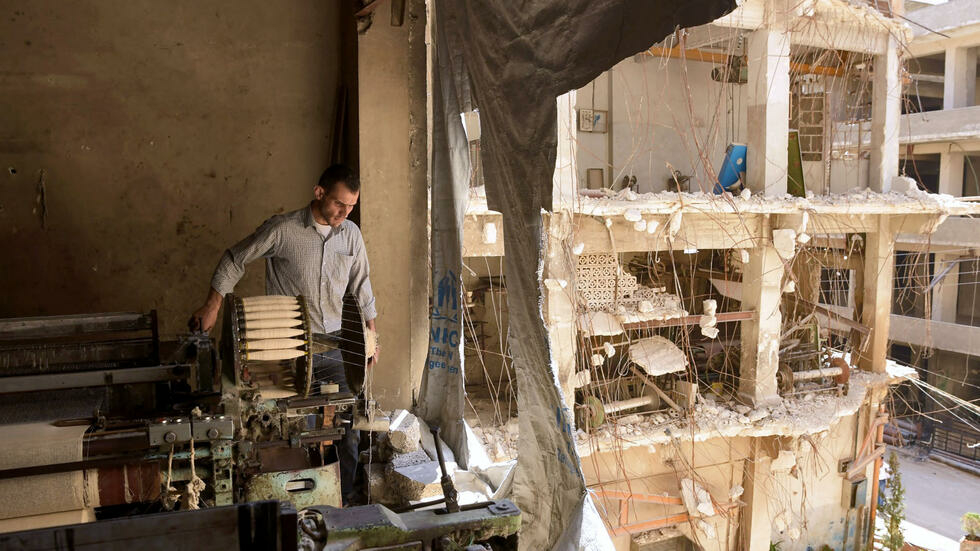


Workshops in Syria’s Aleppo used to clatter on into the night before the war, but these days the machines grind to a halt at 6:00 pm sharp because of power cuts.
Fighting ended almost five years ago in the country’s former economic hub, but limited electricity supply has hampered a full return to work in its manufacturing neighbourhoods that produce everything from plastic to food.
In the Karm al-Qatarji district famous for textiles, Mahmud Majkini, 31, said his business weaving medical gauze was still reeling from the effects of the decade-old conflict.
“I can’t say the war has really ended as my machines haven’t gone back to working around the clock,” he said.
The conflict has ravaged electricity networks as well as oil and gas infrastructure across the country.
Syria’s largest oilfields remain beyond the government’s reach in the country’s Kurdish-held northeast, and Western sanctions have hampered fuel imports from abroad.
Syrians in government-held areas have had to adapt their lives at home and work around power cuts of up to 20 hours a day.
Aleppo’s industrial districts may receive a little more power than residential neighbourhoods, but Majkini says it is still not enough for his business to fully get back on its feet.
Nowadays only half of his eight weaving machines shuttle back and forth in his narrow workshop on the third floor of a building with gutted walls.
He says he hardly dares fix the machine nearest to the gaping facade in case he slips over the edge and falls off.
‘Dicing with death’
“If we had electricity for longer, we could have worked more and fixed the wall,” he said.
But instead, “we’re dicing with death”.
In industrial areas of the northern city, the state is supposed to provide power from 6:00 am to 6:00 pm four days a week, though in practice even that supply is often punctuated by electricity cuts.
Outside these hours, the public network runs dead.
Businessmen who can afford it buy diesel fuel to operate private generators, but many more are forced to shut up shop.
In residential neighbourhoods, where power cuts last longer, many subscribe to private generators.
Government forces retook control of east Aleppo from rebels in late 2016, after years of deadly bombardment on the besieged opposition-held half of the city.
The fighting heavily scarred its industrial neighbourhoods, most of them in the east.
The city’s electrical network was all but obliterated.
Mohammed al-Saleh, Aleppo chief of Syria’s state electricity company, said the authorities had slowly been working to rehabilitate power lines since 2017.
“But it’s not easy,” he said.
“When we returned to eastern parts of Aleppo, there were no transmission stations, no pylons, no power stations. We’re starting over from scratch.”
– ‘Make the most of each minute’ –
In February, the electricity company said it had started repairing the province’s power plant — one of the country’s largest — with support from key government ally Iran.
It followed a 2017 deal between Damascus and Tehran on “cooperation in the electricity sector”, including to fix the Aleppo power station and build a new one in the government stronghold of Latakia.
Until the network is restored, manufacturers are having to adapt.
In Karm al-Qatarji, Abdel Salaam Mazyek, 52, said he missed the good old days when the neighbourhood was alive with the constant swishing back and forth of textile machines.
“We used to work non-stop,” said Mazyek, who owns a workshop producing colourful materials.
But today he only works four days a week, desperately trying to “make the most of each minute of electricity”.
Mustafa Kawwaya, deputy head of the Aleppo chamber of commerce, said there were 35,000 factories and workshops across the city before the war, but that the number dropped to around 2,500 at the peak of the fighting.
Since the government retook control, some 19,000 have reopened for business, but production is still just half of what it was before 2011, he said.
Standing on his balcony surveying the damaged buildings nearby, textile manufacturer Mazyek said he hoped things would get back to normal soon.
“Aleppo workers are known to be hard workers,” he said.
“But what’s missing right now is electricity.”