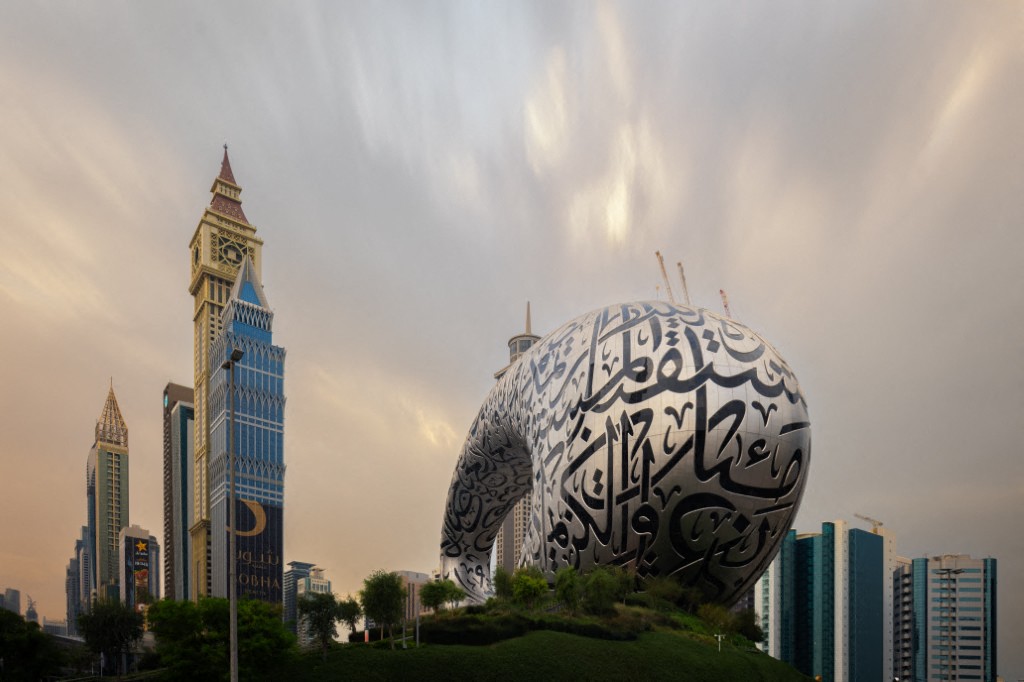
If there is a list for an embodiment of transformation in the past two decades, the United Arab Emirates will be among the top nations that have spearheaded and managed change flawlessly.
Skeptics kept up their rhetoric saying the bubble is about to burst – real estate, financial, foreign labor and more; but the UAE kept marching ahead on the road to development proving that skeptics are just skeptics.
From the subprime economic debacle to Arab Spring and AI revolution, the UAE leadership and the business community have become a shining example of devising and implementing a top-class change management strategy.
Innovative government policies coupled with the private sector agility have made the UAE the most sought-after market to work, visit, live or conduct business.
Even though most economies in the Arabian Gulf countries rely on hydrocarbon revenues, the UAE is the superstar of economic diversification. Zurich-headquartered private bank EFG International says in its recent report that non-oil GDP growth of the UAE in 2030 is expected to be more than double that of the oil sector.
Also, the fiscal breakeven oil prices until 2030 for the UAE and Qatar is US$38 per barrel, and US$42 per barrel for Oman. For Kuwait, Saudi Arabia and Bahrain it is US$82, US$83 and US$167 per barrel, says a joint forecast by EFG Asset Management and Bloomberg in November 2025. So, the UAE is in a comfortable position when it comes to reliance on oil revenues.
For the uninitiated, the fiscal breakeven oil price (BEP) is the minimum oil price a producing country needs to balance its government budget, meaning oil revenues cover all spending (like healthcare, defense, infrastructure, debt). If the actual market price falls below this BEP, the country faces a budget deficit, requiring cuts or drawing down reserves; if it’s above, they can achieve a surplus. It’s a key indicator for oil-dependent economies, calculated using projected government spending, non-oil revenues, and oil production levels, though figures vary by source and country.
According to several reliable energy research organizations, the global oil prices are projected to average between US$55-US$75 per barrel from now until 2030 meaning some oil producers have more urgency than others to diversify their oil-dependent economies.
The UAE is the champion of economic diversification as the country’s top visionary leadership rolled out strategies in the 1970s. The UAE leaders used the 1973-1982 oil windfall to rapidly build infrastructure and then pivot from a purely resource‑based model toward a more balanced development strategy.
A 1983 Ministry of Planning document explicitly defined industrialization as “a main aim of the state for the correction of the structure of production,” showing that diversification away from oil dependence was an articulated federal policy goal by the early 1980s.
In Dubai, diversification was already visible by the late 1970s and early 1980s through large energy‑intensive industrial projects and logistics infrastructure such as Dubai Aluminum, Dubai Gas, and Dubai Cable Company. These projects, together with Port Rashid, Jebel Ali Port and Free Zone, and Dubai International Airport, marked a strategic turn toward trade, shipping, and manufacturing as deliberate complements to hydrocarbons.
From the 1980s onward, the federal government and individual emirates launched broader diversification and liberalization programs to reduce reliance on oil and develop sectors like aluminum, tourism, aviation, re-export trade, and telecommunications.
Academic work describes the 1970s–1980s as the period when the UAE used surplus oil revenue not only for social infrastructure but also for “structural growth,” implementing policies to encourage private investment and domestic productivity in non‑oil sectors.
Later formal visions such as UAE Vision 2021 (launched in 2010) and Abu Dhabi Economic Vision 2030 built on this earlier trajectory by explicitly targeting a knowledge‑based, innovation‑driven economy and further reducing the share of oil in GDP.
Contemporary analyses emphasize that today’s diversification into finance, technology, renewable energy, logistics, and tourism is the continuation and deepening of a strategy whose roots lie in those late‑1970s and early‑1980s policy choices.
As a result, the UAE in 2025 is among the world’s fastest growing economies driven by strong non-oil sectors, robust foreign and domestic investment, pro-business regulation and a flexible regulatory environment, according to a report published by the UAE official agency WAM this week.
Non-oil foreign trade rose 24.5 percent in the first half of 2025 to US$463 billion, around 14 times the global growth rate, it said adding that the UN Conference on Trade and Development (UNCTAD) World Investment Report 2025 ranked the UAE 10th globally for inbound foreign direct investment (FDI) in 2024, at US$45.75 billion.
Also, the International Monetary Fund (IMF) raised its 2025 growth forecast for the UAE to 4.8 percent, while Fitch, Moody’s and S&P Global affirmed the country’s sovereign ratings, citing strong economic performance and sound fiscal policy.
Growth is projected to accelerate to 5.0 percent in 2026, driven by stronger hydrocarbon output and continued expansion in key non-hydrocarbon sectors, including tourism, construction, and financial services, supported by large infrastructure investment, said the IMF in a statement earlier this month.
“Real estate activity continues to be buoyant reflecting the UAE’s position as an attractive destination for investment and employment. Inflation is projected to remain low, averaging 1.6 percent in 2025 and around two percent over the medium term, with housing-related costs being the main source of price pressures,” it said.
The UAE will continue to remain in positive territory as its expenditure is estimated to remain lower than the over revenues. The IMF and UAE government economists say that total revenue including taxes and fees is projected to be US$161.5bn (in 2025), US$164bn (2026), US$176.5bn (2027), US$192bn (2028), US$205bn (2029) and US$218bn (in 2030). However, the expenditure is estimated to be US$133bn (2025), US$136bn (2026), US$146bn (2027), US$160bn (2028), US$171bn (2029) and US$183bn (2030). It’s a budget surplus all the way until 2030, and probably beyond as well.
Data from the UAE Central Bank showed that gross banks’ assets increased to US$1.41 trillion at the end of September 2025, with gross credit increased to US$675 billion during the same period.
Real GDP grew 4.2 percent year-on-year to US$252 billion in H1 2025. Non-oil GDP rose 5.7 percent to US$196 billion, accounting for 77.5 percent of real GDP, while oil activity contributed 22.5 percent.
The UAE Cabinet approved the National Investment Strategy 2031, which includes 12 programs and 30 initiatives aimed at raising annual foreign investment inflows from US$30.5 billion in 2023 to US$65.35 billion by 2031 and grow the UAE’s total foreign investment stock from US$218 billion to US$599 billion.
In 2025, the country launched the “UAE Future 50” initiative across 15 sectors and a national campaign positioning the country as a global capital for entrepreneurs, targeting the training and incubation of 10,000 entrepreneurs. More than 220,000 new companies were registered between January and the end of November, alongside over 36,000 new trademarks, up 48.2 percent from a year earlier.
The UAE also strengthened its role as a global trade gateway through expanded comprehensive economic partnership agreements; the launch of the “UAE Global Center of Trade” program targeting the world’s top 1,000 international trading companies and introduce a digital gateway that connects thousands of UAE exporters to global markets.
By the end of September, the UAE had 402,311 registered national and international trademarks. Nearly 20,000 trademarks were registered in the first half of 2025, up 129 percent from a year earlier, said the official news agency.
Per IMF, the UAE’s economic outlook is strong despite elevated regional and global uncertainty. The US tariff measures have triggered a slowdown and weakening of currencies in some countries, but the UAE is not impacted as the US accounts for only three percent of the UAE’s total exports.
The UAE’s financial markets and capital flows have so far demonstrated lower sensitivity to global shocks compared to other GCC and emerging markets, reflecting strong investor confidence.
Nonetheless, significantly weaker global growth and tighter financing conditions could reduce tourism, capital flows, and oil prices, potentially requiring the use of fiscal and external buffers, according to the IMF.
“The real estate sector may be affected in case of slowdown or reversal of capital flows or a shift in investor sentiment that could lead to an unexpected price correction. Over the medium-term, downside risks include deeper geopolitical fragmentation, cybersecurity, and climate-related risks, and upside from ongoing reforms, strong buffers, and large investment in infrastructure and AI,” it said earlier this month.
There is steady progress in the efforts to digitalize the UAE’s financial sector, including the emergence of the country as a hub for virtual assets. However, the IMF recommends continued close monitoring of the vibrant real estate sector and enhancing the financial and technological regulations to remain ahead of the game.
With its vibrant past and innovative present, the sustainable future belongs to the UAE.
(The author is a senior journalist based in Toronto, Canada)