
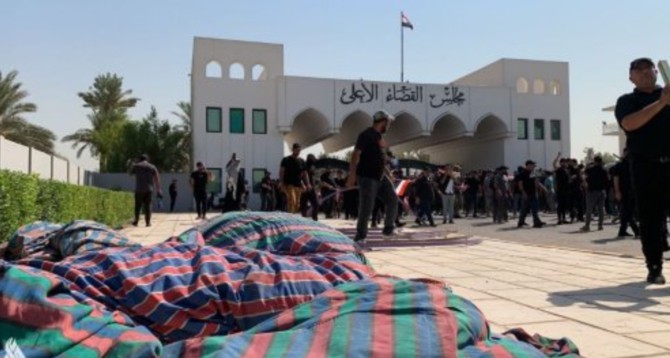


The Sadrists, who have already been camping outside parliament for the past three weeks, pitched tents outside the gates of the body’s Baghdad headquarters, Iraq’s official INA news agency reported.
They carried placards demanding the dissolution of parliament and new elections 10 months after an inconclusive poll failed to deliver a majority government, images released by his bloc showed.
On August 10, Sadr gave the Supreme Judicial Council one week to dissolve parliament to end the political deadlock but the council ruled that it lacked the authority to do so.
Sadr’s opponents in the so-called Coordination Framework, who have been holding a sit-in of their own just outside the Green Zone government and diplomatic compound where parliament is located, want a transitional government before new polls are held.
They include former paramilitaries of the Tehran-backed Hashed al-Shaabi network, and the party of former prime minister Nuri al-Maliki, a longtime Sadr foe.
Last week, caretaker Prime Minister Mustafa al-Kadhemi convened crisis talks with party leaders, but they were boycotted by the Sadrists.
Since the aftermath of the US-led invasion of 2003, Iraq has been governed under a sectarian power-sharing system that reserves the premiership for the country’s Shiite majority community.
The Sadrists insist that after emerging from 2021 elections as the largest bloc in parliament, they should have the right to nominate the prime minister, something their opponents strongly oppose.