
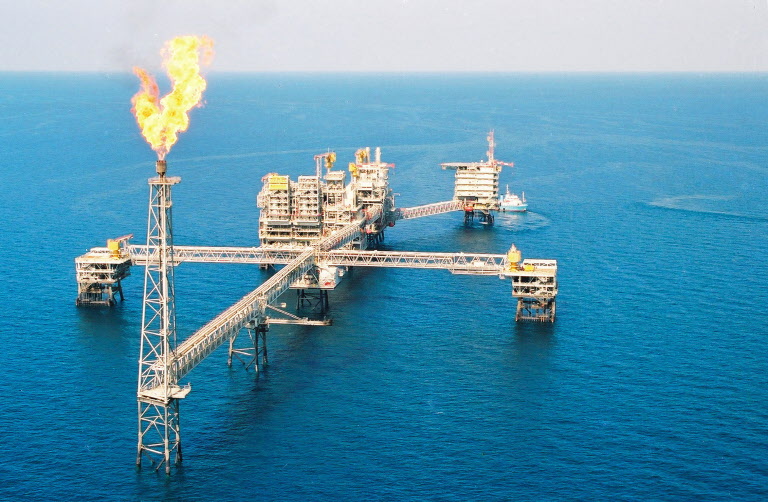


Riyadh, Saudi Arabia– Saudi Arabia and Kuwait said Thursday they have sole ownership of a disputed gas field also claimed by Iran, in an escalating feud after Tehran threatened to pursue exploration.
The offshore field, known as Arash in Iran and Dorra in Kuwait and Saudi Arabia, has long been focal point of contention between the three countries.
The Kuwaiti and Saudi authorities said in a joint statement published on Thursday that “they alone have full sovereign rights to exploit the wealth in that area”.
The two Arab Gulf states renewed “their previous and repeated calls to the Islamic Republic of Iran to negotiate” the demarcation of their maritime borders to settle the issue, according to the statement carried by the official Saudi Press Agency (SPA).
Iran and Kuwait have held unsuccessful talks for many years over their disputed maritime border area, which is rich in natural gas.
Recent attempts to revive negotiations have failed, and Iran’s oil minister on Sunday said Tehran may pursue work at the field even without an agreement.
“Iran will pursue its rights and interests regarding exploitation and exploration” of the field “if there is no desire for understanding and cooperation”, Iranian Oil Minister Javad Owji was quoted as saying by the official Shana news agency.
Last month, Kuwait had invited Iran for another round of maritime border talks after Tehran said it was ready to start drilling in the field.
A few weeks later, Sky News Arabia quoted Kuwait’s Oil Minister Saad Al-Barrak as saying his country would also begin “drilling and production” at the gas field without waiting for a demarcation deal with Iran.
The row over the field stretches back to the 1960s, when Iran and Kuwait each awarded an offshore concession, one to the Anglo-Iranian Oil Company, the forerunner to BP, and one to Royal Dutch Shell.
The two concessions overlapped in the northern part of the field, whose recoverable reserves are estimated at some 220 billion cubic meters (nearly eight trillion cubic feet).
Last year, Kuwait and Saudi Arabia signed an agreement to jointly develop the field, despite objections from Iran which branded the deal as “illegal”.