
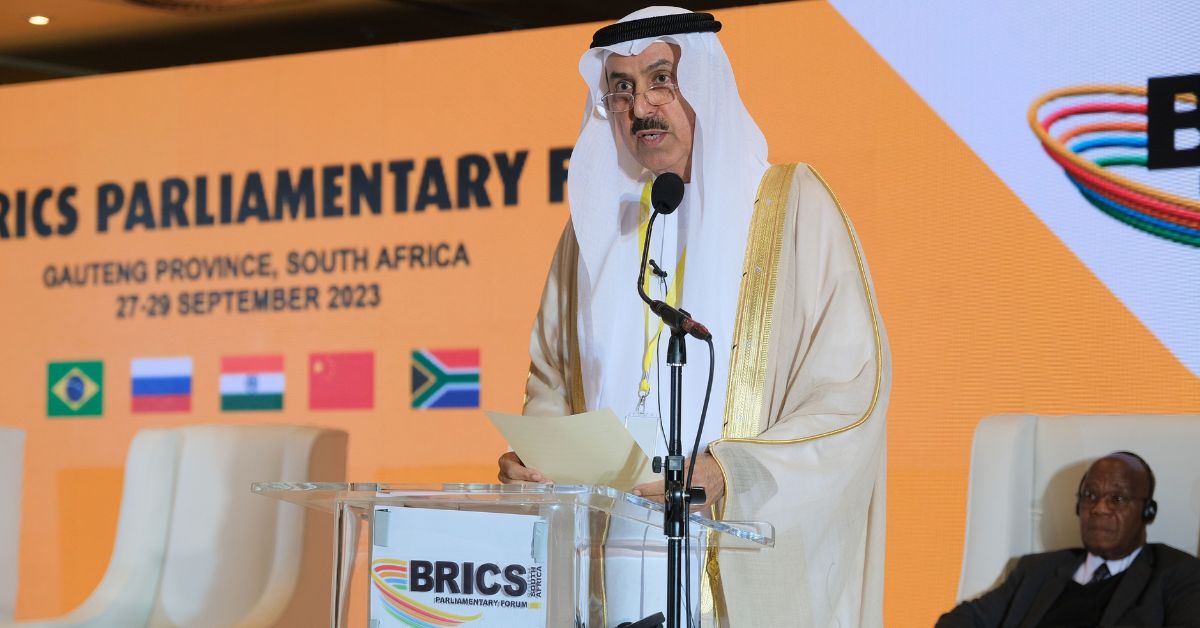


JOHANNESBURG – The BRICS group holds the potential to significantly influence the global economy’s future, considering its combined GDP accounts for about one-third of the world’s total, especially after adding six new member countries, said Saqr Ghobash, Speaker of the UAE’s Federal National Council (FNC)
“This potential is further amplified by its vast human resources, and cutting-edge technological and industrial capabilities,” he added, emphasizing that BRICS could shift global focus to urgent matters like climate change, energy security, innovation, and the promotion of investments in emerging technologies. Furthermore, BRICS has the capability to establish new supply routes and chains.
Ghobash shared these insights during his address at the ninth BRICS Parliamentary Forum’s opening session. The forum, themed “Harnessing Inclusive Multilateralism and Parliamentary Diplomacy to Deepen BRICS and Africa Partnership for Accelerated Implementation of the African Continental Free Trade Agreement,” took place in Johannesburg, South Africa.
He highlighted the UAE’s diplomatic endeavors aimed at fostering regional and global stability, reducing tensions in the Middle East and beyond. He cited the Abraham Accords and the endorsement of the Human Fraternity Document, signed in Abu Dhabi in 2019, as examples of the UAE’s commitment to promoting coexistence, tolerance, and peace among diverse religious groups.
Hosting COP28, Ghobash noted, underscores the UAE’s dedication to consolidating global perspectives, transitioning from theoretical international policies to the practical application of clean and renewable energy solutions. He emphasized that addressing climate change and conserving the environment is a collective responsibility of both developed and developing nations.
The UAE’s participation in the BRICS group resonates with its emphasis on fostering balanced strategic and economic ties, which can contribute to sustainable global economic prosperity within a system characterized by shared duties, responsibilities, and mutual interests.
Ghobash further discussed the importance of strengthening the BRICS-Africa partnership and expediting the African Continental Free Trade Area (AfCFTA) agreement’s execution. This collaboration can pave the way for a unified market for goods and services across Africa, benefiting over 1.3 billion residents and a combined GDP surpassing $3 trillion.
He reiterated the UAE’s commitment to collaborating with African nations to spur sustainable economic and social growth. This commitment was evident when the UAE announced a $4.5 billion financing initiative to enhance Africa’s renewable energy capabilities at the Africa Climate Summit in Nairobi earlier this month. To sum it up, Ghobash mentioned the FNC’s ongoing efforts to bolster sustainable ties with African parliaments, aiming to establish partnership frameworks that can address and overcome challenges hindering cooperation and economic partnership agreements with African nations.