
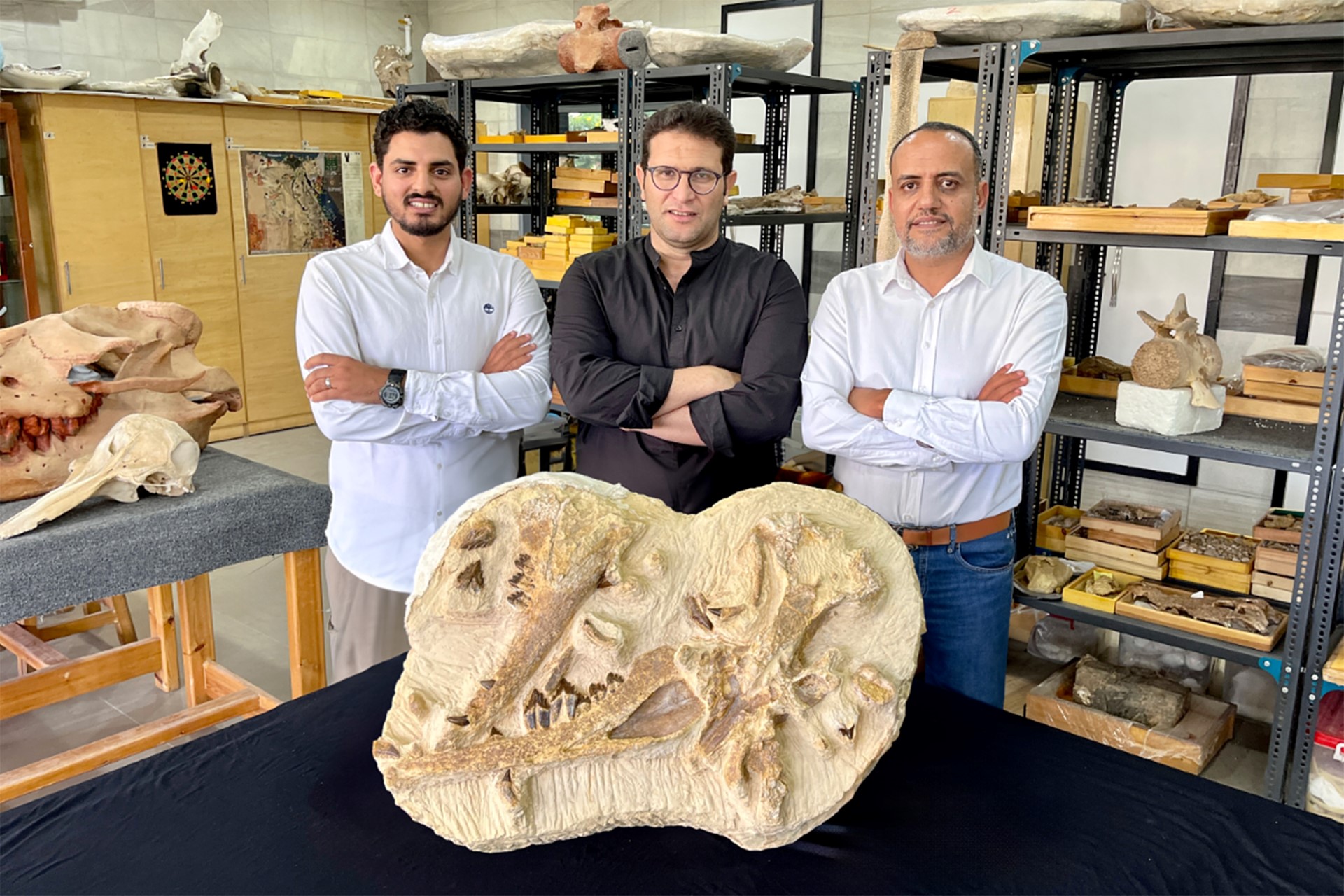


Cairo, Egypt– Palaeontologists in Egypt have unearthed an extinct species of whale that lived 41 million years ago when whale ancestors were just completing their move from land to sea.
The team has dubbed the species “Tutcetus rayanensis” after the Egyptian boy king Tutankhamun and the Wadi El-Rayan Protected Area in Egypt’s Fayoum Oasis where the type specimen was found.
With an estimated length of 2.5 metres (eight feet) and a body mass of approximately 187 kilogrammes (410 pounds), Tutcetus is the smallest species so far found from the basilosaurids, the oldest known whales that lived exclusively in the water.
Team leader Hesham Sallam, of the American University in Cairo (AUC), said it was a “remarkable discovery that documents one of the first phases of the transition to a fully aquatic lifestyle”.
Basilosaurids “developed fish-like characteristics, such as a streamlined body, a strong tail, flippers and a tail fin, and had the last hind limbs visible enough to be recognised as ‘legs’, which were not used for walking but possibly for mating,” Sallam said in an AUC statement.
Erik Seiffert of the University of Southern California, a co-author of the team’s findings published in the review Communications Biology, said the Eocene fossil sites of Egypt’s Western Desert have long been the world’s most important for understanding the early evolution of whales and their transition to a fully aquatic existence.
Fayoum Oasis, some 150 kilometres (90 miles) southwest of Cairo, boasts Wadi al-Hitan, the Valley of the Whales, a UNESCO World Heritage Site that has turned up hundreds of fossils of some of the earliest forms of whale.
Now an oasis in the Western Desert, Fayoum lay under a tropical sea in the Eocene period 56 to 34 million years ago.