
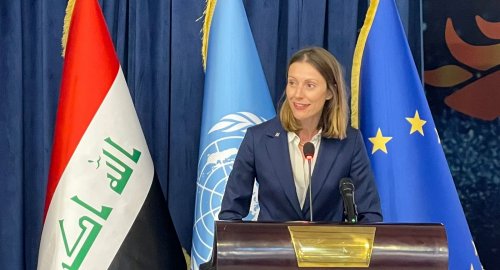


Baghdad, Iraq—The European Union has shown interest to be part of the process of decentralization in Iraq and in this regard it is working in partnership with the Iraqi ministry of planning and other bodies to enhance activity in five sectors of the economy.
The European Union confirmed its endeavor to achieve the decentralization file in Iraq, while revealing a program that enhances the activity of 5 sectors in cooperation with the government.
The representative of the European Union, Barbara Egger, said: “We are interested in the issue of decentralization in Iraq, and it is one of the topics that we are working on with Iraqi officials in partnership with the Ministry of Planning and many relevant ministries and all governorates of Iraq.”
She pointed out that “Iraq has enormous oil wealth, and on the other hand, people in all provinces were not provided with the appropriate service that should be provided to them by their provinces,” noting that “Since 2005, Iraq has taken a very clear course that has changed from the central model to the federal model.
In 2009, within Law 21, a focus was placed on 8 concerned ministries, which are very important in providing services.
“During the past years, we have worked with our partners, including our partners in the United Nations development, and we have been supporting capacity support at the governorate level and supporting the implementation of projects in the governorates,” she said.
She continued, “We have a common goal that includes educating the Iraqi people, providing them with health services, preserving their rights, and owning their rights that help them lead a decent life,” noting that “decentralization is a very long road, and we have the expertise to implement it.”
She indicated that “all decentralized services allow high quality education, health insurance, quality work and employment, and provide the best services to citizens.”
“We have global experiences and we want to decentralize in Iraq, as it is a very important opportunity and a chance to discuss challenges and discuss future opportunities,” explaining that “we are with the Iraqi government to develop a policy that helps the provinces and for the government to be closer to the citizens,” she said.