
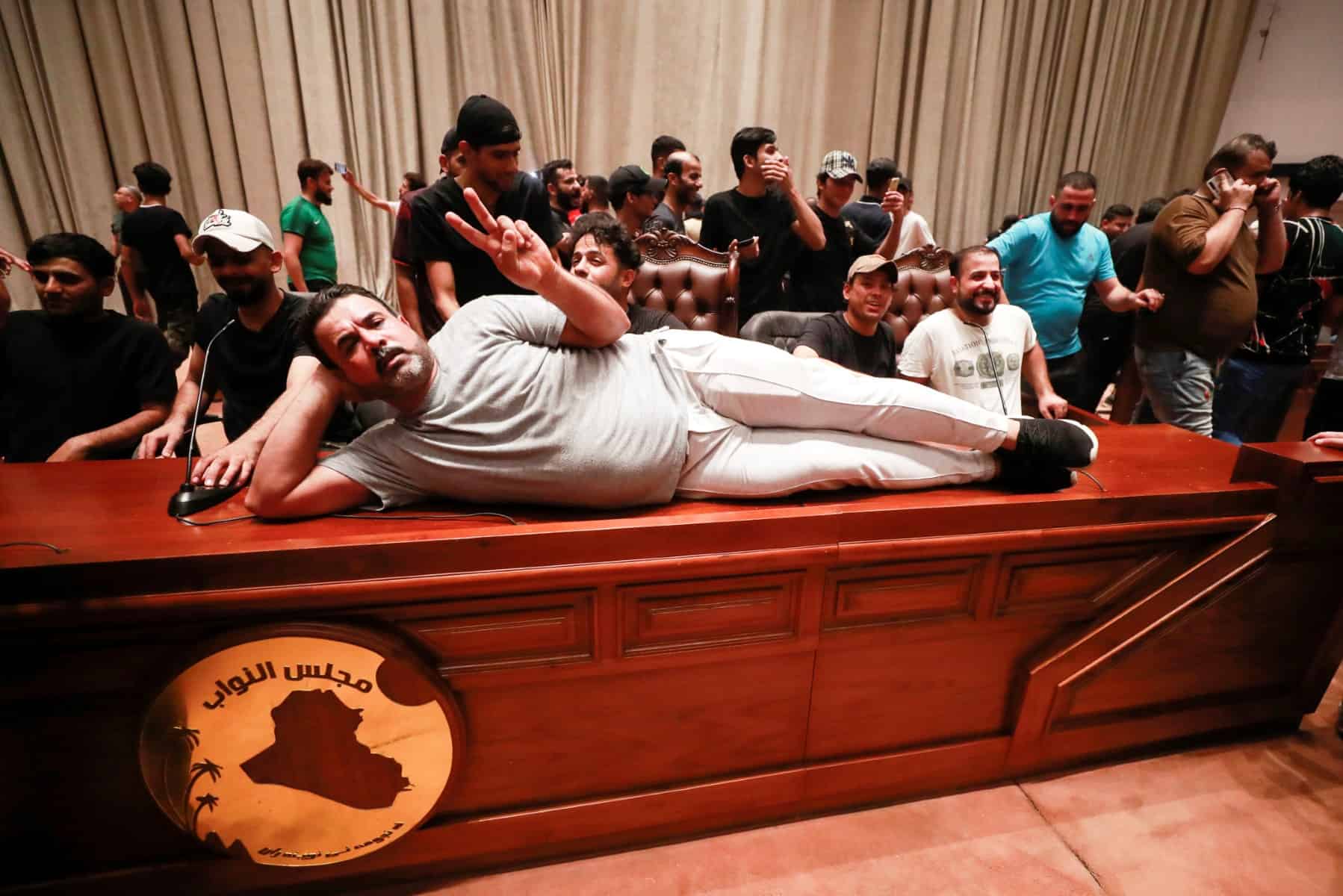


The storming of Iraq’s parliament by hundreds of supporters of populist Shiite cleric Moqtada Sadr has piled pressure on his political opponents working to form a government nearly 10 months after an election.
“Neither side is willing to make any concessions,” political scientist Ali al-Baidar said Thursday, one day after crowds breached Baghdad’s heavily fortified Green Zone and staged a parliamentary sit-in, waving flags and demanding change.
The protests are the latest challenge for oil-rich Iraq, which remains mired in a political and a socioeconomic crisis despite soaring energy prices.
Is Iraq heading towards more protests and a deepening crisis? Or will it be obliged to hold fresh polls?
What were protests about?
Sadr’s bloc won 73 seats in October last year, making it the largest faction in the 329-seat parliament.
But it was still far short of a majority.
In multi-confessional and multi-ethnic Iraq, the formation of governments has involved complex negotiations since the 2003 US-led invasion toppled dictator Saddam Hussein.
By convention, the post of prime minister goes to a leader from Iraq’s Shiite majority.
Sadr, a former militia leader, had initially supported the idea of a “majority government”.
That would have sent his Shiite adversaries from the pro-Iran Coordination Framework into opposition.
The Coordination Framework draws lawmakers from former premier Nuri al-Maliki’s party and the pro-Iran Fatah Alliance, the political arm of the Shiite-led former paramilitary group Hashed al-Shaabi.
But last month Sadr’s 73 lawmakers quit in a move seen as seeking to pressure his rivals to fast-track the establishment of a government.
Sixty-four new lawmakers were sworn in later in June, making the pro-Iran bloc the largest in parliament.
On Wednesday, Sadr’s supporters stormed parliament to protest at Coordination Framework’s nomination for prime minister, Mohammed al-Sudani.
It was clear message from Sadr to his rivals “that there will be no government… without his agreement”, said the political scientist Baidar.
“Via the masses, he signifies that he is an active player in the political landscape, that all must respect his positions and opinions, that nothing can be done without Sadr’s blessing.”
Can the rivals agree?
“This is going to be longest government formation process,” said Renad Mansour of British think tank Chatham House.
Mansour said the protests were Sadr’s warning that he aims to “use street power to bring down his opponents’ attempts to form a government”.
The protesters on Wednesday left peacefully after nearly two hours inside parliament — after Sadr issued messages calling for them to go home, saying they had “terrorized the corrupt”.
But it was far from the first Sadr has encourage protest to show his strength on the streets.
Earlier this month, hundreds of thousands of Muslim worshippers loyal to Sadr attended a Friday prayer service in Baghdad in a display of political might.
Baidar fears “the situation is heading for further escalation”, noting that Sadr’s rivals are in a tough position too.
“The Coordination Framework risks being weakened if it presents an alternative candidate to satisfy Sadr”, he argued.
But Mansour said the Framework was riven with “many internal rivalries”.
Some members are “worried about working without Sadr” because without his backing, such protests as happened on Wednesday “would become a reality to the future government, when and if it is eventually formed.”
Will there be fresh elections?
One option could be to hold fresh elections.
“That’s definitely something that has become more realistic after the recent developments,” said Mansour.
“The Sadrists are hoping that by showing themselves as an opposition force instead of being in the government… could actually attract more votes.”
But political scientist Ihsan al-Shammari, from the University of Baghdad, said that under pressure from Sadr, the current assembly could be paralyzed.
“Part of Sadr’s strategy is to besiege parliament,” he said, suggesting Sadrists could organize a sit-in at parliament or launch a campaign of civil disobedience.
Storming parliament was “only the first step”, said Shammari. “The message is clear, Sadr and his supporters are ready to go further than that.”