
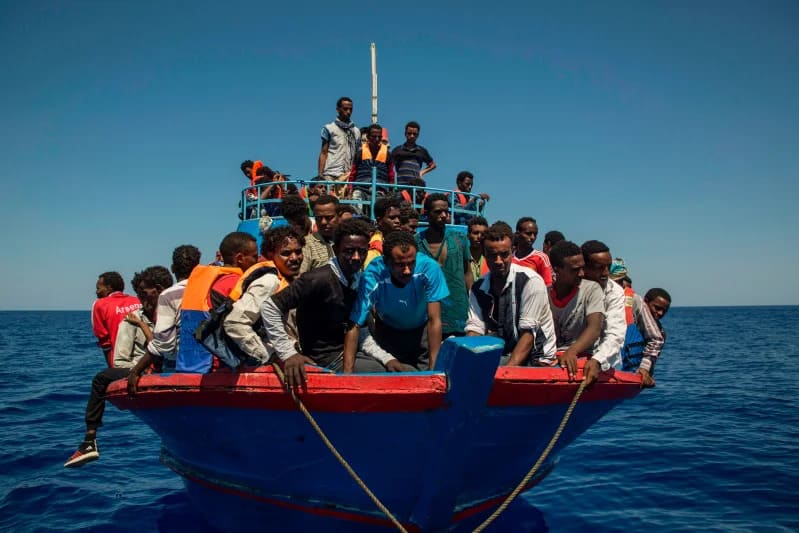


Tunis–As dawn breaks over the Mediterranean, Tunisian coastguards intercept a flimsy craft packed with migrants, bringing their dream of reaching Europe to an end — for now.
“This is your final warning: stop!” an officer shouts.
Some two dozen migrants, wearing inflated inner tubes as makeshift life preservers, look downcast as they realise the game is up.
But Fatim, an 18-year-old from the Ivory Coast who spent a year working as a cleaner in Tunis to raise 1,250 euros in smugglers’ fees, says she will try again.
She sobs as she clambers from the rusty home-made vessel onto the coastguards’ modest speedboat.
“I don’t want to stay in Tunisia,” she says. “Life here is hard.”
The North African country, just 130 kilometres (80 miles) from Italy’s Lampedusa island, has long been a launchpad for people fleeing violence and poverty across the continent and seeking refuge in Europe.
In May last year Tunis signed a deal with Rome, which agreed to supply economic aid in exchange for Tunisian efforts to stem clandestine migration.
But while the Tunisian authorities intercept thousands of migrants a year, most are released once they are back on Tunisian soil, where few want to stay.
“If I found another boat I’d leave again straight away — I’ll never give up,” said Guinean migrant Ali, 20, after he was released at Sfax port.
In just one night early this week, the coastguard intercepted 130 African migrants, including children and babies, on four craft attempting the crossing from the central region of Sfax.
Idia Sow, a 26-year-old Guinean suffering the after-effects of a stroke, said she had paid smugglers 1,560 euros for places for herself and her three-month-old baby on an inflatable boat headed for Lampedusa.
Recorded and released
The migrants are taken back to the port in the provincial capital of the same name, their details are recorded — and then they are released.
Officials say the coastguard lacks the resources to halt the flow.
“We’re in a vicious cycle. We make enormous efforts to stop these migrants, but in the end they’re released and then we find them trying again,” said the patrol’s commander, Colonel Major Brahim Fahmi.
Hours earlier, AFP journalists saw police officers brandishing batons and pistols clear more than 100 migrants from an area of scrubland 30 kilometres (18 miles) along the coast from Sfax.
Some said they had been waiting two weeks for boats.
“This summer we hit a record of more than 17,000 migrants (intercepted off Sfax), almost double the figure in recent years,” said coastguard official Saber Younsi.
“This our role,” he said. “We have to keep doing it, but there’s been a worrying evolution.”
The demand has created one of the few thriving new industries in Tunisia: clandestine boat manufacture.
Younsi said new smuggling networks were emerging to cash in on the surging market, with demand also coming from Tunisians who have given up hope of finding decent jobs and in some cases are emigrating as entire families.
As he spoke at Sfax port, Younsi was surrounded by piles of hundreds of captured migrant boats.
According to official figures, more than 22,500 migrants have been intercepted off the Tunisian coast since the start of the year, around half of them from sub-Saharan Africa.
Some 536 people, mostly Tunisians, have been arrested on suspicion of people smuggling.
Younsi said the authorities were struggling with limited means.
“If the same trend continues, we’ll hit a point where this phenomenon gets out of control,” he said.