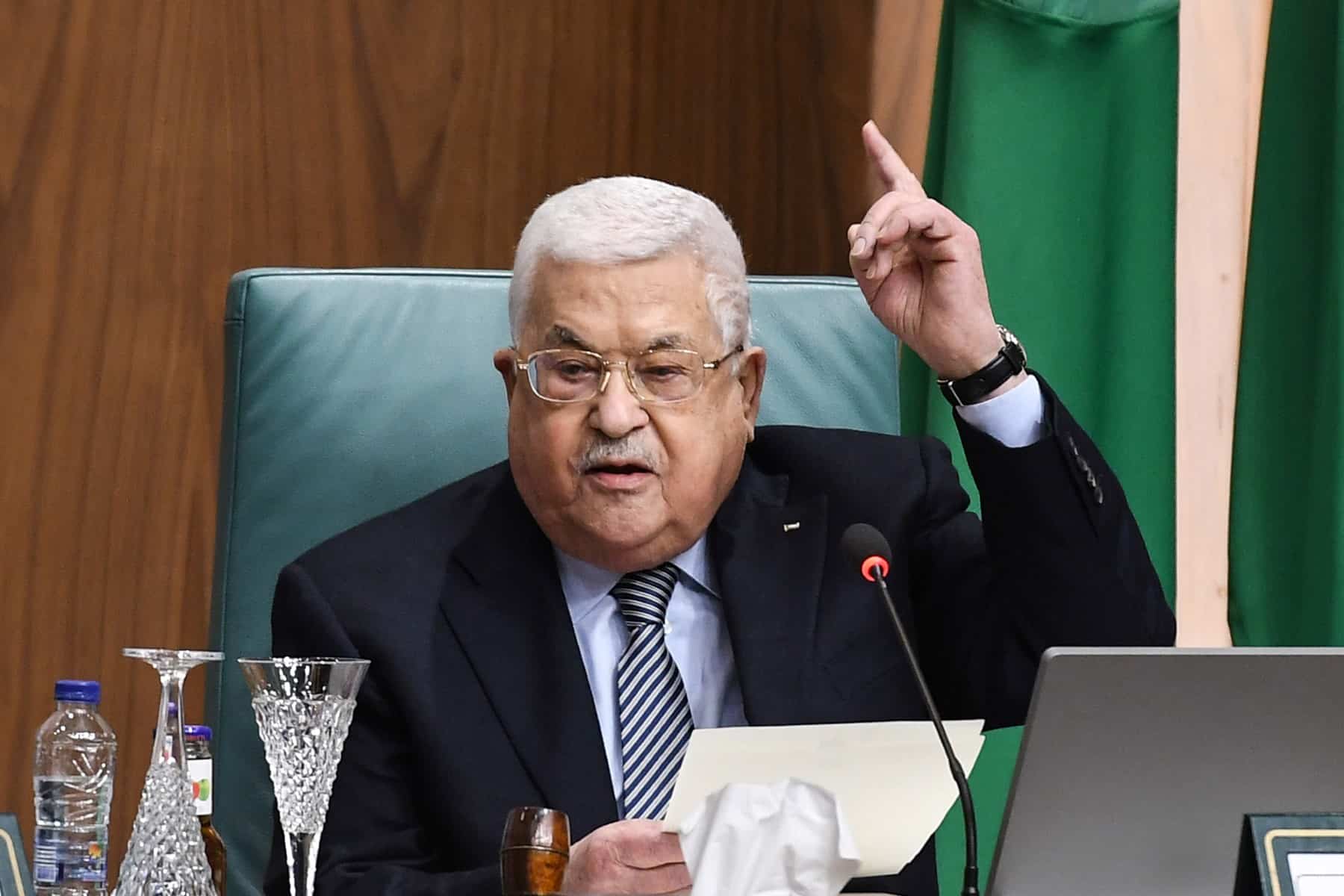

Cairo, Egypt – Palestinian president Mahmud Abbas on Sunday accused Israel of having “crossed all red lines” in the occupied West Bank and east Jerusalem and urged world leaders to put an end to its actions.
The international community must “protect” the Palestinian people and “put a stop to Israeli aggression… (and) unilateral actions”, the head of the Palestinian Authority told an Arab League meeting in Cairo.
“Israeli intransigence and practices have crossed all red lines”, he said at the gathering attended by Egyptian President Abdel Fattah al-Sisi and Jordan’s King Abdullah II.
Last year was the deadliest year in the West Bank since the United Nations started tracking casualties in the territory in 2005.
The Israeli-Palestinian conflict has seen at least 43 Palestinians — including attackers, militants and civilians — killed this year, according to AFP figures.
Nine Israeli civilians including three children, and one Ukrainian have been killed over the same period, according to an AFP tally based on official statements.
In a video address, UN Secretary General Antonio Guterres affirmed the international body’s “clear position against unilateral actions,” citing “illegal settlements in east Jerusalem” in particular.
Sisi — whose country retains its traditional role as a Middle East mediator – vowed to “continue to work with the two sides of the conflict to revive the political process and restore calm in the West Bank and Gaza”.
Abdullah, whose country acts as custodian of Muslim and Christian holy sites in Jerusalem, said Arab leaders “must galvanize efforts to support the resilience of our brothers” in the Palestinian territories.
US President Joe Biden told Abdullah last week that Washington supports a “two-state solution” in the Palestinian-Israeli conflict.
“Mr. Biden tells me he supports a two-state solution, but then does nothing at all,” Abbas added.
A two-state solution would mean the dismantling of Israeli settlements in the occupied West Bank, as well as the partition of Jerusalem, which Israel refuses as it considers the city its undivided capital.
The Arab League is itself split on relations with Israel since 2020 when the United Arab Emirates, Bahrain and Morocco normalized ties with the Jewish state under the US-brokered Abraham Accords, years after Egypt and Jordan had forged relations.