
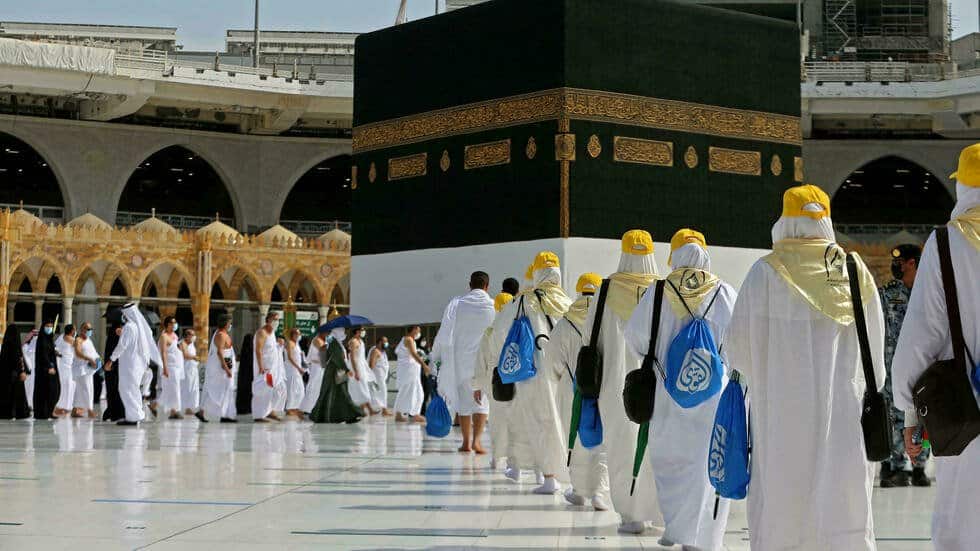


Saudi Arabia will develop algorithms to upgrade services for pilgrims and visitors to the two Holy Mosques.
The Saudi Ministry of Interior, represented by the Special Forces for the Security of Hajj and Umrah, and the Saudi Data and Artificial Intelligence Authority (SDAIA) have announced a strategic partnership for the purpose.
This was revealed by the Lieutenant General Mohammed Al-Bassami, Director of Public Security at the Ministry of Interior, during a panel discussion titled Holistic Adoption of AI Technology at the ongoing Global AI Summit, held under the patronage of Crown Prince Mohammed Bin Salman bin Abdulaziz Al Saud at King Abdulaziz Conference Center in Riyadh from 13-15 September.
Lt. Gen. Bassami discussed the kingdom’s exemplary crowd management as huge numbers of citizens, residents and visitors flock to the two Holy Mosques every year.
Efforts are on to increase the capacity to receive visitors and pilgrims, in line with the targets of the Kingdom’s Vision 2030, with upgraded services driven by cutting-edge technology for the comfort of the pilgrims.
Lt. Gen. Bassami stated that such a massive effort requires countless man-hours and an army of personnel working around the clock to provide the best possible service, which has helped the Kingdom gain vast expertise over several decades.He explained that AI is a tool to ensure the quality of those services.
AI technologies introduced recently at the two Holy Mosques have been helping in keeping crowds under control as they enter and leave, while ensuring that no more than the right number of people are present anywhere around the Holy Mosques at any given time. Also, any crowd-related contingencies can be dealt with swiftly and with little disruption.
Dr. Majed Altuwaijri, Chief Executive Officer of the National Center for Artificial Intelligence (NCAI), said that the cooperation comes as part of NCAI’s efforts to develop AI solutions for applications across various national sectors. He added that NCAI cooperated with Public Security to develop AI solutions that contribute to enhancing the provision of the best possible service for the pilgrims.
Lt. Gen. Bassami pointed out that the Ministry of Interior has multiple plans in place to manage crowds and move people in and out of the two Holy Mosques with real-time monitoring. He added that AI enables enhanced coordination and integration among many agencies to achieve the overall goal of making the experience of pilgrimage smoother and safer.