
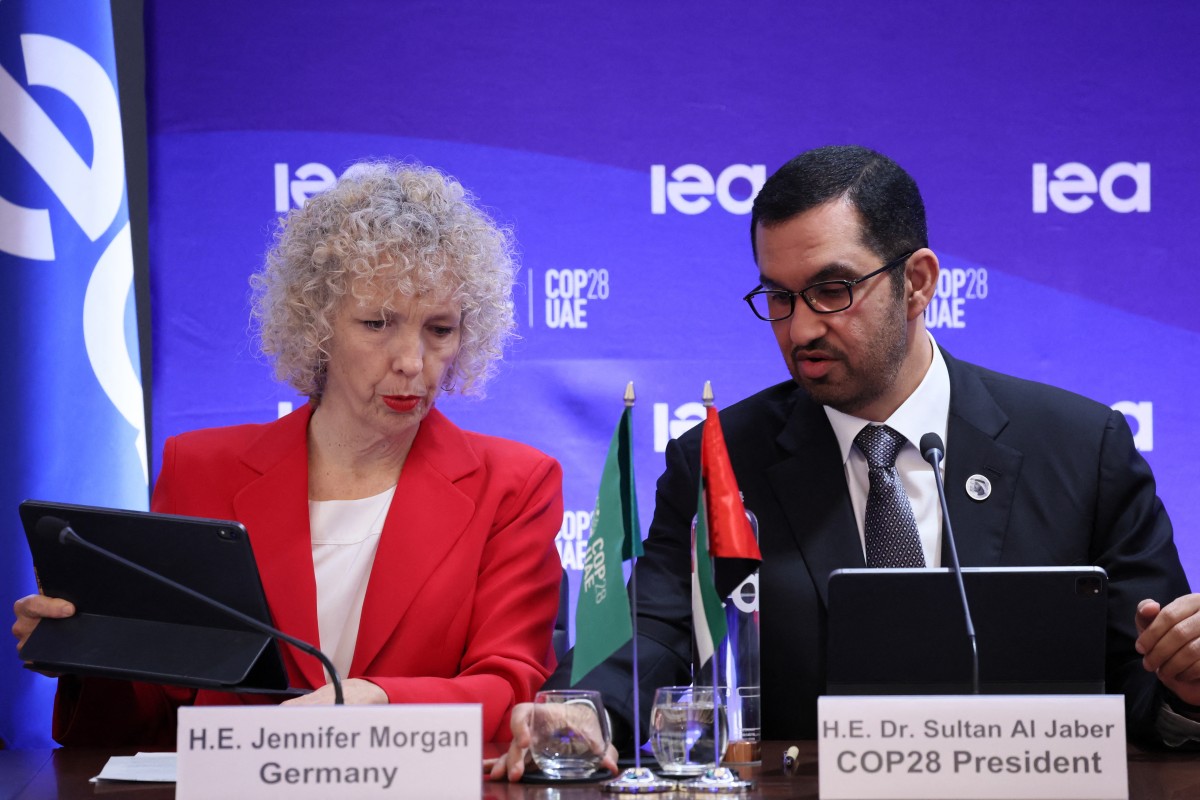


Paris, France — The world needs “trillions” of dollars to spur on the green transition and tackle global warming, the head of last year’s COP28 climate talks said Tuesday, warning that political momentum can evaporate without clear action.
COP28 president Sultan Al Jaber hailed progress made at UN negotiations last year in Dubai, where countries agreed to triple global renewables capacity this decade and “transition away” from polluting fossil fuels.
But the deal lacked important details, including on funding, putting the onus on this year’s COP29 meeting in Azerbaijan.
With impacts accelerating as global heat records are smashed, experts say that funding agreed this year will also play an important role in encouraging governments to toughen their decarbonisation targets.
Jaber, who is also chief of the UAE’s national oil company ADNOC, said finance was “the key enabler of positive change at the speed and scale” needed.
“But not normal scale finance — we need finance at every level,” he said, at an event in Paris organized by the International Energy Agency (IEA).
Countries are expected this year to hammer out a new target for the amount of annual support rich nations will provide to poorer ones for their energy transitions and adaptation to climate impacts from 2025.
The failure of wealthy nations to meet their previous goal of $100 billion per year by 2020 has soured trust, with indications the target was likely reached only in 2022.
Needs already far outstrip the money available. The UN-backed climate finance expert group has estimated that emerging economies except China will need to spend around $2.4 trillion a year by the end of the decade.
“The world must now raise the bar to address the challenge we face,” Jaber said.
“We need to start thinking trillions, not billions.”
‘Believe in numbers’ –
Recognition of the scale of support needed has put the focus on expanding sources of funding.
The World Bank and International Monetary Fund are under pressure to initiate sweeping reforms to align their lending with the Paris deal goal of capping global warming at 1.5 degrees Celsius above preindustrial levels.
Other initiatives under discussion include new taxation, especially on polluting industries, as well as redirecting fossil fuel subsidies into green development.
Jaber warned that there was a risk that “political momentum can dissipate and then fade away or disappear between COPs”.
This year could herald significant uncertainty, with around half the world’s population seeing elections in their countries, including in the United States, the European Union and Russia.
Meanwhile, crises like Russia’s invasion of Ukraine and the conflict between Israel and Hamas stoke international turbulence.
Laurent Fabius, previously France’s minister of foreign affairs and president of the COP21 meeting in Paris, warned that political uncertainty clouds the picture for this year’s climate talks in Baku.
“Because time is short, because the international situation is not good and nobody knows what it will be next November, for many reasons, and because Baku has to deliver,” he said.
He welcomed an initiative by COP hosts United Arab Emirates, Azerbaijan and Brazil — which will hold pivotal 2025 talks — to work together to maintain global focus on keeping the 1.5C goal alive.
Analysts say progress on finance is needed this year to help drive how ambitious countries are in their new national climate targets, with enhanced decarbonization plans expected late this year and early 2025.
IEA chief Fatih Birol said the energy agency, which has become a key player in promoting the energy transition, would offer countries help to beef up emissions-cutting targets, with enhanced decarbonization plans expected this year and in 2025.
He also announced a new mechanism from March 1 to measure the gap between countries’ goals and the actions being taken.
“We trust the governments that they will do what they said they will do, but at the IEA, we believe in numbers,” he said.