

Israeli attacks killed at least eight Palestinians across the Gaza Strip on Sunday, including three security guards at Gaza City’s Islamic University, as Israel tightened restrictions across the occupied West Bank and its military operation in Hebron displaced thousands of Palestinians.
The deaths in Gaza were reported across the north, central areas and the southern city of Khan Younis. Four people were killed in northern Gaza, one in Deir el-Balah and three in Khan Younis, according to reports from the ground.
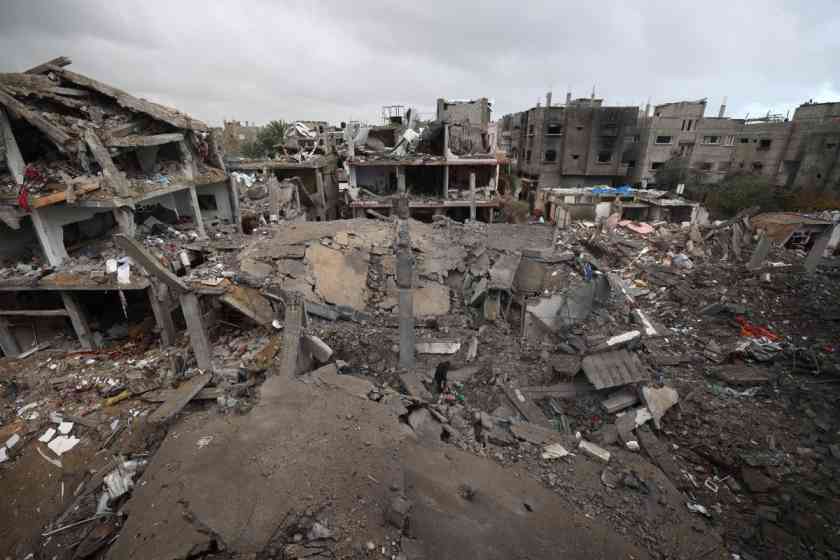
Two Israeli strikes hit the Islamic University campus in Gaza City, killing three security guards and injuring at least seven people. The attacks prompted the university to suspend in-person classes for the remainder of the week, disrupting education in an enclave where schools and other educational institutions have been extensively damaged during the war.
Al Jazeera correspondent Hani Mahmoud said he had been at the university shortly before the attack and had shaken hands with the security guards who were subsequently killed. He described the impact of the strike and the destruction at the scene.
The latest deaths added to the toll from Israel’s war on Gaza, which has killed at least 74,544 Palestinians and wounded 175,692 since October 2023, according to figures cited in the reports.
Gaza’s Education Ministry separately said Israeli attacks had killed 10 students and one teacher between October 18 and 24. The continuing violence has further undermined education and access to essential services.
Hebron operation forces thousands from their homes
In the occupied West Bank, Israel’s military operation in Hebron has forced at least 2,670 Palestinians from their homes, according to the Palestinian prime minister’s office. Most of those displaced are women, children and older people.
The operation followed a shooting on Friday in which two Israeli soldiers were killed. Israeli forces subsequently imposed extensive restrictions, raided homes and businesses, and demolished properties in areas associated with the alleged attackers.
Hebron’s governor said about 400 families had been expelled from their homes. Residents have sought shelter with relatives and friends as the military operation has disrupted daily life and left neighbourhoods largely deserted.
Journalist Jasper Nathaniel described parts of the city as a “ghost town” after residents were expelled. Israeli forces reportedly searched hundreds of buildings and marked homes during the operation, while demolitions left families with little time to gather their belongings.
Palestinian officials have accused Israeli authorities of using the military operation to impose collective punishment. Israeli Finance Minister Bezalel Smotrich said he had ordered immediate demolitions, while other far-right members of the government have advocated a hard-line approach towards Palestinians.
The Israeli military was reportedly preparing to conclude the Hebron operation within days, after searching about 500 buildings and finding two weapons, according to Israeli public broadcaster reports. Thousands of residents had nevertheless already been displaced, and homes and vehicles had been destroyed.
Israel also announced that it would close land crossings with the occupied West Bank on Tuesday for its general election. Palestinian workers were to be barred from entering most areas from Sunday through Monday, followed by a full closure of crossings into and out of the territory on election day.
The restrictions add to the disruption caused by military raids, demolitions and movement controls across the territory.
Settler violence and restrictions deepen West Bank pressures
Violence against Palestinian farmers has continued during the annual olive harvest, with Palestinian authorities reporting 482 attacks across nine West Bank governorates since the season began on October 3.
The attacks targeted farmers and olive groves and restricted access to agricultural land, according to the Palestinian Colonization and Wall Resistance Commission. Incidents included an attack on Washington Post photojournalist Heidi Levine and European diplomats earlier this month.
The Israeli military dismissed international concerns, saying the incidents attracting media attention represented only a small proportion of the territory’s olive-growing areas.
The olive harvest is an important source of income for Palestinian families, while access to farmland has become a recurring point of tension in areas near Israeli settlements and outposts.
The latest developments come amid growing concerns over displacement and settlement expansion across the occupied West Bank. The military lockdown and planned crossing closures are likely to compound the difficulties faced by residents, workers and farmers.
Palestinian prisoners face further restrictions
Israel’s National Security Minister Itamar Ben-Gvir said he wanted to make Palestinian prisoners’ lives “hell” and voiced support for executing people he described as terrorists.
Ben-Gvir also called for dismantling the Palestinian Authority and publicized the confiscation of an improvised cake made by Palestinian prisoners from bread and jam. He said the inmates had been placed in solitary confinement following disciplinary proceedings.
Separately, Israeli authorities released Palestinian physician Mazen Al-Rantisi after more than four months in detention, the Palestinian Prisoner’s Society said. The 71-year-old, known as the “doctor of the poor”, was arrested at his home in Ramallah on June 21.
The organisation said physical evidence indicated that Al-Rantisi had been assaulted while in custody. Israeli media reports at the time linked his arrest to his role as chair of the Union of Health Work Committees, a Palestinian health and development organisation.
The latest developments underline the mounting pressures facing Palestinians in both Gaza and the West Bank, where deadly attacks, displacement, restrictions on movement and detention continue alongside the destruction of homes and essential infrastructure.