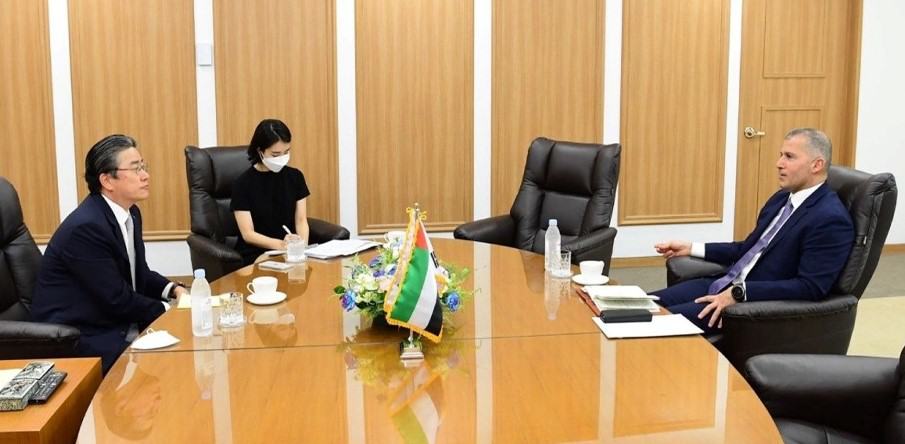

Emirates Nuclear Energy Corporation (ENEC) and the Korea Electric Power Corporation (KEPCO) who are partners in a joint venture nuclear energy project in Abu Dhabi Emirate, discussed future cooperation in the sector.
Mohamed Ibrahim Al Hammadi, Managing Director and CEO of ENEC had a meeting in the South Korean capital Seoul with Seung-il Cheong, President and CEO of KEPCO, the joint venture partner and prime contractor of the Brakah Nuclear Energy Project, being developed in the Al Dhafra region in the Abu Dhabi Emirate.
Al Hammadi’s visit to South Korea comes within the framework of the joint venture agreement between ENEC and KEPCO and in line with the special strategic partnership between the UAE and the Republic of Korea.
Al Hammadi and Cheong discussed the progress of the Barakah Nuclear Energy Plant, with the KEPCO CEO reaffirming his team’s commitment of completing the remaining units at Barakah in an efficient manner. They also discussed how the plant will help in reducing carbon emission. They also discussed prospects for future cooperation and exploring the opportunities available in the nuclear energy sector.
The overall completion rate of the Barakah Plant is now over 97 percent as the first and second units are commercially operational and are producing electricity. The third unit is in the operational readiness phase pending Operating License from the Federal Authority for Nuclear Regulation (FANR).
The Barakah Plant is accelerating the decarbonization of the power sector in the UAE and the Arab World, significantly contributing to achieving Net Zero emission by 2050.