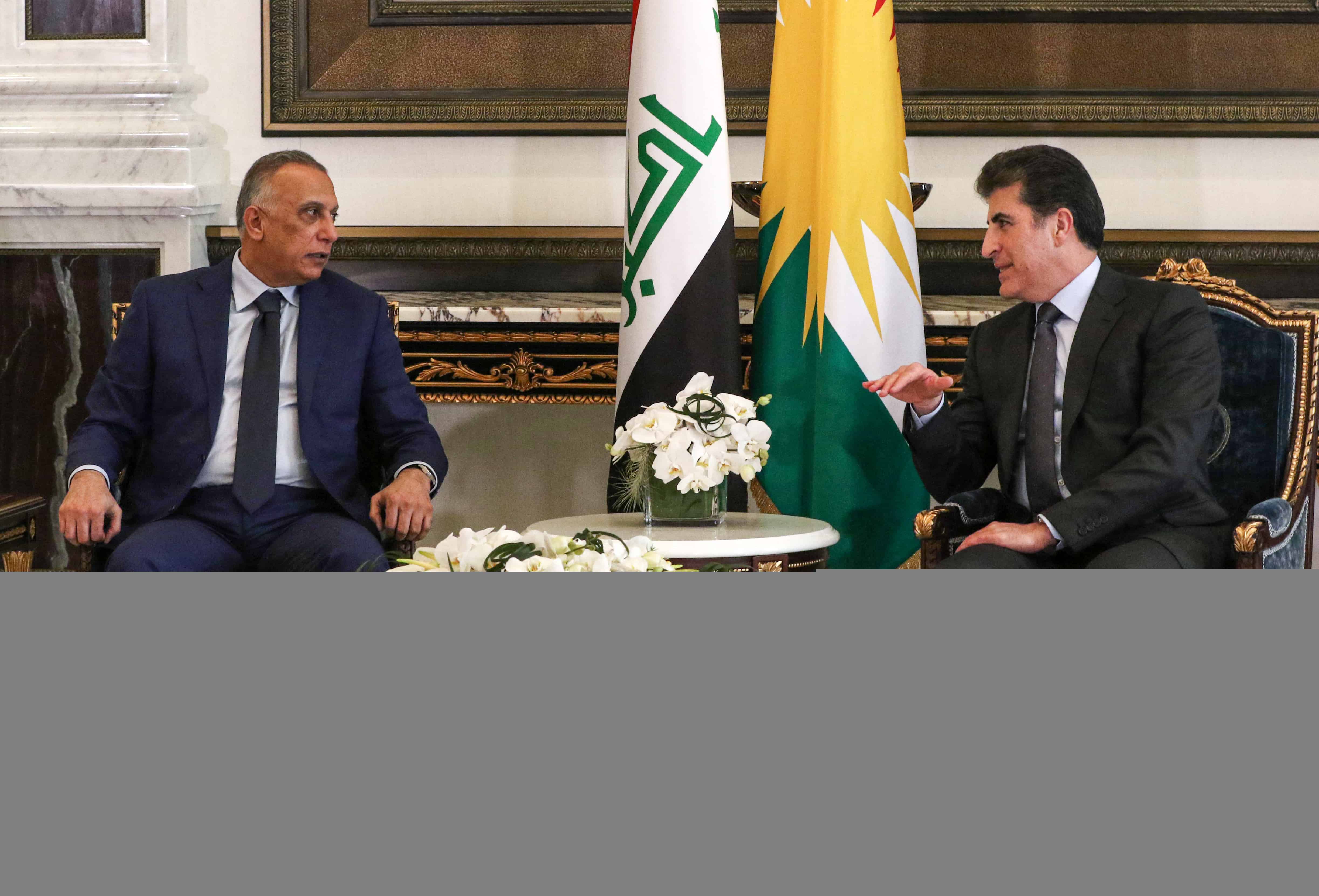

The federal government in Baghdad and the autonomous Kurdish region pledged Saturday to “increase dialogue” to ease a simmering oil dispute that has been playing out in the courts in recent months.
The announcement came during a rare visit to the Iraqi capital by the Kurdish region’s prime minister. Masrour Barzani, who had not visited Baghdad since 2019, met Iraqi Prime Minister Mustafa al-Kadhemi for wide-ranging talks.
An oil dispute that has been poisoning relations between the two sides, and threatening to harm Iraq’s lifeline oil industry according to analysts, was among the topics.
“It was agreed to increase dialogue between the federal ministry of oil and the ministry of natural resources in the Kurdistan region of Iraq to address the outstanding issues and continue working to reach common solutions,” a statement from Kadhemi’s office said.
“The two sides… emphasized the need to strengthen cooperation and joint coordination between the federal government and the regional government to attract investments, and maximize revenues,” it added.
The long-simmering dispute came to a head in February — at a time of political deadlock in Baghdad — when the federal supreme court ordered Kurdistan to hand over oil extracted from its territories to the federal authorities.
Then earlier this month, a commercial court in the Iraqi capital annulled contracts between the Kurds and foreign firms, after the oil ministry in Baghdad filed a judicial complaint.
Iraq, the second largest producer in the Organization of the Petroleum Exporting Countries, sits on enormous reserves, and revenues from the sector feed 90 percent of the federal government budget.
It exports an average of 3.3 million barrels per day (bpd) of crude, while production in Kurdistan amounts to just over 450,000 bpd.
In a bid to defuse tensions, Kurdistan proposed setting up two companies specialized in oil exploration and marketing that would coordinate with Baghdad, a spokesperson for the regional government said earlier this month.
Baghdad has fought to regain control of output from fields in Kurdistan since the autonomous region began marketing oil independently more than a decade ago.