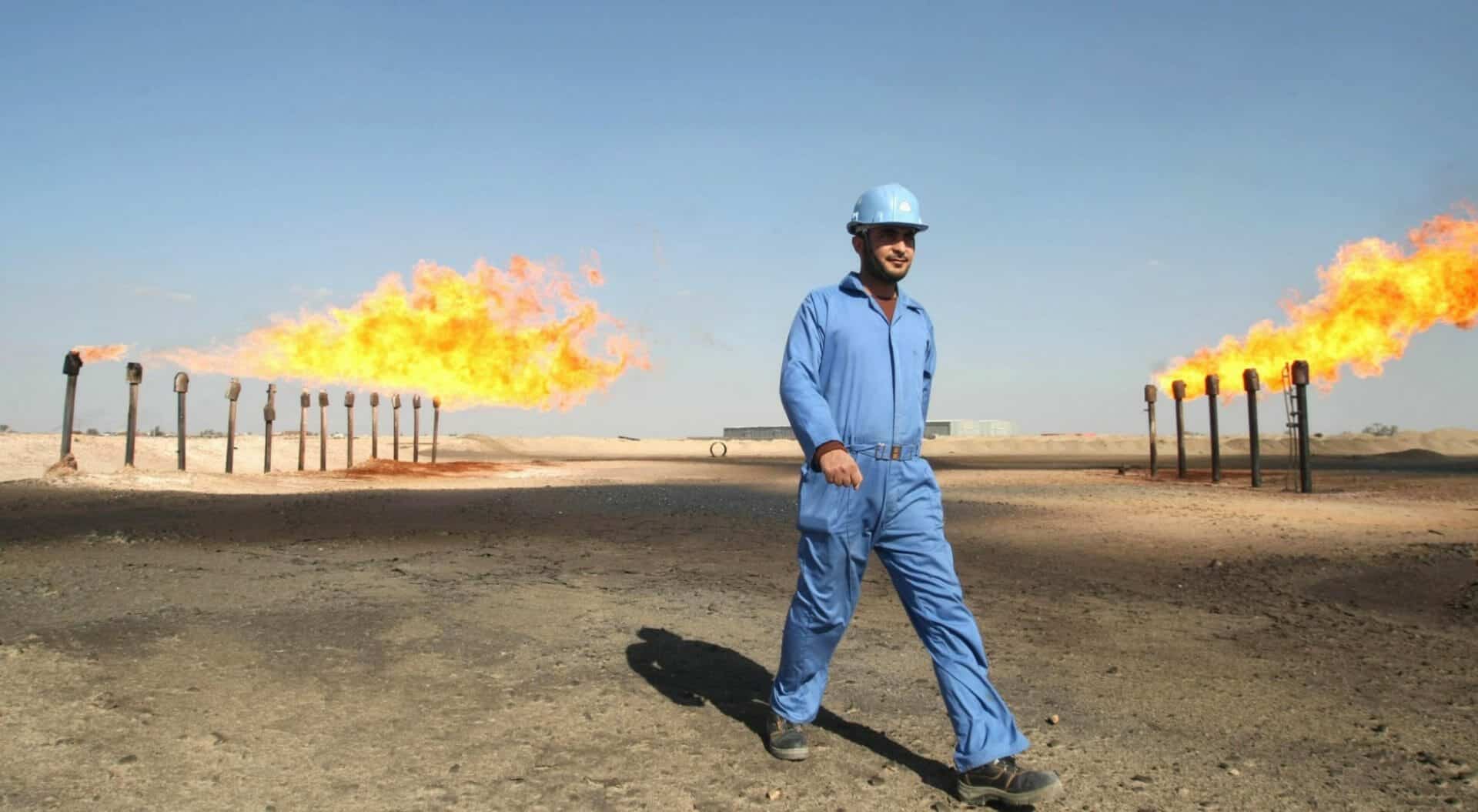

Iraq has launched a new project that aims to recover gas normally set alight during oil extraction at two oilfields in the country’s south.
Flaring, or burning off excess gas during oil extraction, is a highly polluting practice but far less costly than processing it for sale.
According to the World Bank, Iraq is the second-biggest user of flaring worldwide after Russia.
The new project, signed in 2017 with oil services company Baker Hughes, will eventually allow 200 million cubic feet of gas a day that is usually torched on the Nasiriyah and Gharraf oilfields to be captured, according to a statement from the oil ministry sent to the media on Sunday.
It seeks to “exploit the gas that escapes from all oilfields across all Iraq, consolidate national gas production” and help preserve the environment, Oil Minister Ihsan Ismail was quoted as saying in the statement.
A ministry official told AFP that the implementation of the project and exploitation of the gas would have to wait 30 months for the completion of infrastructure works.
The World Bank said the amount of gas torched in Iraq annually reached 17.37 million cubic metres last year.
Earlier this month, French giant TotalEnergies signed a contract to invest in oil, gas and solar production in Iraq.
The French major plans initially to invest $10 billion in infrastructure, the proceeds of which will then allow a second round of investments of $17 billion, the officials said.
One of the projects will see the construction of a complex to exploit production from the sector’s gas fields.
Rather than flaring or burning off the excess, the plan is to recover it for use in electricity generation.
The premier’s office has said this will “reduce gas imports”.
“Reducing flaring and increasing gas production is a priority for Iraq as well as for Total,” TotalEnergies chief Patrick Pouyanne had tweeted earlier this year.
Decades of conflict, poor maintenance and rampant corruption have battered Iraq’s energy sector.
Despite being the number two producer in the Organization of the Petroleum Exporting Countries, Iraq is experiencing an acute energy crisis and chronic blackouts that fuel social discontent.
It is highly dependent on neighbouring Iran, which supplies a third of its gas and electricity needs.
Baghdad currently owes Tehran six billion dollars for energy already supplied.