
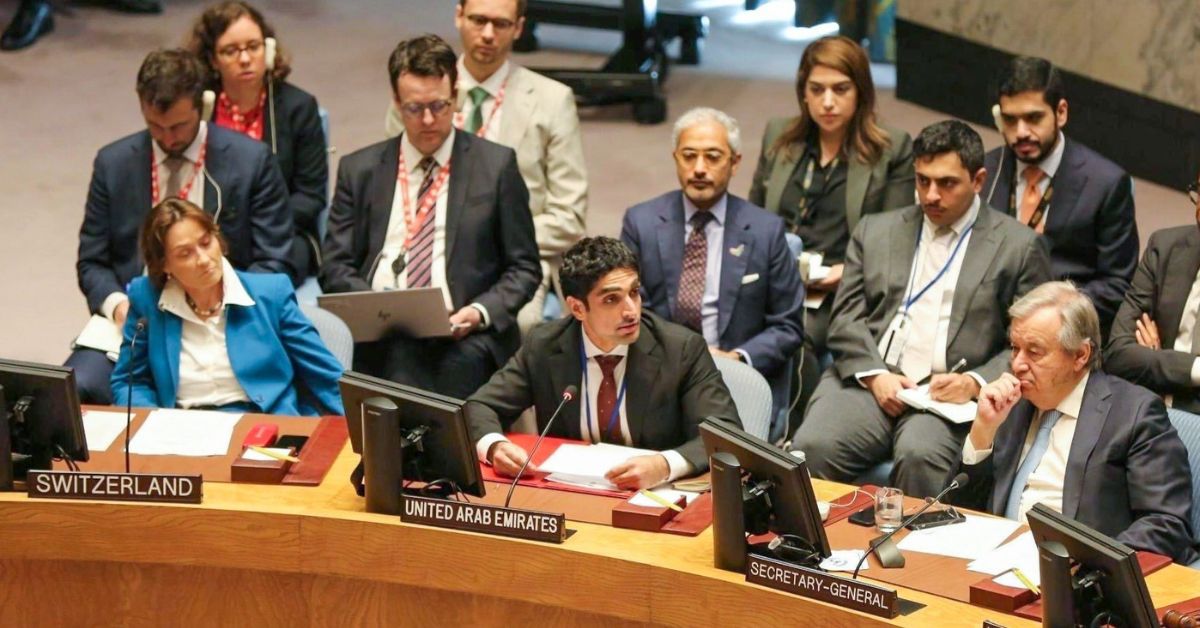


NEW YORK –There is an urgent need for the international community to harness the opportunities presented by Artificial Intelligence (AI) while diligently assessing its potential threats to international peace and security, said Omran Sharaf, the Assistant Minister for Advanced Science and Technology at the UAE’s Ministry of Foreign Affairs.
Speaking at a United Nations Security Council meeting convened by the UK on “Artificial intelligence: opportunities and risks for international peace and security”, Sharaf highlighted that the rapid development of AI, outpacing even Moore’s Law, necessitates a wake-up call for global governments.
“AI development is now outpacing Moore’s Law and moving at breakneck speed, and governments are unable to keep up. This is the wake-up call we need,” Sharaf asserted.
Sharaf urged for a balanced outlook towards AI, emphasizing the need for “optimistic realists” who not only assess the possible threats posed by AI to world stability and peace but also identify and leverage the opportunities it presents.
Calling for the establishment of universal rules, Sharaf advocated against the misuse of AI in promoting hate speech, misinformation, and disinformation that can incite conflict. He also underlined the potential of AI in peacebuilding efforts such as tracking terrorist activities and monitoring the effects of climate change. However, he cautioned against the risk of AI being used to fabricate false narratives that can incite violence.
Sharaf also called upon the international community to implement flexible regulations that would ensure responsible use of AI, without hampering its development. He insisted on the need to avoid replicating the world’s biases in AI.
During his New York visit, Sharaf held meetings with Nicolas de Rivière, Permanent Representative of France to the UN, and Ambassador Jeffrey DeLaurentis, Acting Deputy Representative of the US to the UN.
The call for a considered approach towards AI was also supported by UN Secretary-General António Guterres, who emphasized the potential of AI in accelerating human development, while warning against its malicious use.
The Secretary-General stressed the need for global collaboration in governing AI and suggested the creation of a new UN entity dedicated to this purpose. He also plans to convene a high-level meeting for AI and release a policy brief addressing AI governance recommendations.
Guterres also called on the Security Council to exercise leadership on AI and to work towards common measures for AI transparency, accountability, and oversight. “We must work together for AI that bridges social, digital, and economic divides, not one that pushes us further apart. I urge you to join forces and build trust for peace and security,” he concluded.