
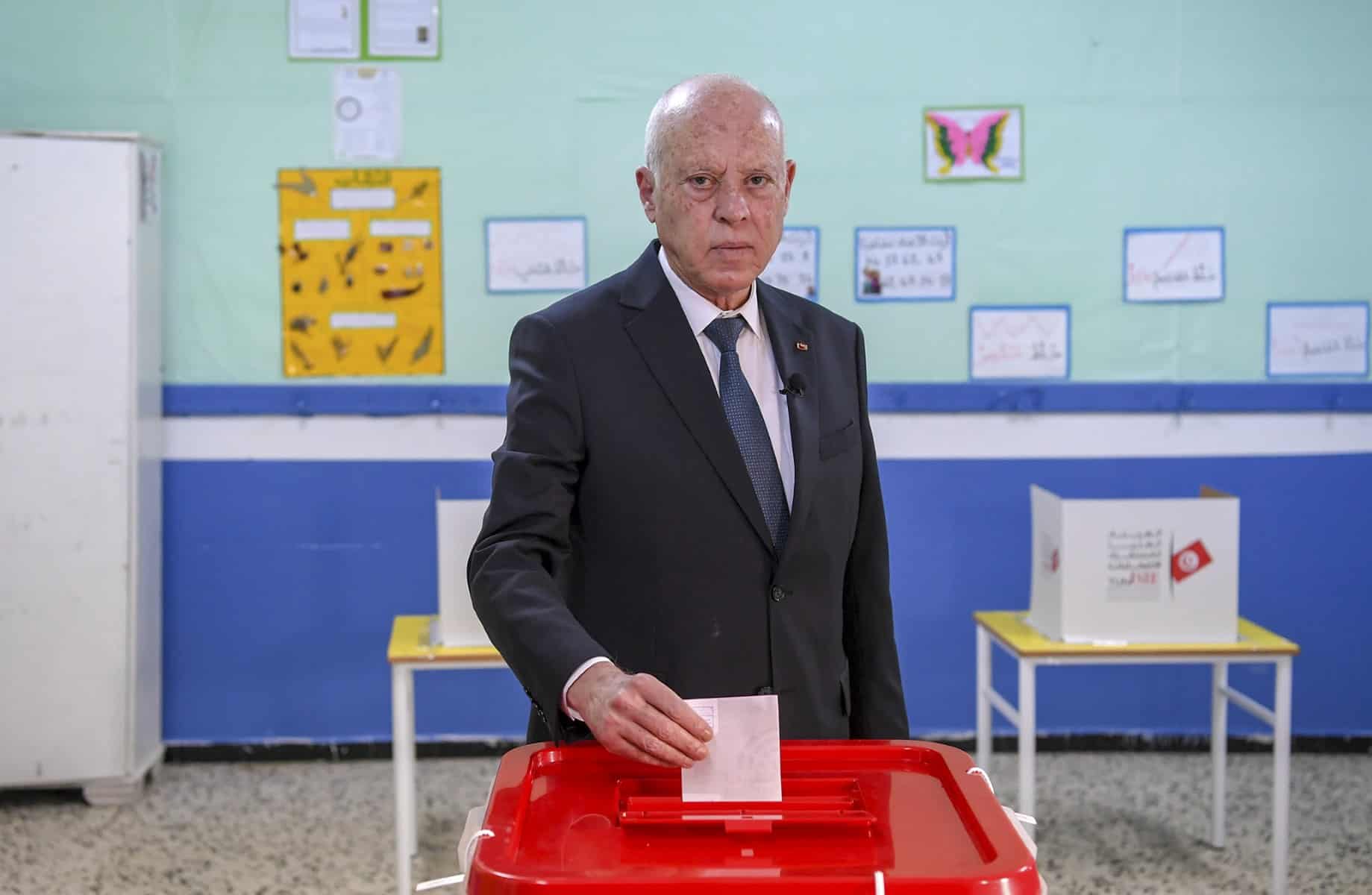


TUNIS, TUNISIA – President Kais Saied on Thursday appointed a new governor of the central bank of Tunisia, a north African country in the throes of economic hardship.
Saied named Fethi Zouhair Nouri, a 69-year-old member of the central bank’s board, to succeed Marouane Abassi, 64, whose six-year mandate ends on Saturday, a presidency statement said.
Tunisia has grappled with a growing economic crisis following the COVID-19 pandemic, political tensions after Saied’s power grab in 2021, and Russia’s war in Ukraine.
Nouri’s appointment came days after parliament passed a controversial amendment allowing the central bank to finance the public budget with an interest-free loan.
On February 6, a majority of 92 votes out of 133 among the Assembly of People’s Representatives approved an amendment to an article that had prohibited the central bank from financing the public treasury.
The new measure allowed for a loan of 7 billion Tunisian dinars ($2.2 billion), repayable in 10 years after a three-year grace period, to help fill a budget deficit of 28.7 billion dinars planned for 2024.
Opposition representatives called the amendment an “easy solution” and said it was unreliable, while others said it was much needed with Tunisia’s debt hovering at around 80 percent of GDP.
The exiting central bank governor warned that the loan would lead to “a decline in foreign currency reserves”, with potentially negative effects on the Tunisian dinar.
Abassi’s successor takes over with inflation running at 8 percent and growth of only 0.4 percent in 2023, compared with 2.4 percent the previous year, according to figures published on Thursday by the National Statistics Institute (INS).
Unemployment was 16.4 percent at the end of 2023, compared with 15.2 percent at the end of 2022, the INS reported.
Jobless rates were even higher among Tunisians aged 15 to 24 with 40.9 percent at the end of 2023, compared with 38.8 percent at the end of 2022.
New governor Nouri has been a member of the central bank’s board of directors since 2016.
He has also been a member since 2013 of the Economic Analysis Council which advises the government, and has taught at the Faculty of Economic Sciences and Management of Tunis since 1990.
President Saied was democratically elected in 2019, but two years later he sacked the government and suspended parliament. He later amended the constitution to further centralize power.