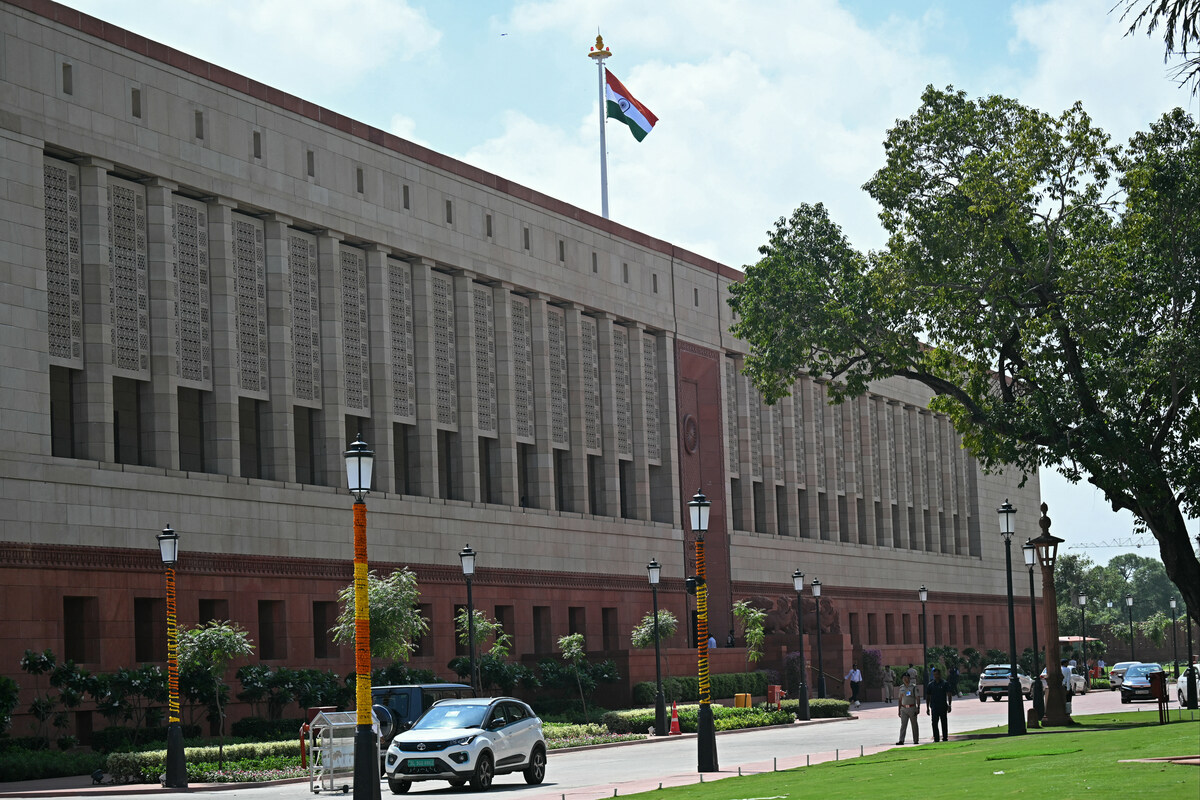

New Delhi, India – Indian lawmakers walked to the country’s new parliament on Tuesday to symbolize the legislature’s departure from its former home in chambers built during British rule.
The triangular building that will now seat nearly 800 representatives from across India is the centerpiece of a remodeling of the heart of New Delhi by Prime Minister Narendra Modi.
His government has worked to rid the Indian capital of the vestiges of the colonial era, which itself saw a wholesale transformation of the megacity by British planners at the beginning of the last century.
“Today India has awakened with a new consciousness,” Modi said in the central hall of the old parliament building before leading fellow legislators by foot across to the new complex.
Modi’s Hindu-nationalist government called a special session of parliament to match the relocation, which coincides with the beginning of a festival celebrating the elephant-headed deity Ganesh.
India’s lower house held a brief first session in its new home to introduce a bill setting a 33 percent quota on female representation among lawmakers.
If passed, the proposed law would dramatically lift the number of women in parliament.
Just 104 of India’s 788 MPs were women after the last national election, according to government figures — a little over 13 percent.
India’s parliament has grown considerably over the decades, with more than 100 additional lawmakers in total across both houses since its first post-independence elections in 1952.
The new, larger building has extra room to accommodate parliament’s expanded ranks along with updated technology.
It stands next to the ageing and cramped colonial-era building from where India’s first prime minister Jawaharlal Nehru made his landmark “tryst with destiny” speech to signal the beginning of the country’s independence in 1947.
Modi has stressed in public speeches the need for India to abandon traces of a “colonial mindset”.
His government has worked to excise traces of the British era from the country’s urban landscape.
The new parliament is part of a broader renovation of New Delhi’s main political precinct.
The government has yet to specify its plans for the old assembly but media reports have suggested that parts of the complex will be used as archives and a museum.