
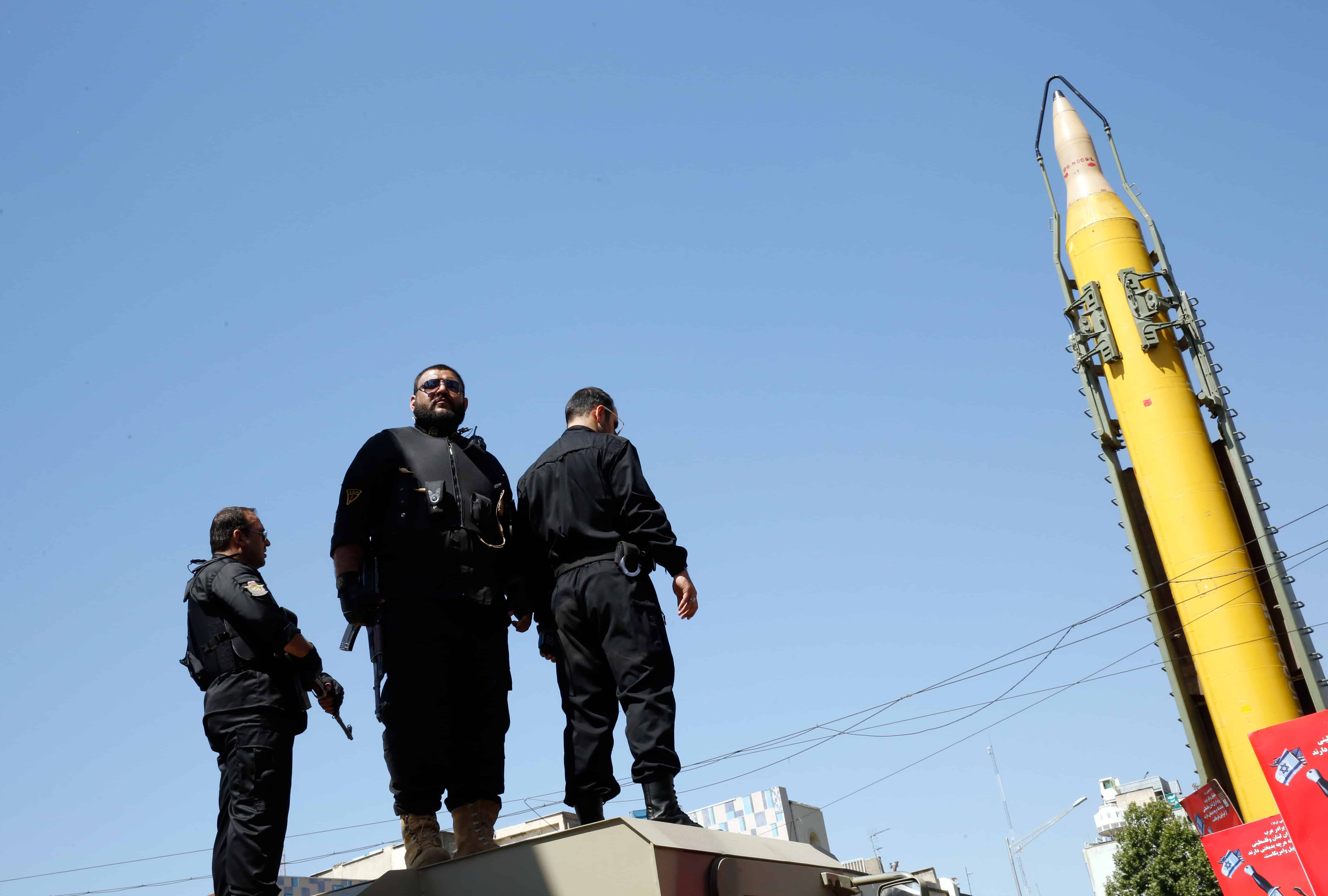


Iran’s Islamic Revolutionary Guard Corps on Wednesday announced the development of a surface-to-surface missile whose stated range would put arch foe Israel within reach.
The Guards’ Sepahnews website said the missile was named the Khaybarchekan after a victorious battle fought by the Prophet Mohammed in the seventh century.
Armed forces chief of staff Mohammad Bagheri described it as a strategic, “long-range” missile.
The Guards’ Sepahnews website said the missile has a range of 1,450 kilometers (about 900 miles), runs on solid fuel and is capable of penetrating anti-missile systems.
It was unveiled during a visit to a surface-to-surface missile base of the Guards’ air force, with the chief of the aerospace department Amirali Hajizadeh present.
“Its maneuverability and extreme speed allow it to reach targets within a radius of 1,450 kilometers,” the website said.
Iran has the largest arsenal of missiles in the Middle East.
On December 24, the Islamic republic fired 16 ballistic missiles to conclude military drills described by generals as a warning to Israel.
The Jewish state is located little more than 1,000 kilometers from Iran’s western frontier.
Bagheri said on Monday that Iran was “self-sufficient in terms of military equipment”, noting it could become one of the world’s largest arms exporters if US sanctions were lifted.
The International Institute for Strategic Studies (IISS) says Iran has about 20 types of ballistic missiles as well as cruise missiles and drones.
Their capabilities vary, with the Qiam-1 having a range of 800 kilometers and the Ghadr-1 able to reach 1,800 kilometers.
The IISS, a London-based think tank, says Iran’s current priority is to increase the accuracy of its missiles.