
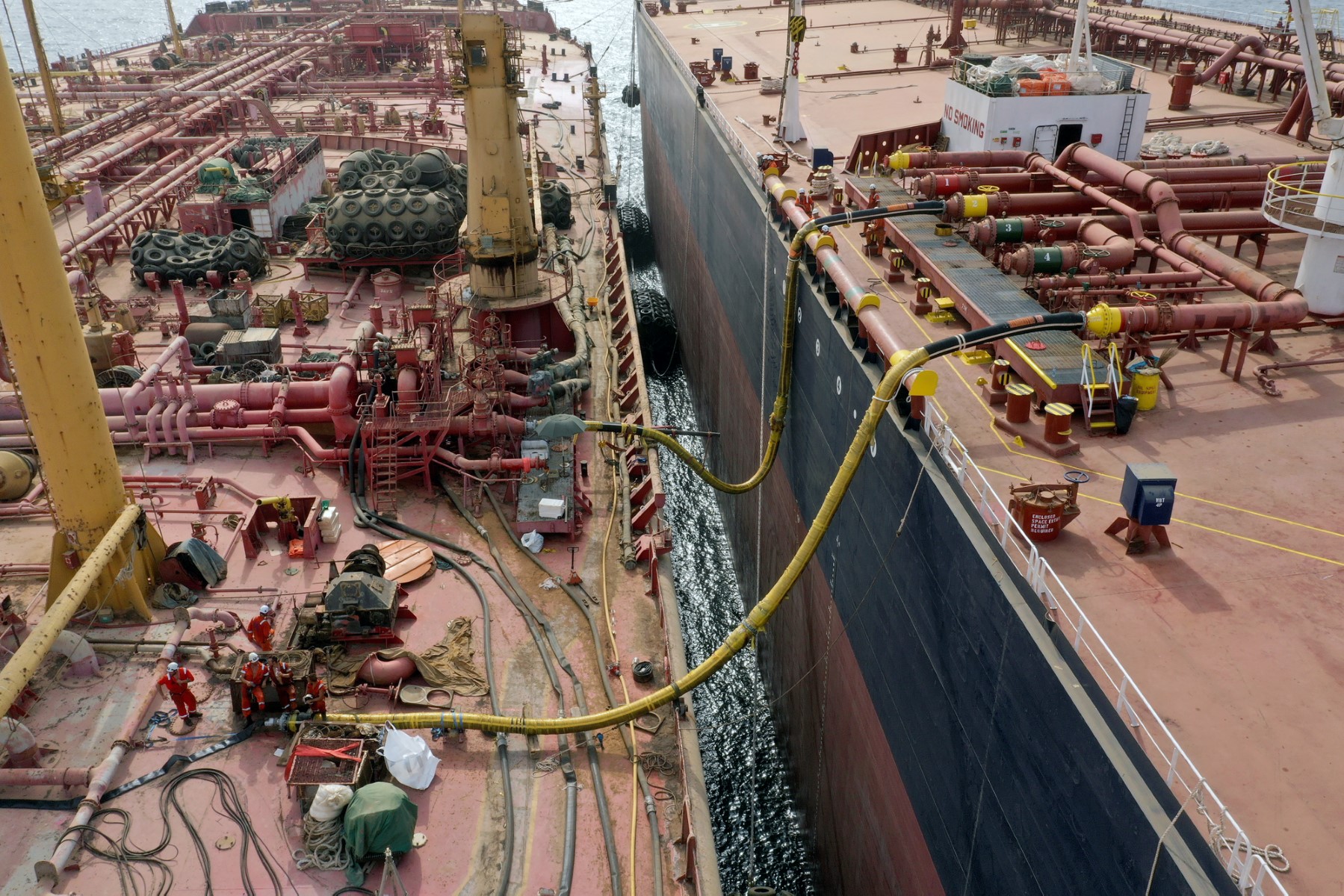


Dubai, United Arab Emirates– Most of the oil on board a rusting supertanker off war-torn Yemen has been moved to a replacement vessel in a bid to avert a catastrophic spill, the United Nations has said.
The transfer of 1.14 million barrels of Marib light crude from the 47-year-old FSO Safer to the new vessel started last week.
“More than half the oil aboard the decaying FSO Safer has been transferred to the replacement vessel Yemen in the past seven days,” the UN resident coordinator for Yemen, David Gressly, said on social media on Tuesday.
Gressly had previously said the entire transfer would take less than three weeks.
The UN Development Programme project manager for the Safer, Mohammed Mudawi, said more than 636,000 barrels of oil had been pumped to the replacement tanker.
“We reached the 55 percent mark today (Wednesday) at 9:00 am (0600 GMT),” Mudawi told AFP.
“Pumping continues very smoothly.”
The UN hopes the $143 million operation — for which it is still $20 million short — will eliminate the risk of an environmental disaster that it estimates would cost $20 billion to clean up.
Because of the Safer’s position in the Red Sea, a spill would also cost billions of dollars per day in shipping disruptions through the Bab al-Mandab Strait to the Suez Canal, while devastating ecosystems, coastal fishing communities and lifeline ports.
The Safer, a floating storage and offloading facility, has been moored around 50 kilometres (30 miles) from the port of Hodeida since the 1980s.
It has not been serviced since war broke out eight years ago between rebels, who control the capital Sanaa and the waters where the Safer is positioned, and a Saudi-led coalition backing the internationally recognised government.
The ageing vessel, with its corroding hull, is carrying four times as much oil as was spilled in the 1989 Exxon Valdez disaster off Alaska.