
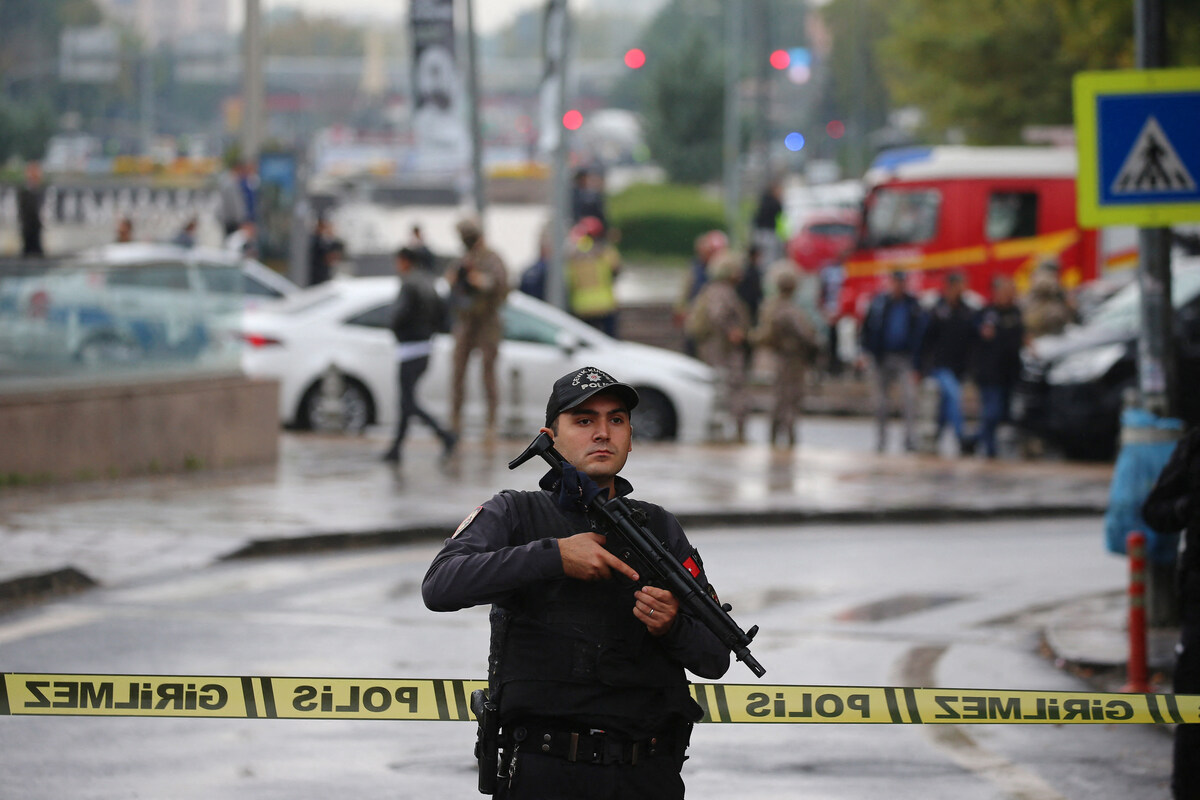


Istanbul, Turkey – Turkey warned Wednesday it could step up cross-border air strikes against Kurdish targets after concluding that militants who staged a weekend attack in Ankara came from Syria.
Turkey convened a top national security meeting to prepare its response to Sunday’s attack.
Police shot dead one of the assailants while the other died in an apparent suicide blast outside Turkey’s interior ministry that injured two security officers.
A branch of the Kurdistan Workers’ Party (PKK) — listed as a terror group by Turkey and its Western allies — claimed responsibility for the first bombing to hit Ankara since 2016.
“As a result of the work of our security forces, it has become clear that the two terrorists came from Syria and were trained there,” Foreign Minister Hakan Fidan said in televised remarks.
“From now on, all infrastructure, large facilities and energy facilities belonging to (armed Kurdish groups) in Iraq and Syria are legitimate targets for our security forces,” he added.
“I recommend that third parties stay away from these facilities.”
Turkey conducted air raids against PKK rear bases in the northern mountains of Iraq hours after Sunday’s attack.
The defense ministry released fresh images Wednesday purporting to show PKK targets being hit in Iraq the night before.
Iraqi Defense Minister Thabet al-Abbasi was expected in Ankara on Thursday for talks with counterpart Yasar Guler as tensions soared.
Kurdish suspect killed –
Fidan’s comments suggest that Turkey could intensify its drone and artillery strikes in Syria.
Turkish media reported Wednesday that the MIT intelligence agency had conducted an operation in Syria killing one of the suspected masterminds of an Istanbul bombing that claimed six lives in November of last year.
The British-based Syrian Observatory for Human Rights confirmed that an “intelligence official” in the semi-autonomous Kurdish region of northeastern Syria was killed on Tuesday.
Ankara has military bases and supports groups fighting both regime forces and the Kurds in Syria.
US-supported Syrian Democratic Forces (SDF) — the Kurds’ de facto army in the area — led the battle that dislodged Islamic State group fighters from the last scraps of their Syrian territory in 2019.
But Turkey views the Kurdish People’s Protection Units (YPG) that dominate the SDF as an offshoot of the PKK.
Turkish President Recep Tayyip Erdogan has launched a series of armed incursion into Syria and repeatedly threatened to expand attacks against the YPG.
Ankara on Tuesday also announced the detention of 67 suspected PKK members in raids across Turkey’s predominantly Kurdish southeast.
Sunday’s attack coincided with the opening of a Turkish session of parliament during which lawmakers will be asked to ratify Sweden’s membership of the NATO defense alliance.
Turkey’s ratification has been held up by anger over the refusal by the Swedish police to ban marches by the PKK and their supporters in Stockholm.
Some analysts believe the PKK may be trying to block Turkey’s ratification because it would herald an improvement in Ankara’s ties with Washington.
Turkey has been trying to get the United States to drop its support for the SDF — a policy shift Ankara may expect in return for its ratification of Sweden’s membership, analysts say.