
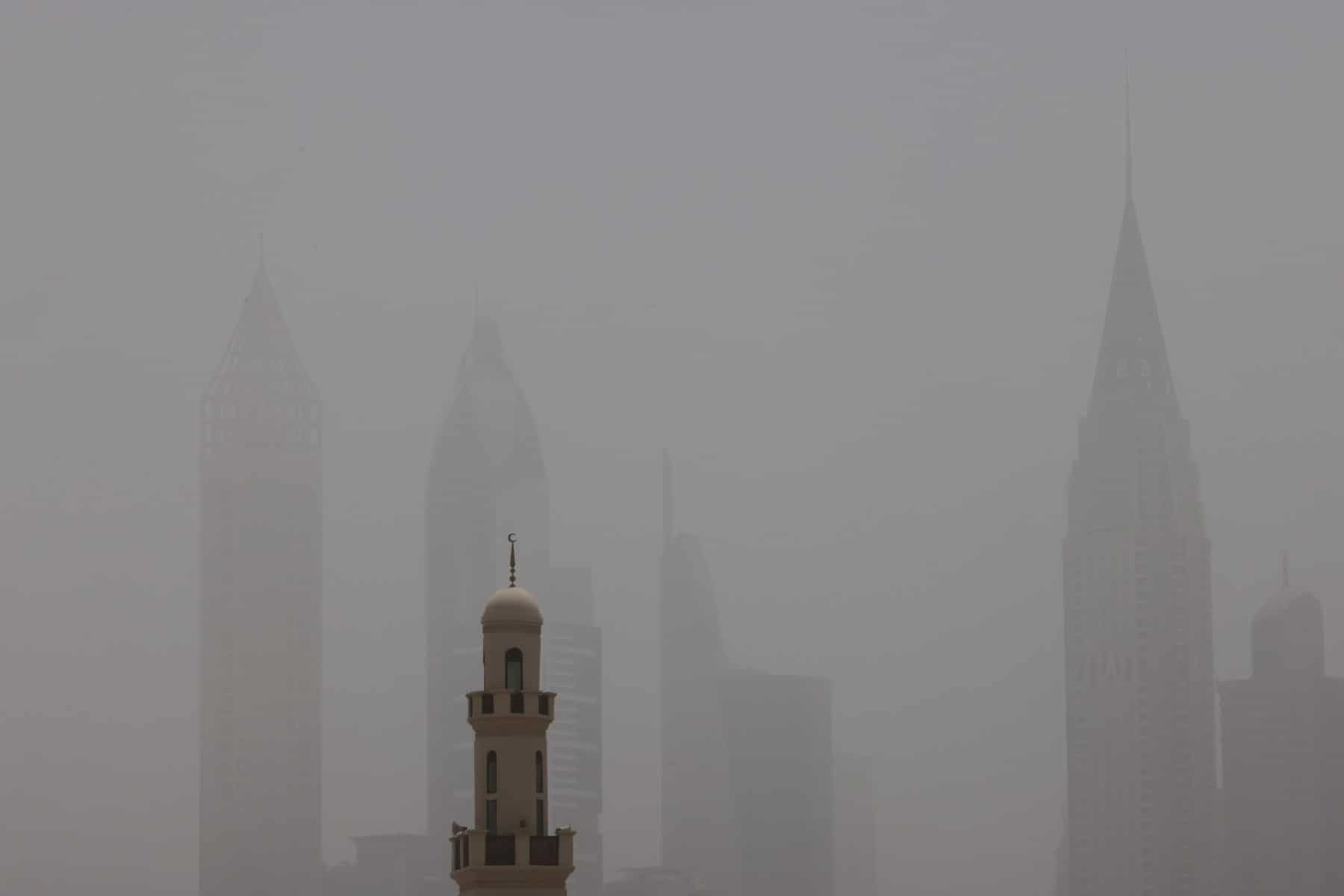


The world’s tallest building disappeared behind a grey layer of dust on Wednesday as sandstorms that have swept the Middle East hit the United Arab Emirates, prompting weather and traffic warnings.
The 828-metre (2,716 ft, 6ins) Burj Khalifa, which towers over Dubai and is usually visible across the busy financial hub, retreated behind a curtain of airborne dirt that shrouded much of the country.
The UAE is just the latest country in the path of sandstorms that have smothered Iraq, Kuwait, Saudi Arabia, Iran and others in recent days, closing airports and schools and sending thousands to hospital with breathing problems.
Capital city Abu Dhabi’s air quality index (AQI) soared into the “hazardous” zone overnight, according to waqi.info and the Plume pollution app.
The Middle East’s sandstorms are becoming more frequent and intense, a trend associated with overgrazing and deforestation, overuse of river water and more dams.
Experts say the phenomenon could worsen as climate change warps regional weather patterns and drives desertification.
Emirati authorities issued a nationwide warning urging residents to remain vigilant.
“Abu Dhabi Police urges drivers to be cautious due to low visibility during high winds and dust,” the police force tweeted, as residents took to social media to publish photos and videos.
“Please do not be distracted by taking any videos or using your phone,” it added.
‘Hazardous weather’
A National Center for Meteorology graphic showed nearly all the country covered by the storm, with the warning: “Be on the alert: hazardous weather events are expected.”
Winds with speeds up to 40 kilometres (25 miles) per hour are blowing the dust, it said, reducing visibility in some areas to less than 2,000 metres (2,200 yards).
However, a Dubai airports spokesman said there was no impact on air traffic. Weather conditions were expected to remain the same for the next few days.
In neighbouring Saudi Arabia, badly hit on Tuesday, conditions eased in the capital Riyadh on Wednesday but continued to restrict visibility in the city centre.
Emergency rooms in Riyadh hospitals received some 1,285 people suffering from respiratory problems over 24 hours from the sandstorm, the state-run Al-Ekhbariya channel reported late on Tuesday.
The Saudi national weather centre reported that dust was also affecting visibility in the west and south, specifically in Assir, Najran, Hael and Medina provinces. Medina is home to Medina city, the second-holiest city in Islam.
The centre predicted another sandstorm would arrive in the kingdom by Sunday.