


-
The 55-year-old leader gets 95% of the vote in a row-hit election
-
Assad vows to strengthen economy and people’s livelihoods
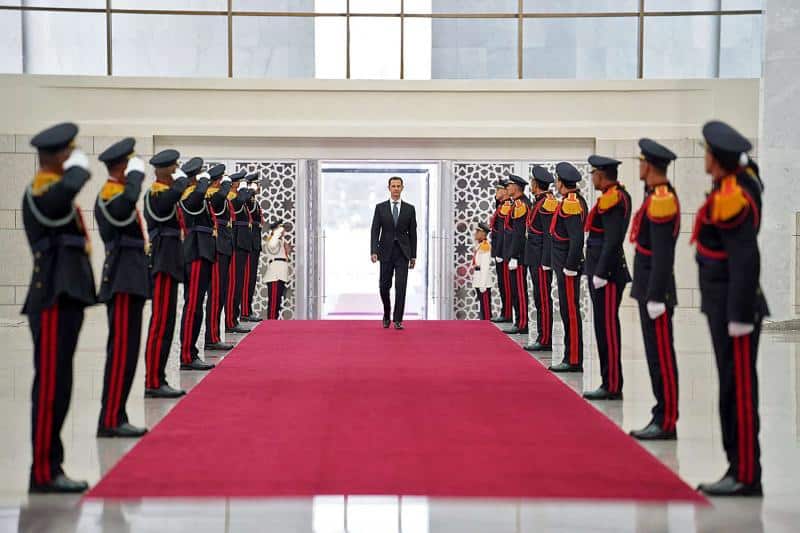
President Bashar al-Assad took the oath of office for a fourth term in Syria Saturday, after taking 95 percent of the vote in a controversial election dismissed abroad.
Assad was sworn in on the constitution and the Quran in the presence of more than 600 guests, including ministers, businessmen, academics and journalists, organisers said.
The elections “have proven the strength of popular legitimacy that the people have conferred on the state,” 55-year-old Assad said, in his inauguration speech.
They “have discredited the declarations of Western officials on the legitimacy of the state, the constitution and the homeland.”
He called on “those who bet on the demise of the homeland” to return to its “embrace”.
“We tell each and every one of them, you are exploited by the enemies of our country against your own people, and the revolution with which they deceived you is an illusion,” he said.
The vote extending Assad’s grip on power was the second since the start of a decade-long civil war that has killed more than 500,000 people, displaced millions and battered the country’s infrastructure.
On the eve of the May 26 election, the United States, Britain, France, Germany and Italy said the poll was “neither free nor fair”, and Syria’s fragmented opposition has called it a “farce”.
With his campaign slogan, “Hope through work”, Assad cast himself as the sole viable architect of a reconstruction phase for the troubled country.
Economy new priority
In his speech Saturday, he outlined the priorities looking forward.
“During more than 10 years of war, our concerns were many, and dominated by security and the unity of the homeland, but today these are mostly liberating those parts of the homeland that still need to be, and facing the repercussions of the war for the economy and people’s livelihoods.”
Government forces control two-thirds of the country, but several parts of the north remain beyond their control.
Syria’s former Al-Qaeda affiliate and allied rebels run the rebel bastion of Idlib in the northwest.
Kurdish-led forces control a large swathe of the east after expelling the Islamic State group from the region.
And Turkey and its Syrian proxies hold a long strip of territory along the northern border.
Assad takes his oath as the country faces a dire economic crisis.
More than 80 percent of the population live in poverty, and the Syrian pound has plunged in value against the dollar, causing skyrocketing inflation.
In recent weeks, the government has hiked the price of unsubsidised petrol, bread, sugar and rice, while power cuts can last up to 20 hours a day in areas it controls.
Nationwide, 12.4 million people struggle to find enough food each day, the World Food Programme says.
The Damascus government has blamed the country’s economic woes on Western sanctions and a deepening crisis in neighbouring Lebanon.
Assad was first elected by referendum in 2000 following the death of his father Hafez al-Assad, who had ruled Syria for 30 years.
(With AFP inputs)