
The United States on Friday announced a fresh round of sanctions targeting people and companies in China, Hong Kong, Belarus, and the United Arab Emirates for allegedly helping Iran acquire supplies and military equipment for its missile and drone programs.
The sanctions come as tensions continue to rise in the Persian Gulf amid ongoing clashes between Washington and Tehran over the Strait of Hormuz.
According to the U.S. Treasury Department, the measures are aimed at disrupting Iran’s military industrial supply chain and restricting its access to materials required to build drones and missiles.
“Under President Trump’s decisive leadership, we will continue to act to keep America safe and target foreign individuals and companies providing Iran’s military with weapons for use against U.S. forces,” Treasury Secretary Scott Bessent said in a statement.
The move comes ahead of a summit between U.S. President Donald Trump and Chinese President Xi Jinping in Beijing next week.
China remains Iran’s largest oil buyer, and the Trump administration has repeatedly accused Beijing of helping sustain the Iranian economy through continued purchases of Iranian crude oil.
The report noted that the Trump administration has also targeted independent Chinese “teapot” refineries, which are among the biggest importers of Iranian oil. However, China reportedly directed its companies to ignore the U.S. sanctions under domestic policy measures.
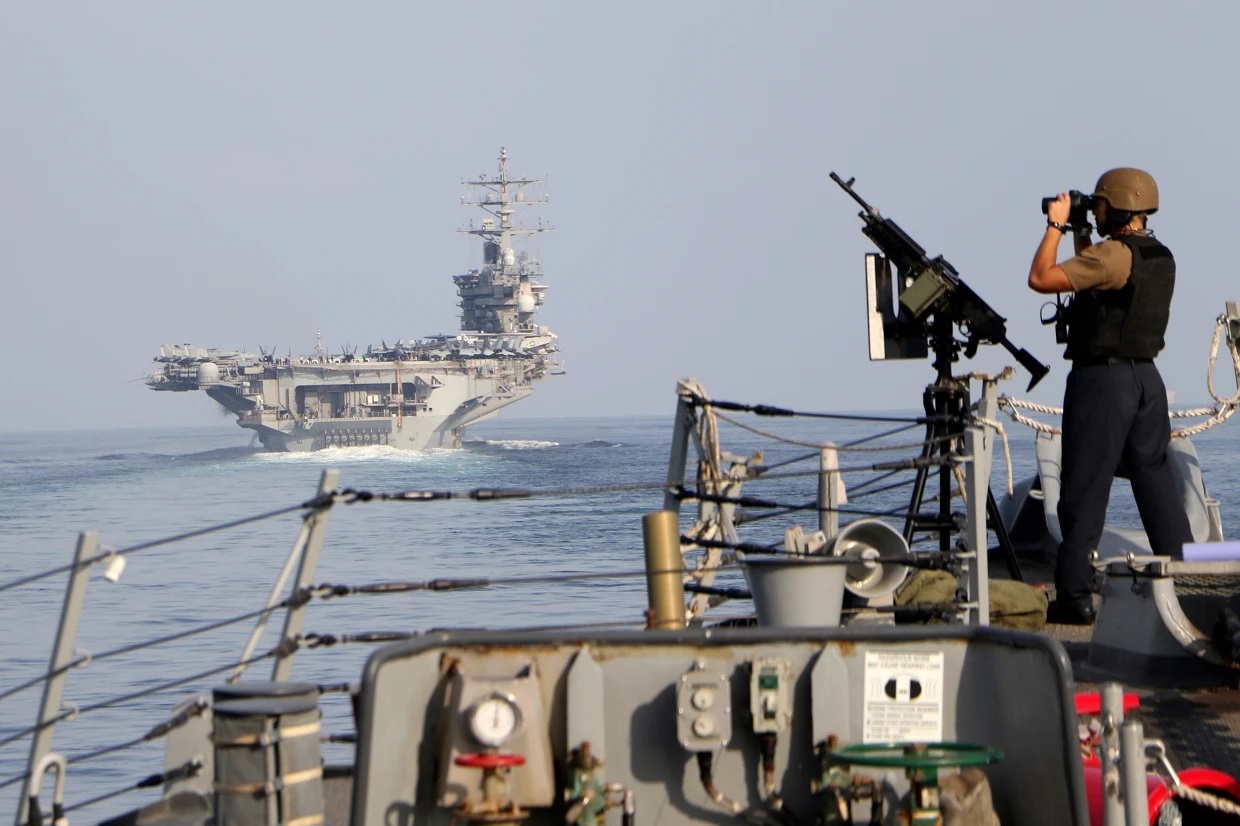
The sanctions also coincide with efforts by Washington to pressure Tehran into reopening the Strait of Hormuz, a vital global oil shipping route that has witnessed military confrontations in recent weeks.
The U.S. military on Friday said it had fired on and disabled two Iranian-flagged oil tankers attempting to reach an Iranian port.
Speaking earlier this week, Bessent said Washington expected China to use its influence with Tehran.
“Let’s see if China — let’s see them step up with some diplomacy and get the Iranians to open the strait,” he told Fox News.
Iran says main issues being discussed are ceasefire and ‘stability in the region’
Iran has said that ongoing discussions surrounding the conflict are primarily focused on securing a ceasefire and restoring regional stability, while Tehran continues to evaluate a proposal put forward by the United States.
Speaking to the Iranian news agency IRNA, Iranian Foreign Ministry spokesperson Esmaeil Baghaei said the current negotiations are centred on ending hostilities and ensuring peace in the wider region.
“The most important issues being discussed currently are the ceasefire, efforts to end the war and ‘peace and stability in the region’,” Baghaei said.
He added that Iran is still examining the proposal submitted by Washington and has not yet reached a final decision on its response.
According to Baghaei, once Tehran completes its review process, the decision will be formally communicated through Pakistani mediators involved in facilitating the exchange.
He said that they were still reviewing the US’s proposal, but once it was finalised, they would make a decision.
He further noted that the outcome of the message exchange would shape the next phase of diplomatic engagement.
“Once a decision is made, it will be conveyed to the Pakistani mediators, and based on the results of this exchange of messages, the next steps will be determined,” he added.
UAE calls for protection of international waterways amid rising threats in Hormuz
The United Arab Emirates has urged stronger international action to safeguard global shipping routes amid escalating tensions in and around the Strait of Hormuz, warning against threats to civilian and commercial vessels.
Addressing the United Nations, Mohammed Issa Abushahab, the UAE’s representative to the UN, said a draft resolution submitted by the country reaffirms established principles of international law and stresses the importance of protecting freedom of navigation in international waters.
“The draft resolution at the UN reinforces established international law,” Abushahab said, adding that “international waterways cannot be controlled through coercion, through coercion attacks or threats against civilian and commercial shipping”.
He accused Iran of escalating maritime threats over recent months through attacks and interference targeting merchant vessels operating in the region.
“For months, Iran has continued attacks and threats against merchant and commercial vessels, interfered with lawful navigation, placed sea mines in and around the Strait of Hormuz, and attempted to impose illegal tolls on international shipping,” he said.
According to Abushahab, the proposed resolution demands the disclosure and removal of sea mines in and around the strategic waterway and rejects attempts to impose illegal restrictions on maritime transit.
“The resolution demands the disclosure and removal of sea mines placed in and around the Strait of Hormuz. It rejects the imposition of illegal tolls and interference with freedom of navigation and lawful transit passage. It supports the establishment of a humanitarian corridor to facilitate the movement of aid, fertiliser, and other essential goods through the strait,” he added.
The Strait of Hormuz remains one of the world’s most critical shipping chokepoints, handling a major share of global oil and gas trade. Rising tensions in the region have renewed concerns over energy security and disruptions to international commerce.
US, Iran edge closer to deal as one-page MoU takes shape
The United States and Iran appear to be nearing a preliminary agreement to de-escalate the ongoing conflict, with the White House drafting a concise one-page memorandum of understanding (MoU).
According to an Axios report citing US officials, Washington expects Tehran to respond to the proposal within 48 hours. While no formal agreement has been reached yet, this marks the closest both sides have come since hostilities began on February 28.
The proposed MoU is intended to establish a framework for further negotiations, particularly around Iran’s nuclear programme — a longstanding sticking point in US-Iran relations.
Key Provisions: Nuclear Curbs, Sanctions Relief, Hormuz Access
The draft MoU outlines several major provisions expected to form the backbone of a potential agreement:
- Iran may agree to a moratorium on nuclear enrichment
- The US could lift certain economic sanctions
- Billions in frozen Iranian funds may be released
- Both sides may ease restrictions on transit through the Strait of Hormuz
However, officials caution that these provisions remain conditional and subject to a final, comprehensive agreement. The MoU is expected to trigger a 30-day negotiation window to address unresolved issues.
‘We Are Getting Close’: Mediators Signal Breakthrough
Sources involved in mediation efforts suggest that both sides are nearing consensus.
A Pakistani official familiar with the talks said: “We will close this very soon. We are getting close.”
The negotiations are being led by US envoys Steve Witkoff and Jared Kushner, engaging Iranian officials both directly and through intermediaries.
Trump Halts Naval Mission Amid Signs of Progress
Donald Trump indicated optimism about the talks, announcing a pause in “Project Freedom,” a US naval operation designed to escort vessels through the Strait of Hormuz.
“We have mutually agreed… to see whether or not the Agreement can be finalized and signed,” Trump wrote on social media, signalling confidence in the diplomatic process.
Fragile Ceasefire Holds Despite Renewed Attacks
While diplomatic momentum builds, tensions on the ground remain high.
The United Arab Emirates reported fresh missile and drone strikes, describing them as a “serious escalation.” Iran has denied involvement.
Meanwhile, US Secretary of State Marco Rubio reiterated Washington’s defensive posture:
“There’s no shooting unless we’re shot at first.”
Hormuz Disruptions Continue to Rattle Global Markets
The Strait of Hormuz — a critical artery for global oil trade — has remained largely disrupted since late February, impacting energy markets worldwide.
Despite US assurances about securing shipping routes, conflicting reports and continued incidents underscore the fragility of the situation.
Iran Seeks ‘Fair and Comprehensive Agreement’
Iranian Foreign Minister Abbas Araqchi reiterated Tehran’s stance, stating that the country is open to dialogue but insists on balanced terms.
He said Iran is seeking “a fair and comprehensive agreement,” while confirming that talks are ongoing with Pakistan acting as a mediator.
High Stakes Diplomacy: War Toll and Global Pressure Mount
With thousands reportedly killed and economic pressures intensifying globally, the proposed MoU is being viewed as a crucial step toward de-escalation.
However, the success of this initiative will depend on whether both Washington and Tehran can sustain diplomatic momentum through the upcoming negotiation phase.
Donald Trump pauses Hormuz operation amid US–Tehran talks
Donald Trump abruptly announced a pause in the United States’ newly launched naval escort mission in the Strait of Hormuz, just hours after his administration had signalled a firm operational shift. In a social media post on Tuesday evening, Trump said the operation would be halted “for a short period of time,” pointing to what he described as “great progress” in negotiations with Iran.
The decision marked yet another sharp pivot in U.S. strategy during a conflict now entering its third month. Earlier in the day, Secretary of State Marco Rubio had declared that active combat operations had concluded and that Washington’s focus had moved to safeguarding maritime traffic under a mission named “Project Freedom.”
“The operation is over: Epic Fury — as the president notified Congress — we’re done with that stage of it. We’re now onto this Project of Freedom,” Rubio said.
Despite the announcement, the escort initiative had barely begun to make an impact. Only three commercial vessels managed to pass through the strait under U.S. protection since the mission started on Monday — a stark drop from pre-war levels, when roughly 130 ships transited daily.
The pause adds to uncertainty surrounding a fragile cease-fire. The strait remains a focal point of tension, with Iran warning that ships may pass only with its approval, while the U.S. maintains a blockade preventing Iranian vessels from crossing. Trump underscored that aspect in his statement, asserting the blockade would “remain in full force and effect.”
Meanwhile, commercial shipping has nearly ground to a halt. Around 1,600 vessels and approximately 20,000 seafarers are stranded in or near the waterway, underscoring the scale of disruption to global trade.
Confusion also persists over what constitutes a violation of the cease-fire. Speaking to reporters, Trump suggested Iran was aware of the limits but declined to clarify them. “You’ll find out,” he said, “because I’ll let you know.”
As both Washington and Tehran continue to claim influence over the strait, the situation remains volatile, with regional spillovers adding to the instability.
UAE Comes Under Iranian Attacks for Second Consecutive Day: Ministry
The United Arab Emirates has reported coming under missile and drone attacks for a second straight day, intensifying tensions linked to the ongoing Iran conflict. According to the UAE’s Defence Ministry, the latest strikes followed an earlier incident in which at least three people were injured and a drone ignited a fire at a key oil facility in Fujairah.
However, Iran has strongly denied responsibility. The Islamic Revolutionary Guard Corps (IRGC) issued a statement rejecting the allegations outright.
“If any action had been taken, we would have announced it firmly and clearly. Therefore, the report of that country’s Ministry of Defense is absolutely denied and is devoid of any truth,” the IRGC statement said.
The reported attacks come against the backdrop of escalating tensions in the Strait of Hormuz, where Iran has effectively asserted control by targeting or threatening vessels attempting to pass without its consent. This follows retaliatory measures after joint U.S.-Israeli strikes on Iranian targets earlier this year.
The UAE has not yet disclosed the full extent of damage from the most recent attack, but the developments have heightened fears of a broader regional escalation. At the same time, conflicting narratives between Tehran and Abu Dhabi reflect the deepening information war accompanying the military standoff.
The crisis has already sent shockwaves through global energy markets. With roughly a fifth of the world’s energy exports flowing through the Strait of Hormuz, disruptions have pushed oil and gas prices to multi-year highs, amplifying concerns about economic fallout far beyond the region.
As tensions simmer and denials clash with on-ground claims, the situation underscores how fragile the cease-fire remains — and how quickly it could unravel into a wider conflict.