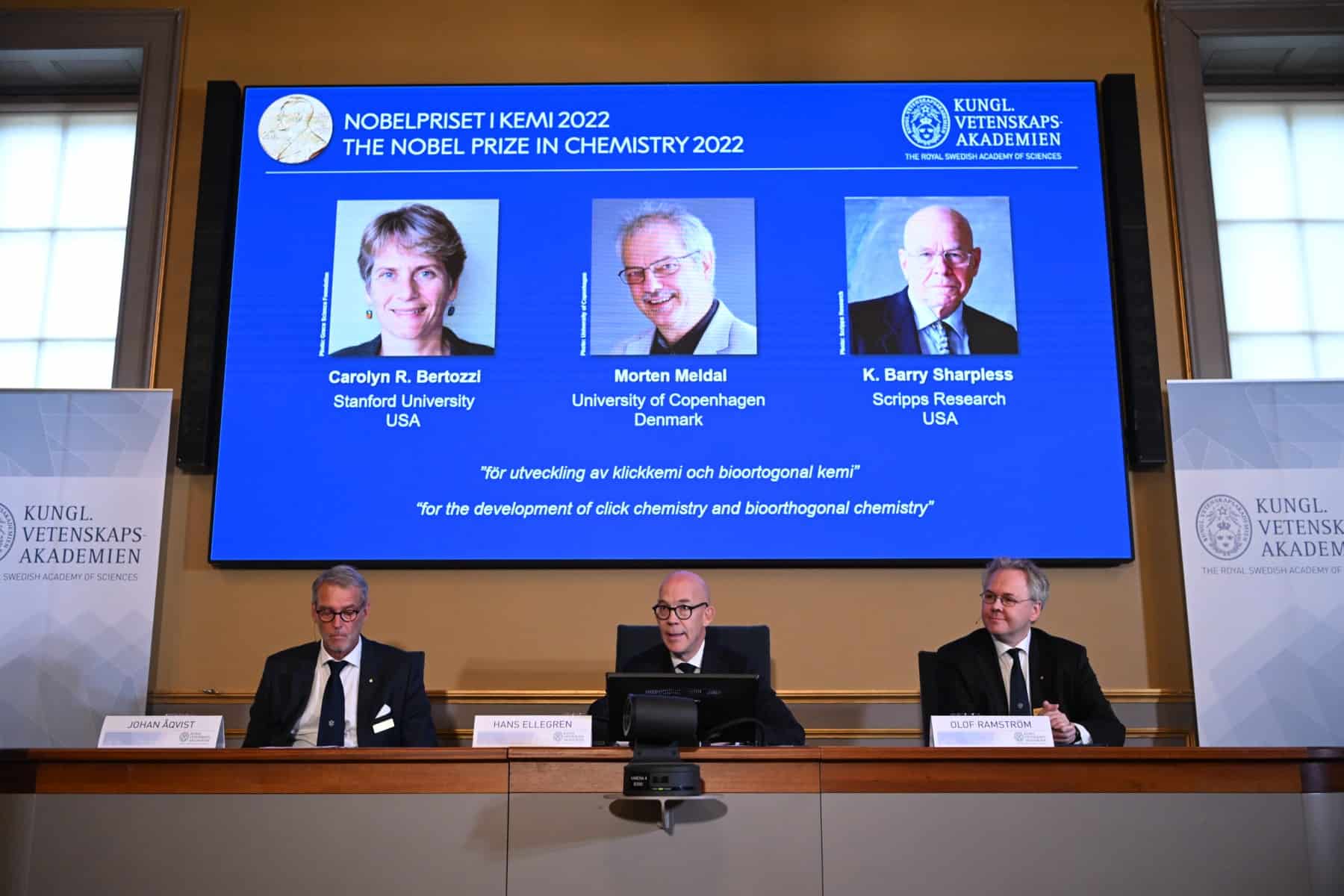

Stockholm, Sweden—The Nobel Chemistry Prize was on Wednesday awarded to a trio of chemists from the United States and Denmark who laid the foundation for a more functional form of chemistry.
Americans Carolyn Bertozzi and Barry Sharpless, together with Denmark’s Morten Meldal, were honoured “for the development of click chemistry and bioorthogonal chemistry,” the jury said.
The award marks the second Nobel for 81-year-old Sharpless, who won the chemistry Nobel in 2001.
Only four other individuals have achieved that feat, including Polish-born Frenchwoman Marie Curie.
Click chemistry “is an elegant and efficient chemical reaction that is now in widespread use,” the jury said in a statement.
“Among many other uses, it is utilised in the development of pharmaceuticals, for mapping DNA and creating materials that are more fit for purpose,” it added.
The trio will share the Nobel award sum of 10 million Swedish kronor ($917,500), and will receive the prize from King Carl XVI Gustaf at a formal ceremony in Stockholm on December 10, the anniversary of the 1896 death of scientist Alfred Nobel who created the prizes in his last will and testament.
Last year, the academy honoured Germany’s Benjamin List and US-British dual national David MacMillan for their development of a precise tool for molecular construction known as asymmetric organocatalysis.
On Monday, the Medicine Prize went to Swedish paleogeneticist Svante Paabo for his discoveries on the genomes of extinct hominins and human evolution.
Physicists Alain Aspect of France, John Clauser of the United States and Austria’s Anton Zeilinger won Tuesday’s Physics Prize for developing experimental tools that helped prove quantum entanglement — a phenomenon Albert Einstein dismissed as “spooky action at a distance”.
The Chemistry Prize will be followed by the highly watched Literature and Peace prizes, announced on Thursday and Friday respectively.
The Peace Prize is expected to hold a special significance this year given the Russian invasion of Ukraine.