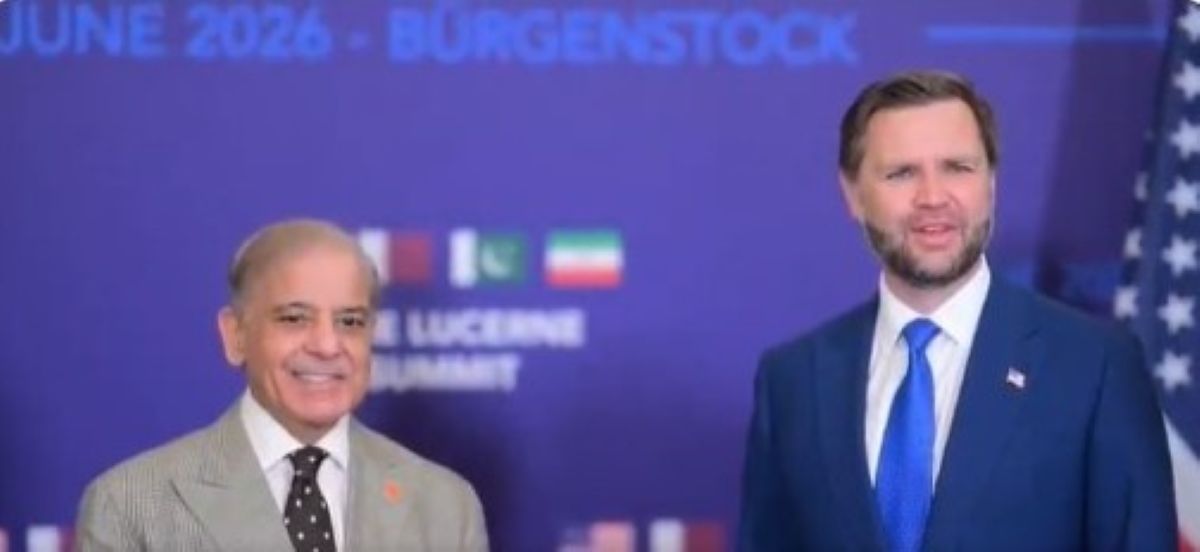

Dubai, UAE — U.S. Vice President JD Vance said on Sunday he hoped Washington and Tehran could “turn over a new leaf” in relations as the two sides opened what he described as a historic round of face-to-face talks in Switzerland aimed at implementing and expanding last week’s preliminary agreement.
Speaking at the start of meetings in Burgenstock, Vance said President Donald Trump wanted to transform relations with the Iranian people and that the talks would allow both sides to work through outstanding issues.
“President Trump has asked us to turn over a new leaf” in relations with Iran, Vance said, adding that the negotiations offered an opportunity to resolve long-standing disputes.
The talks began amid fresh uncertainty over the future of the agreement after Trump threatened new military action against Iran if Hezbollah continued attacks on Israel from Lebanon.
“If they don’t, we’ll hit Iran very hard again, just like we did last week, only harder,” Trump wrote on Truth Social, demanding that Tehran immediately stop its “proxies in Lebanon from causing trouble.”
Talks under way
Qatar confirmed the launch of negotiations on Sunday, describing the gathering as the first meeting of a high-level committee involving the United States, Iran and mediators Qatar and Pakistan.
The Gulf state said it hoped the discussions would lead to a comprehensive and lasting agreement building on the memorandum of understanding signed by Washington and Tehran earlier this week.
Pakistani Prime Minister Shehbaz Sharif and army chief Field Marshal Asim Munir were among officials attending the talks, according to Pakistan’s government.
Reuters reported that U.S. and Iranian negotiators also held a trilateral meeting with Qatari mediators as discussions got under way.
Iranian state television said separate discussions involving Iran, the United States and Qatar were focusing on a comprehensive ceasefire in Lebanon and the issue of Iranian assets frozen abroad.
Vance acknowledged that ceasefires are often “a little bit messy” but said he remained optimistic diplomacy could succeed.
Lebanon remains sticking point
Iran signalled that progress toward a broader agreement would depend on developments in Lebanon, where clashes between Israel and Hezbollah have continued despite a ceasefire announced earlier this week.
Foreign Ministry spokesman Esmaeil Baqaei said Tehran would not enter negotiations on a final agreement unless provisions requiring an end to fighting on all fronts, including Lebanon, were implemented.
“Without the implementation of these provisions, especially paragraph one, entry into the negotiation phase for the final agreement is not possible,” Baqaei wrote on X.
Iranian officials have repeatedly argued that the preliminary accord cannot survive if hostilities continue in Lebanon.
Israeli Defence Minister Israel Katz said Israeli troops would continue operating against threats inside Lebanon and would remain in the security zone established in southern Lebanese territory.
“There has never been, and there is currently no restriction on IDF soldiers in Lebanon from acting to eliminate threats,” Katz said.
Hormuz remains closed
The Strait of Hormuz remained closed on Sunday, according to a military source cited by Iran’s Fars news agency, extending a move announced by Tehran on Saturday in response to Israeli military operations in Lebanon.
Iran’s Tasnim news agency, citing a source close to the negotiating team, reported that the waterway would not reopen until a Lebanon ceasefire was respected and waivers allowing Iranian oil exports were issued.
The strait, located between Iran and Oman, is one of the world’s most important energy transit routes and carries a significant share of global seaborne oil exports.
The negotiations are expected to continue over the coming days as both sides attempt to resolve disputes over Iran’s nuclear programme, sanctions relief and implementation of the broader regional agreement.
Iran has said it is not seeking a nuclear weapon but will not relinquish what it describes as its right to uranium enrichment.