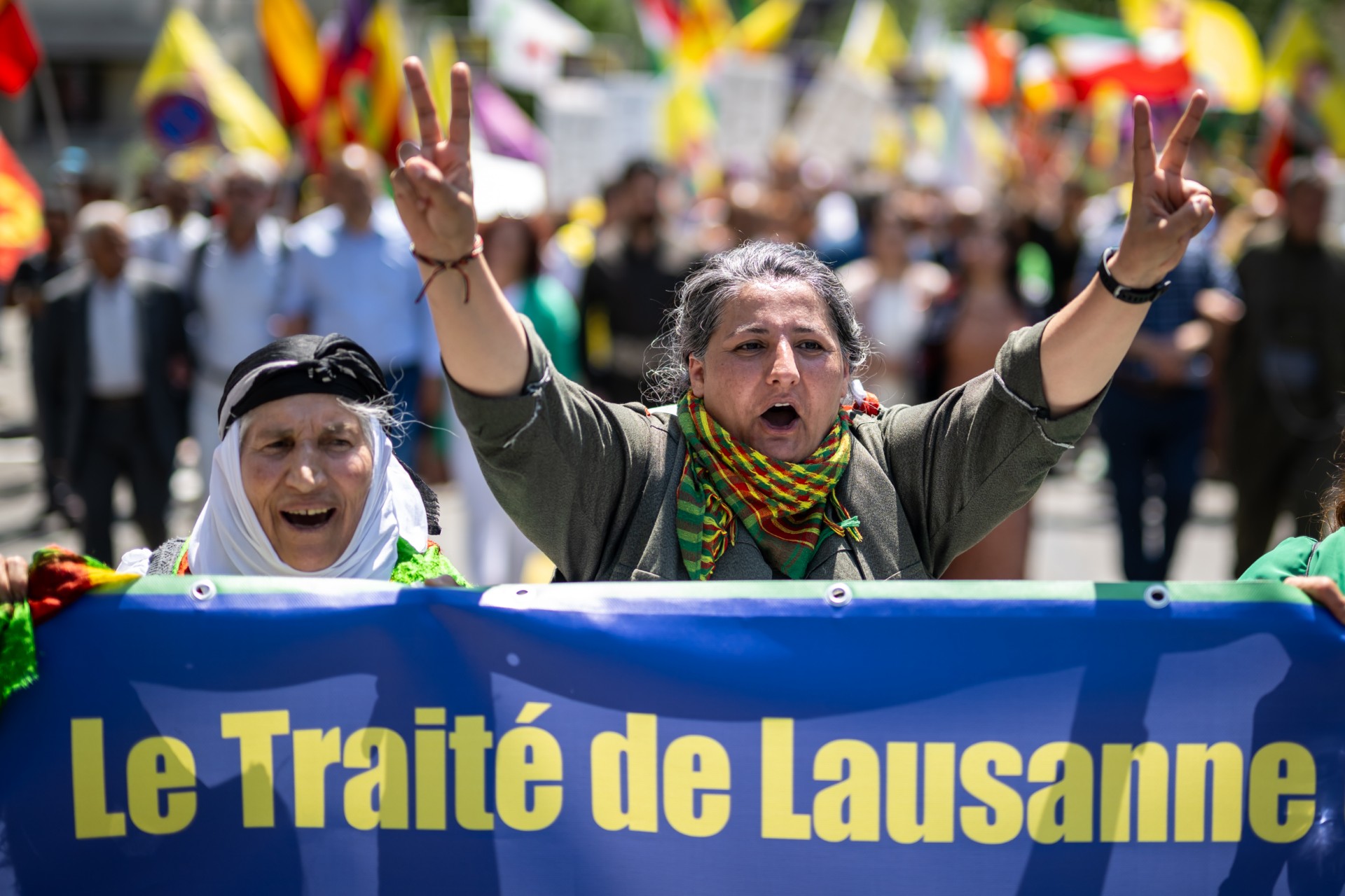

Lausanne, Switzerland– Around 6,000 Kurds rallied on Saturday to demonstrate against the 100th anniversary of the Treaty of Lausanne which defined the borders of modern Turkey but shattered aspirations for a Kurdish state.
The demonstrators marched through the Swiss city in opposition to the 1923 treaty, while organisers urged the international community to reconsider the agreement and its consequences for the Kurdish people.
The demonstrators, who came from across Europe, gathered by Lake Geneva before marching uphill to the Palais de Rumine where the treaty was signed.
Several carried flags representing the Kurdistan Workers’ Party (PKK), which is outlawed in Turkey and blacklisted as a terror organisation in the European Union.
The Kurdistan Cultural Centre in Lausanne said the treaty “enacted the separation of the Kurdish people between four states — Turkey, Iraq, Iran and Syria — whose democratic record over the past century is largely negative”.
Berivan Firat, a spokeswoman for the Kurdish Democratic Council of France, told AFP: “The Kurdish people, like all the peoples of the world, claim a right to be able to live with their identity on their own lands.
“This treaty opened the door to all sorts of bullying, all sorts of massacres towards the Kurdish people,” she said.
“Our detractors are the worst dictators in the Middle East and it is time to decriminalise the Kurdish movement and especially to review the Treaty of Lausanne, which has no value for us. It is null and void.”
Months of talks
The Conference of Lausanne opened in November 1922 to negotiate a new agreement to replace the 1920 Treaty of Sevres between the Allies and the Ottoman empire, which Turkey no longer recognised under its new leader Mustafa Kemal Ataturk.
Lausanne was chosen primarily due to Swiss neutrality, but also because it was easily accessible by the Orient Express train which linked Paris with Istanbul.
The conference, with Britain, France, Italy and Turkey as the main players, ran from November to February, and again from April to July. The new Italian leader Benito Mussolini addressed the talks.
The treaty resulted in forced population exchanges between Turkey and Greece. It allowed for unrestricted civilian passage through the Turkish Straits.
Eastern Anatolia became part of modern-day Turkey; in return, Turkey gave up its Ottoman-era claims to Syria and Iraq to the south.
Armenians and Kurds played no part as their territorial ambitions were dashed.
“Lausanne is synonymous with betrayal, with deep trauma for these peoples. And it still lasts today,” historian Antoine Fleury, professor emeritus of the University of Geneva, told Switzerland’s ATS news agency.
Plea for apology
“We demand an apology from Lausanne, which divided Kurdistan into four parts,” said protester Munevver Gok, 56, a housewife living in the Netherlands.
Fellow demonstrator Kardo Lucas Larsen, 41, who lives in Denmark, told AFP: “a protest like this joins the Kurdish people together and this gives us the feeling like a nation.
“We can stay strong… and then we can decide about our future.”
Switzerland’s Turkish community is planning its treaty commemorations in October around the 100th anniversary of the Turkish republic, with concerts and conferences.