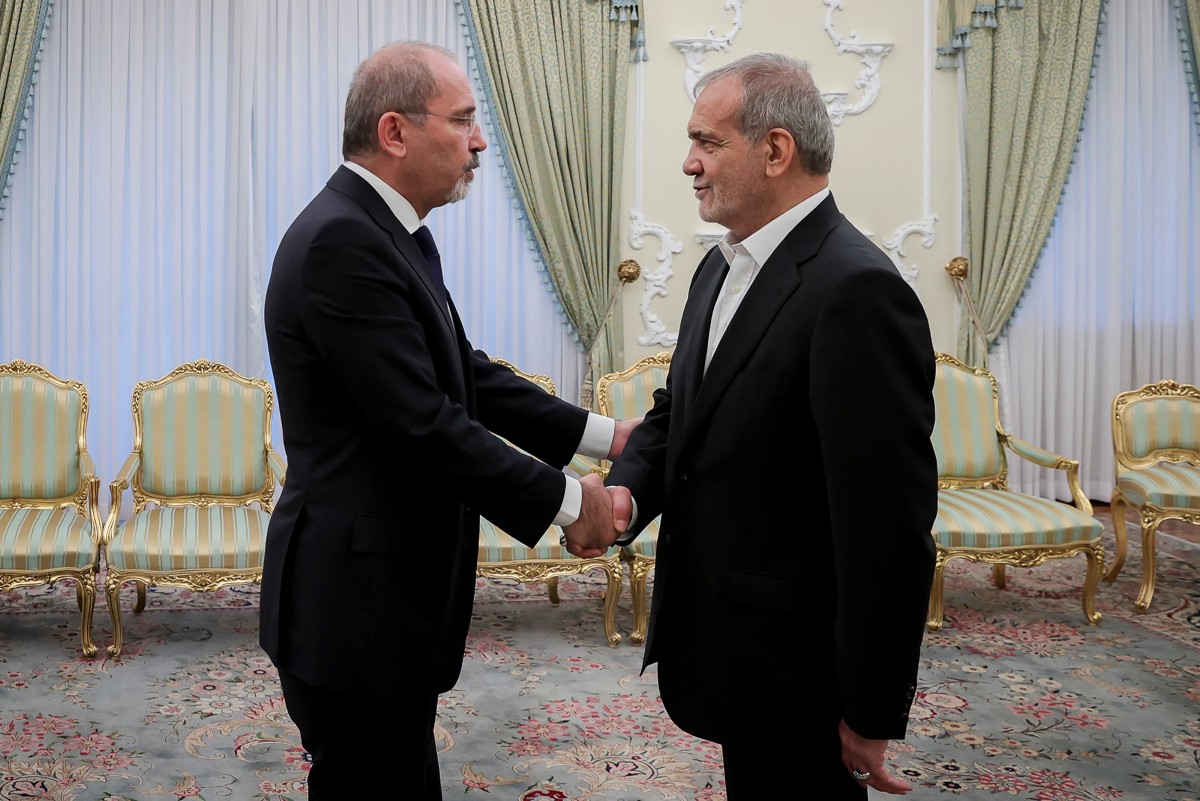

Tehran, Iran – Jordan’s Foreign Minister Ayman Safadi held talks Sunday during a rare visit to Iran, as fears of an escalation between Tehran and Israel grew following the killing of Hamas chief Ismail Haniyeh.
The political head of Palestinian group Hamas was killed early on Wednesday in Tehran, where he had attended the inauguration of Iran’s President Masoud Pezeshkian.
Iran and the Hamas, which Tehran supports, vowed to retaliate and blamed the strike on Israel, which has declined to comment.
ISNA news agency said Safadi “met and held consultations with” acting foreign minister Ali Bagheri after landing in Tehran.
Jordan’s top diplomat then met Pezeshkian, who said Haniyeh’s killing was a “grave” and “brazen” act by Israel and vowed anew to avenge his death, the official news agency IRNA reported.
Earlier, IRNA said Safadi would “exchange views with Iranian officials on regional and international issues” during his visit.
The Jordanian foreign ministry said Safadi would deliver a message from King Abdullah II to the Iranian president on “the situation in the region and bilateral relations”.
The royal court in Amman meanwhile said that King Abdullah had received a phone call from French President Emmanuel Macron “which covered the dangerous situation in the region”.
The king appealed for “further international efforts to reach comprehensive calm and prevent a regional expansion of the conflict”, a statement said.
Iran has held talks with multiple Arab countries including Jordan, Egypt, Oman and Qatar among others since Haniyeh’s killing.
Tehran repeatedly reaffirmed its “inherent right” to take action against Israel.
Israeli Prime Minister Benjamin Netanyahu says his country is at “a very high level” of preparedness for any scenario — “defensive and offensive”.
Haniyeh’s killing came hours after Israel killed a senior commander of the Lebanese Tehran-backed Hezbollah group, Fuad Shukr, whom Israel blamed for a weekend rocket strike which killed young people on the Israeli-annexed Golan Heights.
Iran’s Revolutionary Guards have said Haniyeh was killed by a “short-range projectile” launched from outside his accommodation in Tehran.
Israeli military spokesman Daniel Hagari had earlier told journalists “there was no other Israeli aerial attack… in all the Middle East” on the night Shukr was killed in Lebanon.
The dual killings are the latest of several major incidents that have inflamed regional tensions during the Gaza war, which has drawn in Iran-backed groups in Syria, Lebanon, Iraq and Yemen.