
Dubai, UAE — Arabian Travel Market (ATM) 2026 concluded Thursday at Dubai World Trade Centre after a four-day run that drew travel buyers from more than 115 countries, six co-located Best Stand Awards, and a string of major industry announcements — capping an edition that had already been rescheduled twice before finally taking place.
The 33rd edition, held under the theme “Travel 2040: Driving New Frontiers Through Innovation and Technology,” saw the launch of Visit UAE, the country’s first unified national tourism brand, alongside the UAE Grand Tour digital platform mapping a single route through the seven emirates.
Deals signed
Emirates signed 11 memoranda of understanding during the show, while Rotana unveiled a pipeline of 40 hotels and more than 8,300 keys, ten of them in Saudi Arabia.
Etihad Airways and Etihad Rail signed an MoU to explore a seamless air-rail travel experience, and Mastercard and Trip.com showcased AI booking agent TripGenie, developed with Network International.
Separately, a consortium of Air Arabia Group, Nesma Group and KUN Holding Company said a new Saudi airline would begin flying between Dammam and Riyadh, Madinah and Jeddah from 20 September.
“There was a tangible sense of confidence and optimism throughout this year’s edition, as exhibitors capitalised on opportunities to fill their Q4 sales pipelines,” said Danielle Curtis, Regional Portfolio Director – UAE at organiser RX Global, adding that floorspace dedicated to technology doubled with the debut of the co-located ATM Travel Tech show. Preparations for ATM 2027, set for 3–6 May, are already underway.
A show that almost didn’t happen this year
ATM’s path to September was not straightforward. The event was originally slated for 4–7 May, then pushed to 17–20 August as organisers cited the need to “prioritise the safety and well-being of customers, partners and colleagues” amid a difficult year for regional travel, before shifting again to its final 14–17 September window following further consultation with exhibitors and stakeholders.
The disruption tracked a difficult year for Gulf tourism more broadly: Dubai’s sector has been working to recover from the fallout of the Iran war, which rattled regional aviation and insurance markets.
That recovery was visible in the numbers by the time ATM opened. Dubai recorded 869,000 international overnight visitors in August — the highest monthly tally since February — with hotel occupancy climbing to 66%, up from just 36% in March. Issam Kazim, CEO of the Dubai Corporation for Tourism and Commerce Marketing (DCTCM), told Bloomberg during the period that the emirate was pushing to have travel advisories lifted altogether.
“We’re trying to remove Dubai and the UAE from the travel advisories,” he said, arguing that doing so would ease insurance costs and encourage international carriers to resume services.
Airlines have faced higher operating and insurance expenses through the conflict, forcing Dubai to lean on local residents, incentives and visitor programmes to prop up demand in the interim.
Against that backdrop, Kazim struck a more assured note at the close of ATM itself, calling the show “an invaluable platform for the global travel and tourism industry to come together in Dubai” and pointing to strong participation from both local and international stakeholders as evidence of continued confidence in the city’s tourism proposition.
Best Stand Awards reward function over flash
An independent panel — Danielle Azzi Sleiman of DWTC, Dave Goodger of Tourism Economics, Piers Kelly of RX Global and Sarah Duignan of STR — handed out six Best Stand Awards this year, favouring exhibitors who paired visual impact with business functionality.
The Dubai Department of Economy and Tourism took Best Stand Design (over 150sqm) for a three-tier layout built to handle heavy meeting volume without losing its welcoming feel. Rove Hotels won the 50–150sqm category for a “bold, playful design,” complete with television-inspired staff costumes, while Agilysys claimed the under-50sqm award for maximising a compact footprint with contemporary, unconventional styling.
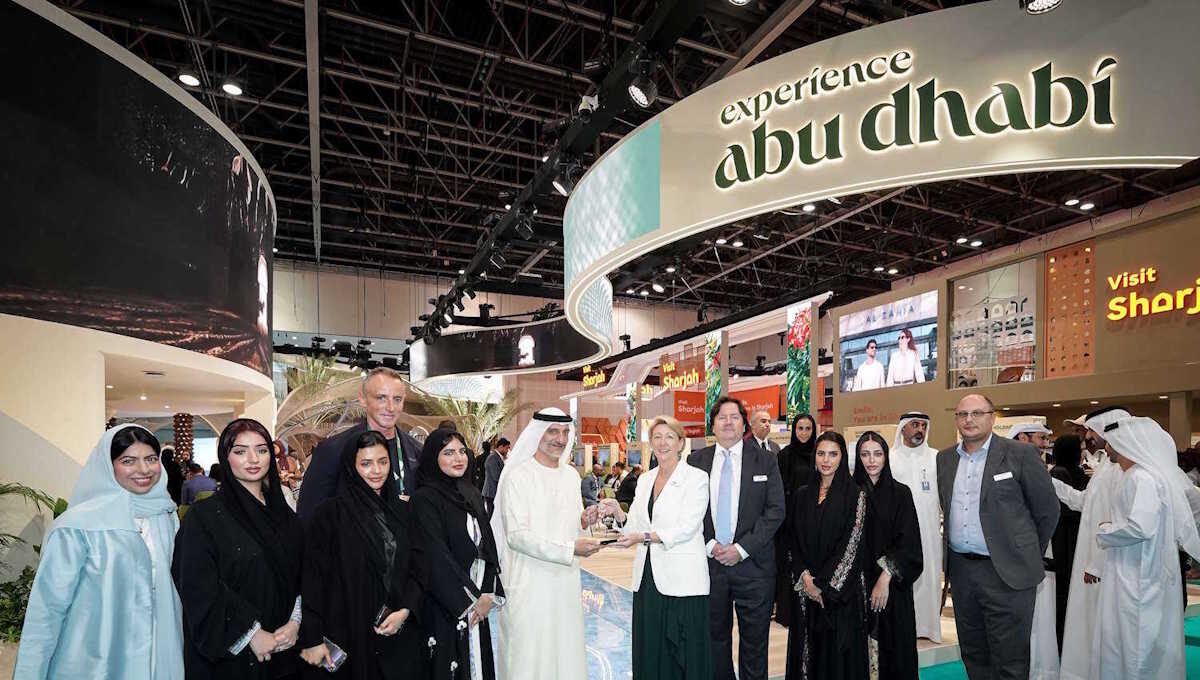
Marriott was named Best Stand for Doing Business after recreating the atmosphere of its hotel lobbies for meetings on the show floor, and the Department of Culture and Tourism – Abu Dhabi won Best Stand Feature for an interactive dune-buggy activation and displays of Emirati craftsmanship. At the co-located ATM Travel Tech, HBX Group took the Best Use of Technology award for a stand built around suspended technological features.
“The standard of this year’s stands has been exceptional,” Curtis said, “with exhibitors thinking carefully about how their presence at ATM can create an engaging visitor experience while supporting meaningful business conversations.”
The Asia-GCC corridor emerges as the next growth story
Beyond the stands, ATM’s Global Stage sessions pointed to where the region’s next wave of visitors may come from. Oxford Economics data presented at the show showed 164.8 million overnight guests travelled from Asia into GCC countries in 2025 — up 161% on 2019, a period that included the pandemic.
“There has been significant growth from key source markets like India… [and] 10% growth from China during that period,” said Aaron Goldring, Senior Economist at Oxford Economics.
Panellists credited visa liberalisation for much of that momentum. Shahab Abdollah Shayan of the Dubai Department of Economy and Tourism described removing visa barriers for Chinese travellers in 2016 and later rolling out Alipay and WeChat Pay acceptance across the city, so that visitors need “just their passport and their phone.”
The traffic runs both ways: Waad Melliti of the World Tourism Cities Federation said China’s 2018 visa-free access for all six GCC states helped push GCC arrivals into China past 150,000 in 2025, a 100% year-on-year increase, with Saudi and UAE arrivals up 110% and 113% respectively. Frederic Brohez of Pulse Hotels & Resorts framed the opportunity in product terms, saying operators are chasing “experiential holidays” as traveller expectations shift across both regions.
Germany leans on its GCC partnerships
Among the destination stands, the German National Tourist Office (GNTO) used ATM to reaffirm its long-term GCC strategy, citing 1.2 million overnight stays and €3 billion in spending from Gulf visitors in 2025.
Joined by Lufthansa Group, Munich Airport, Studiosus Incoming, Value Retail Management and Visit Berlin, GNTO pitched Germany as a year-round destination spanning seasonal campaigns from Christmas markets to culinary tourism.
“Confidence and flexibility are becoming increasingly important when planning international travel,” said Yamina Sofo, Director of GNTO’s GCC marketing office, pointing to demand for “clear information, dependable connections and greater ease throughout the planning process.”
With ATM 2026 now closed, the show’s twin narratives — a hard-won recovery for Dubai’s own tourism sector and a fast-opening Asia-GCC corridor — are likely to shape how exhibitors plan for the next edition, due back at DWTC in May 2027.