
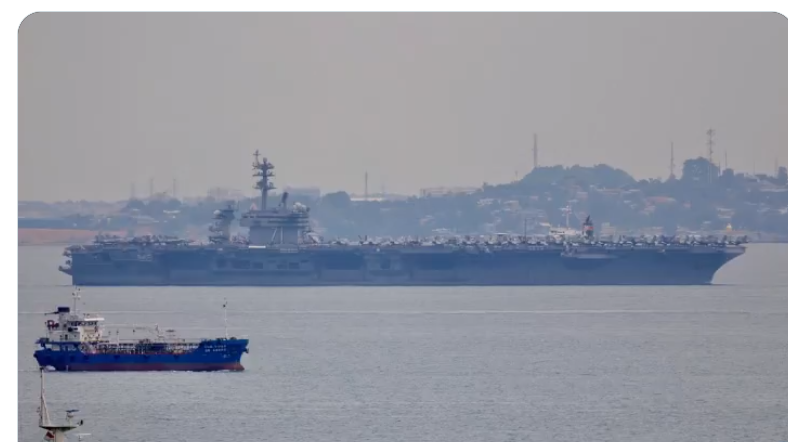

The USS Theodore Roosevelt has arrived in the Middle East, joining two other US aircraft carriers operating in the US Central Command (CENTCOM) area of responsibility, as tensions escalate across the region with Iran reporting explosions aboard two oil tankers in the Strait of Hormuz and Yemen’s Houthis claiming territorial advances.
The arrival of the aircraft carrier was confirmed by a US official speaking to Al Jazeera, although no further details were provided about its deployment or operational mission.
The developments come amid continuing military confrontation, a US naval blockade of Iranian ports and growing instability around key maritime routes, including the Strait of Hormuz and the Bab al-Mandeb.
IRGC reports explosions aboard two tankers in Hormuz
Iran’s Islamic Revolutionary Guard Corps (IRGC) Navy said two oil tankers transiting the southern route of the Strait of Hormuz without its permission struck sea mines and exploded.
According to Iran’s Fars News Agency, the vessels were using the southern route under the protection of US aircraft when the explosions occurred.
The IRGC Navy said the incidents were a response to the US naval blockade of Iranian ports and violations of Iranian rules governing passage through the strategic waterway.
It warned that vessels failing to comply with its instructions would be “firmly dealt with”, signalling that maritime traffic through the strait remains vulnerable despite the recovery in shipping movements.
Separately, the UK Maritime Trade Operations (UKMTO) agency reported an incident about 430 nautical miles east of Yemen’s Socotra island in the Indian Ocean.
Four armed men were reportedly aboard a skiff, with a ladder also visible. UKMTO advised vessels transiting the area to exercise caution and report suspicious activity as authorities investigated.
Houthis claim Bab al-Mandeb control, advance towards Aden
Yemen’s Iran-aligned Houthis said they had taken control of the Bab al-Mandeb Strait, a strategically important shipping passage connecting the Red Sea with the Gulf of Aden.
The group’s Al Masirah television, quoting a military source, said Houthi fighters had repelled pro-government forces from the area.
The Houthis also claimed to have pushed Yemeni government fighters beyond the Kharaz district in southern Lahij governorate and targeted the Qa’wah camp with six missiles.
The claims came after forces affiliated with Yemen’s internationally recognised government said on Sunday they were withdrawing from territory near Bab al-Mandeb to concentrate on defending Aden, the interim capital, against the Houthi advance.
The group’s advances are also threatening government positions around Taiz, one of Yemen’s largest cities and a key stronghold of armed opposition to the Houthis.
Houthi-affiliated media separately reported air strikes on Hodeidah airport on the Red Sea coast and the Hijat al-Abd area in Taiz governorate.
The United Nations refugee agency has warned that fighting is approaching a camp housing about 9,600 people in Lahij.
In a separate development, Houthi authorities released 600 conflict-related detainees, according to the International Committee of the Red Cross.
Oil prices fall as regional exports recover
Oil prices declined on Monday amid expectations of a global supply surplus, with shipments through the Strait of Hormuz approaching pre-war levels despite continuing attacks on shipping.
Brent crude futures fell 54 cents, or 0.6 percent, to $95.30 a barrel by 0427 GMT.
The International Energy Agency said on Friday that the global oil market was expected to return to a surplus in the fourth quarter of this year.
Lower Chinese refinery throughput in October also pointed to weakening crude demand, adding to pressure on prices.
US and Iranian officials exchange warnings
US Treasury Secretary Scott Bessent predicted that Iran’s economy would contract by 25 percent between March 2026 and March 2027 as Washington maintains its sanctions campaign against Tehran.
Speaking to Fox News, Bessent described the administration’s Operation Economic Outcast, launched in August, as the greatest economic isolation imposed on a single country.
Former US ambassador to the United Nations Nikki Haley urged Middle Eastern allies to support Washington’s efforts to end the war, arguing that regional partners benefited from US control of the Strait of Hormuz.
Former US Vice President Mike Pence, meanwhile, argued that Republicans had lost the midterm elections not because Washington went to war with Iran but because it stopped its military campaign prematurely.
Iranian Foreign Minister Abbas Araghchi also criticised US Secretary of State Marco Rubio, invoking a Roman general’s defeat to suggest that Washington could face a similar outcome despite its military superiority.
Gaza humanitarian crisis deepens
The humanitarian situation in Gaza remained dire, with the territory’s Health Ministry reporting four additional deaths on Sunday, taking the Palestinian death toll since the October 11, 2025, ceasefire to 1,647.
The ministry said 5,969 people had been injured and 850 bodies recovered over the same period.
Australia, Canada, Italy and the United Kingdom urged Israel to allow immediate and unimpeded humanitarian access throughout Gaza, warning that severe weather and flooding had compounded the suffering of Palestinians.
Australian Foreign Minister Penny Wong said heavy rain and winter conditions were worsening an already critical humanitarian situation.
Separately, the Gaza Government Media Office condemned an Israeli attack on a civilian checkpoint on October 28 that killed several employees of the Ministry of National Economy.
It said the checkpoint had been responsible for regulating truck movements and protecting the safe passage of goods, accusing Israel of deliberately targeting civilian infrastructure and disrupting essential supply chains.
Iraq’s President Nizar Amedi also urged US President Donald Trump to honour his campaign pledge to end wars, saying Washington should formally bring the conflict with Iran to an end.