
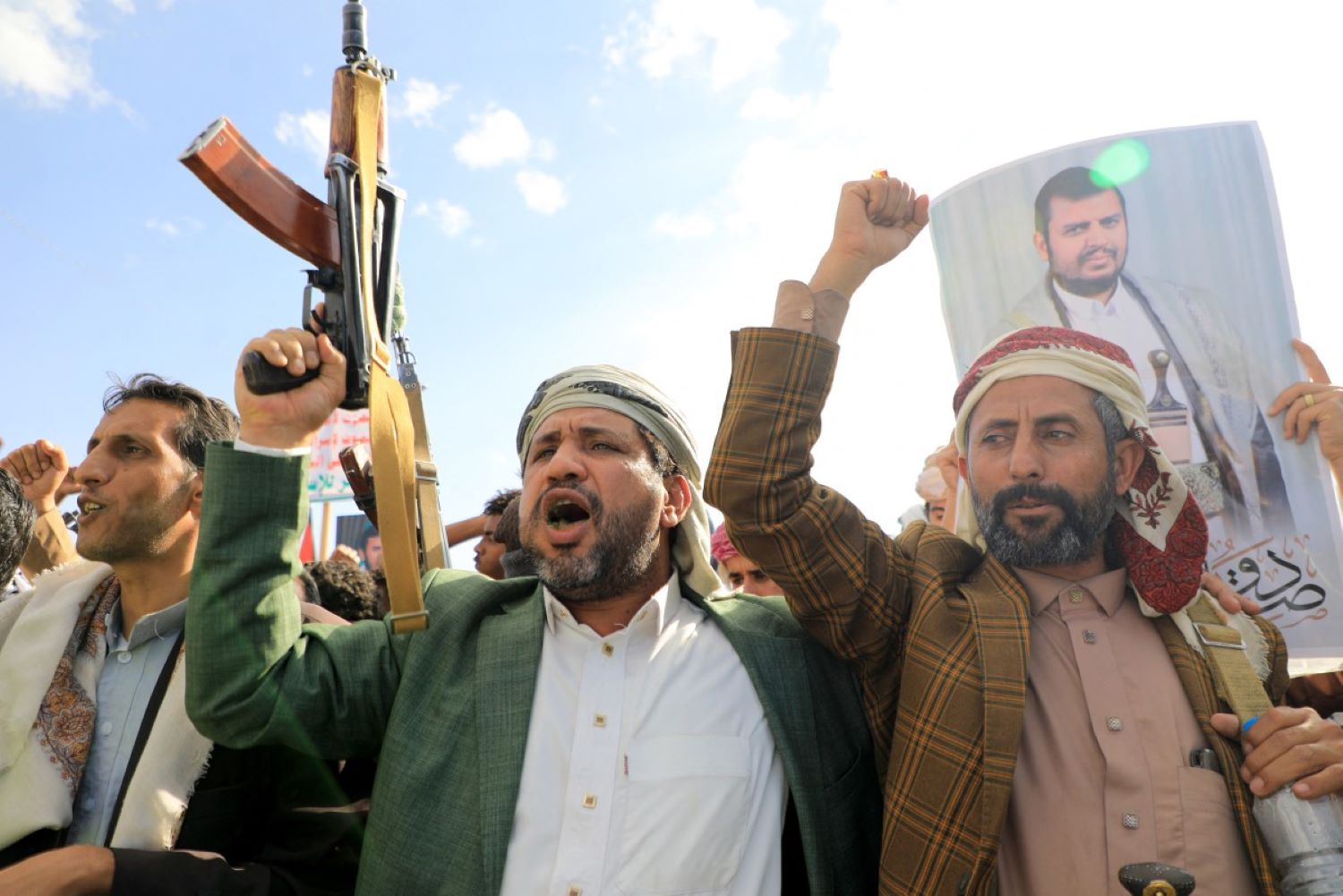

Yemen’s internationally recognised government is facing mounting military pressure as Houthi forces advance towards Aden after government-aligned troops withdrew from positions overlooking the strategic Bab al-Mandeb Strait.
The developments come amid escalating tensions between Iran and the United States, including reports of tanker fires in the Strait of Hormuz, a US aircraft carrier deployment in the Middle East and renewed diplomatic efforts to end the conflict.
Houthis gain ground near Bab al-Mandeb
Government forces said they had withdrawn from Dhubab airport and territory near Bab al-Mandeb to reinforce the defence of Aden, the interim seat of the internationally recognised government.
The withdrawal has left the Iran-aligned Houthis in control of an area overlooking the strategic waterway, which connects the Red Sea to the Gulf of Aden. Houthi forces have also advanced in parts of southern Yemen, including areas in Taiz and Lahij.
The International Organization for Migration said at least 348,000 people had been displaced in fighting between Saudi-backed government forces and the Houthis since August 1. The agency revised its figures after recording the displacement of 18,780 people between November 8 and 14.
Saudi Arabia has replaced the commander overseeing its coalition forces in Yemen. King Salman appointed General Fayyad al-Ruwaili to the command, according to Saudi state media. Lieutenant General Fahd bin Hamad al-Salman, who was removed from the position, was appointed military adviser to the Saudi defence minister.
The Houthis have claimed that Saudi forces launched 88 air strikes and missile attacks in 24 hours against Sanaa and several governorates, including Saada, Taiz, Lahij, al-Jawf and Marib. The group also claimed civilian casualties. These claims have not been independently verified.
Tanker incidents raise Hormuz concerns
In the Strait of Hormuz, Iran’s navy said a fourth tanker had caught fire after colliding with a sea mine. It said the vessel was navigating in a restricted area east of the strait with its navigation systems switched off.
Iran has warned vessels against entering areas it considers unauthorised and said ships must coordinate with its armed forces to ensure safe passage.
The UK Maritime Trade Operations agency separately reported that a tanker had been attacked seven nautical miles off Khasab, Oman. All crew members were accounted for, while the extent of damage remained unknown.
The incidents came as the Islamic Revolutionary Guard Corps said it had seized a US MQ-170 drone near Qeshm Island following what it described as an electronic warfare operation.
US carrier deployment and diplomatic efforts
The US military confirmed that the aircraft carrier USS Theodore Roosevelt was operating in the Central Command area of responsibility as part of a scheduled deployment. Iran said the carrier’s arrival reinforced its view that Washington was not serious about pursuing peace and was building up forces for a possible new confrontation.
Iranian Foreign Minister Abbas Araghchi travelled to Muscat for talks with his Omani counterpart after attending an Economic Cooperation Organization meeting in Islamabad. He said the organisation had welcomed Tehran’s proposal for a two-day ceasefire.
US Vice President JD Vance said there was no disagreement between him and President Donald Trump over Iran. He acknowledged the political cost of higher energy prices but said the conflict would not become a “forever war”.
Meanwhile, Iran’s Foreign Ministry spokesman Esmaeil Baghaei criticised US policy, saying it undermined international order and allowed powerful countries to exempt themselves from accountability.
Iran is also facing warnings of winter gas shortages. Its government has forecast a peak-demand deficit of about 430 million cubic metres per day, with damage from US and Israeli strikes adding to longstanding problems caused by ageing infrastructure, underinvestment and sanctions.