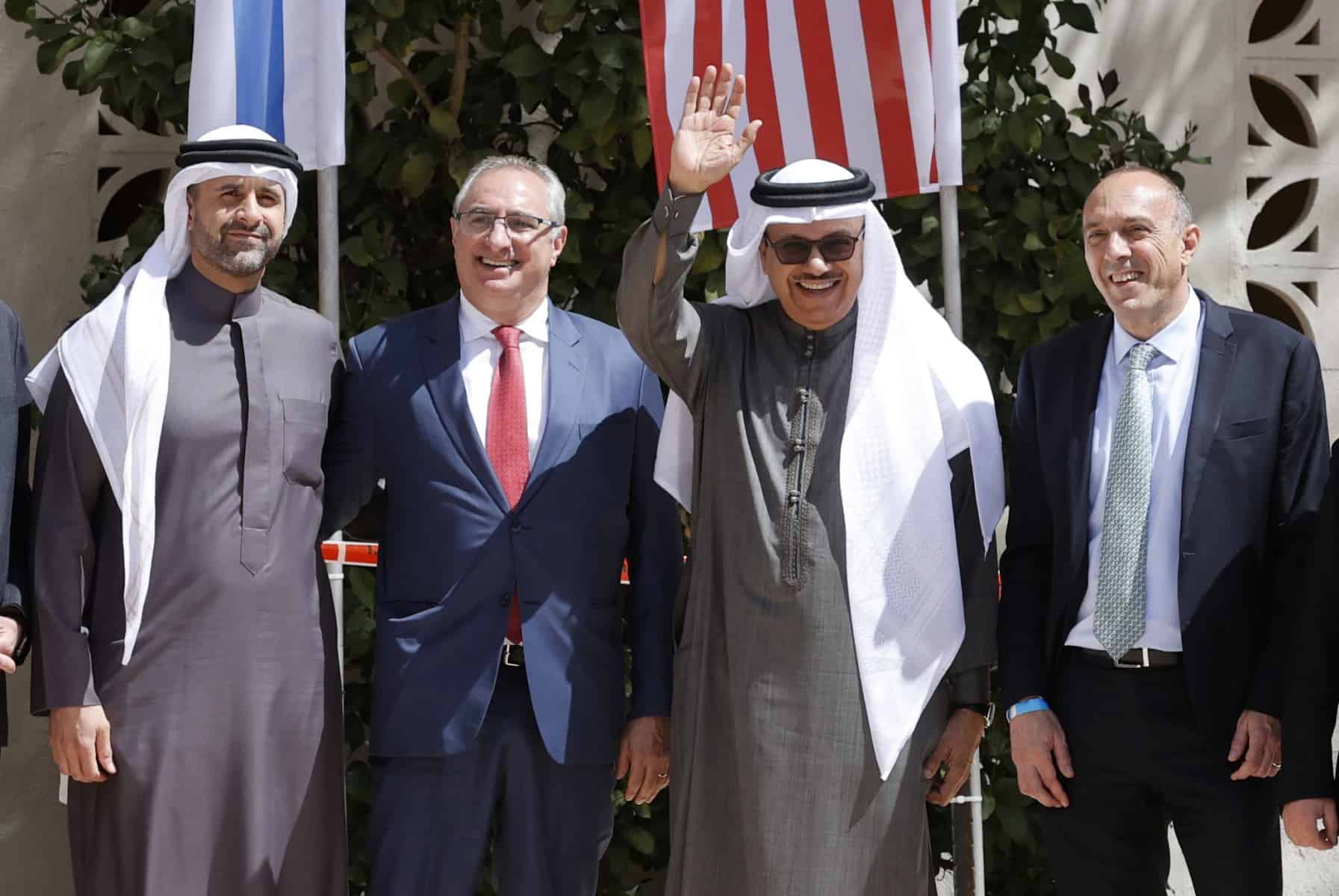

The deepening alliance between Israel and several Arab states “intimidates and deters” Iran, Israel’s Foreign Minister Yair Lapid said Monday as he hosted an unprecedented meeting with four Arab foreign ministers.
The talks in Israel’s Negev desert, joined by US Secretary of State Antony Blinken, came as signals mount that a 2015 agreement on Iran’s nuclear program — opposed by Israel and several Arab states — will soon be restored.
Lapid made the comments alongside the top diplomats of the US as well as the United Arab Emirates, Morocco and Bahrain — which established full ties with Israel in 2020 — and Egypt, which recognized Israel in 1979.
“This new architecture, the shared capabilities we are building, intimidates and deters our common enemies — first and foremost Iran and its proxies,” Lapid said.
“They certainly have something to fear.”
UAE and Bahrain formed ties with Israel under the Abraham Accords, brokered by former US President Donald Trump. Morocco then re-established relations with Israel under a separate Trump-brokered agreement.
Israeli leaders have argued that the normalizations highlight a changed Middle East, where Arab leaders are no longer compelled to keep a distance from Israel so long as its conflict with the Palestinians remains unsolved.
The Abraham Accords infuriated the Palestinians, who argued that they marked a betrayal of a decades-old Arab League consensus against dealing with Israel until it agreed to the establishment of Palestinian state, with its capital in east Jerusalem.
Blinken has voiced strong support for the Abraham Accords, negotiated by the previous US administration, but cautioned at the Negev meeting that they cannot replace Israeli-Palestinian peace-building.
The gains brought about by the Abraham Accords “are not a substitute for progress between Palestinians and Israelis,” Blinken told reporters.