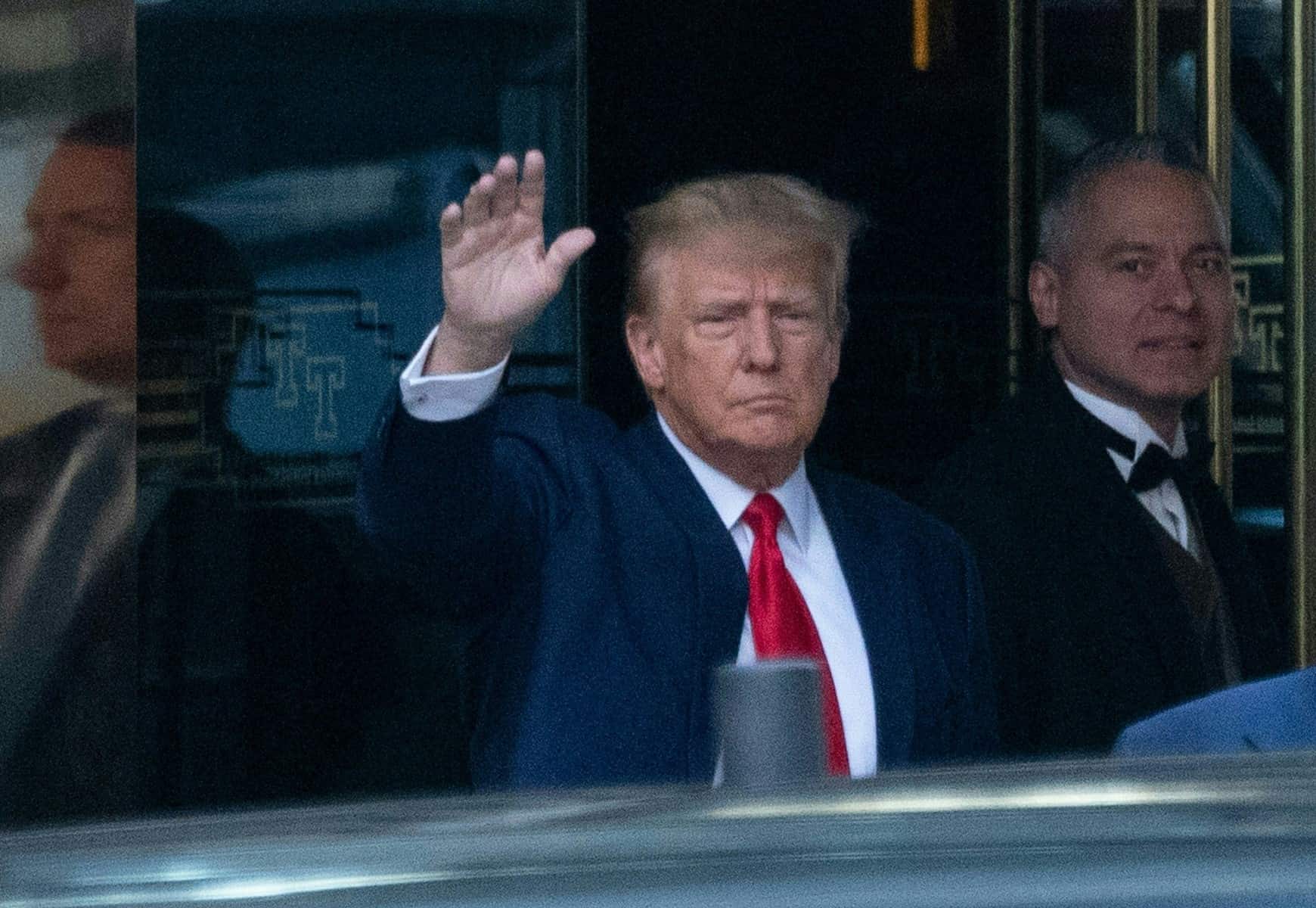

US President Donald Trump has claimed that Iran is in a “state of collapse” and said Tehran has approached Washington seeking relief from the US blockade on Iranian ports.
Speaking amid escalating tensions, Trump said Iran wanted the restrictions removed “as soon as possible”. The remarks come as Washington continues its maximum pressure campaign against Tehran, targeting its economy, trade routes and oil exports.
Trump did not provide evidence for his claim about Iran’s condition or specify whether any formal negotiations were underway. However, the statement signals continued US efforts to portray sanctions and maritime restrictions as having a severe impact on the Iranian economy.
The comments were made as regional powers, including Gulf states, gathered in Saudi Arabia to discuss security threats and economic fallout linked to the ongoing conflict.
Gulf leaders urge Iran to rebuild trust after regional attacks
Leaders of the Gulf Cooperation Council (GCC) met in Saudi Arabia and called on Iran to take urgent steps to restore regional confidence following recent attacks.
In a joint message after talks in Jeddah, Gulf leaders said Iran must take “the initiative to make serious efforts to rebuild confidence” after what they described as “treacherous” attacks on the region.
The extraordinary summit marked the first in-person meeting of GCC leaders since the beginning of the war involving Iran. Key discussions focused on regional security, missile and drone threats, and the closure of the Strait of Hormuz.
Officials also examined the broader economic impact of disruptions to Gulf exports, with member states heavily dependent on the strategic waterway for shipping oil, gas and other critical commodities.
The summit reflected growing concern among Gulf capitals over instability and the risk of prolonged conflict.Lebanon condemns Israeli strike that killed emergency workers
Israel has killed three emergency workers in southern Lebanon in an attack strongly condemned by Lebanese authorities.
Lebanese President Joseph Aoun described the strike as a “war crime”, accusing Israel of targeting personnel engaged in humanitarian duties.
The incident is likely to heighten already severe tensions along the Lebanon-Israel frontier, where cross-border hostilities have intensified in recent months.
Emergency responders have increasingly faced danger while operating in conflict zones, drawing criticism from international rights groups and humanitarian organisations.
Lebanon has repeatedly called for international intervention to halt Israeli strikes and ensure civilian and humanitarian protections.
The United Arab Emirates has announced it will leave OPEC on Friday, bringing to an end nearly 60 years of membership in the oil-producing alliance.
The UAE, currently OPEC’s third-largest producer and the world’s seventh-largest oil producer, said the decision was made “in terms of its long-term strategic and economic vision”.
Abu Dhabi also signalled plans to gradually raise output from around 3.6 million barrels per day to 5 million barrels per day by 2027.
The move is expected to have major implications for global oil markets and the future balance within OPEC, which has long coordinated production levels among member states.
The announcement came as Gulf leaders met in Saudi Arabia to discuss regional security and economic stability.
Panama Canal traffic rises as vessels avoid Strait of Hormuz
The number of ships transiting the Panama Canal has risen sharply as commercial vessels reroute to avoid the Strait of Hormuz amid the conflict involving Iran.
Victor Vial, finance chief of the Panama Canal Authority, said around 300 additional ships had passed through the canal since October compared with the same period last year.
“The expectation is that this will continue until the situation in the Middle East is resolved,” Vial said at a meeting, according to Reuters.
The increase follows the closure of the Strait of Hormuz, a crucial maritime chokepoint near Iran’s coast. Many vessels carrying cargoes have been forced to seek alternative routes or source goods from different countries.
Transit costs through the canal typically range between $300,000 and $400,000 depending on vessel size. The Associated Press reported some ships are paying up to $425,000 in extra charges for last-minute passage slots.
The surge highlights how regional conflict is disrupting global shipping patterns and increasing transport costs.
Iran accuses US of ‘piracy’ over vessel seizures in UN protest
Iran has formally protested to the United Nations over the seizure of Iranian vessels by the United States, calling the actions illegal and amounting to piracy.
Iran’s UN envoy, Amir Saeid Iravani, sent a letter to the UN secretary-general and president of the Security Council condemning the measures.
“Reliance on domestic arrangements, which are inherently illegal, can under no circumstances justify such an abhorrent crime committed through the use of force,” he said in the letter, according to the semi-official Tasnim news agency.
“Such behaviour constitutes illegal coercion, interference in lawful international trade, and the unlawful seizure of property. Simultaneously, it sets a dangerous precedent that severely undermines the international rule of law,” Iravani added.
Tehran has consistently argued that US maritime enforcement actions violate international law and threaten global trade norms.
Trump says King Charles agrees Iran must never get nuclear weapon
US President Donald Trump said Britain’s King Charles III shares his view that Iran must not be allowed to obtain a nuclear weapon.
Speaking at a state dinner at the White House while hosting the British monarch, Trump referred to the ongoing conflict with Iran.
He said his administration was “doing a little Middle East work right now” and claimed the situation was “going very well”.
“We have militarily defeated that particular opponent, and we’re never going to let that opponent ever – Charles agrees with me even more than I do – we’re never going to let that opponent have a nuclear weapon,” he added.
The remarks are likely to attract attention both for their diplomatic implications and for invoking the British monarch in a contentious geopolitical dispute.
US says blockade hurting Iran’s oil exports and economy
US Treasury Secretary Scott Bessent has said Washington’s sanctions and blockade measures are severely damaging Iran’s economy and oil sector.
“The Treasury Department, through Economic Fury, has targeted Iran’s international shadow banking infrastructure, access to crypto, shadow fleet, and weapons procurement networks,” Bessent said in a post on X.
He said the measures also targeted funding routes linked to Iranian regional allies and “independent Chinese ‘teapot’ refineries that support Iran’s oil trade”.
According to Bessent, “these actions have disrupted tens of billions of dollars in revenue that would be used to fund” the Iranian government.
He further claimed that “Tehran’s inflation has doubled and its currency has rapidly depreciated.”
Bessent added that the US blockade on Iranian ports was restricting exports.
“Kharg Island, Iran’s primary oil export terminal, is soon nearing storage capacity, which will force the regime to reduce oil production,” he said.
He said this was causing “an additional approximately $170 million per day in lost revenue and causing permanent damage to Iran’s oil infrastructure”.
Trump dissatisfied with Iran peace proposal that delays nuclear talks
US President Donald Trump has expressed dissatisfaction with Iran’s latest proposal aimed at ending the conflict and reopening the Strait of Hormuz, according to multiple media reports. The proposal reportedly seeks to pause discussion of Tehran’s nuclear programme until after the war is brought to an end.
However, the White House appears unwilling to separate the two issues. Sources cited by Reuters said Trump believes Iran’s nuclear ambitions must be addressed at the very start of any negotiations. The New York Times reported that Trump told advisers he was not satisfied with the offer, while CNN said the administration is unlikely to approve a deal that lifts pressure on Iran without securing nuclear concessions first.
US officials are said to view the current blockade of Iranian ports as one of Washington’s strongest bargaining tools and are reluctant to give it up prematurely.
Iran Signals Openness to Renewed Talks Amid Diplomatic Push
Iran’s Foreign Minister Abbas Araghchi has indicated that Tehran is considering a US request to resume negotiations, suggesting a possible diplomatic opening despite ongoing hostilities.
Araghchi made the remarks during a high-profile meeting with Russian President Vladimir Putin in St Petersburg, where regional security and the conflict were believed to be central topics. The statement comes as international pressure grows for both sides to de-escalate and return to the negotiating table.
The Iranian proposal reportedly focuses first on ending military operations and restoring maritime trade routes before revisiting the more contentious nuclear issue.
UN Warns Hormuz Closure Could Trigger Global Food Crisis
The United Nations has called for the immediate reopening of the Strait of Hormuz, warning that continued disruption in one of the world’s most important shipping lanes could have severe global consequences.
UN Secretary-General Antonio Guterres said the confrontation between the United States and Iran in the waterway threatens international supply chains, particularly energy and food shipments. Dozens of countries have backed calls for “urgent and unimpeded reopening” of the strait.
The Hormuz route is critical for transporting oil, gas, and essential commodities. Prolonged closure or military confrontation there could push up prices worldwide and destabilise already fragile economies.
War Disrupts Global Electronics Supply Chain
The conflict has also triggered fresh economic fallout, with Reuters reporting sharp increases in the price of printed circuit boards (PCBs), a core component used in nearly all electronic devices.
The spike follows an Iranian strike earlier this month on Saudi Arabia’s Jubail petrochemical complex, which disrupted production of high-purity polyphenylene ether (PPE) resin — a vital raw material used in PCB laminates.
Saudi chemical giant SABIC, which controls roughly 70 percent of global supply of the material, has reportedly not resumed normal output since the attack. As a result, PCB prices surged by as much as 40 percent in April compared with March, according to a Goldman Sachs note cited by Reuters.
The disruption could affect global production of smartphones, computers, automobiles, and consumer electronics in the coming months.
Iran Praises Russia Ties During Crisis
Following talks with President Putin, Foreign Minister Araghchi praised Moscow for standing with Tehran during a period of heightened regional turmoil.
In a post on X, Araghchi said recent developments had demonstrated the strength of the strategic partnership between Iran and Russia. He added that Tehran welcomed Russia’s support for diplomacy and valued its solidarity during the crisis.
The remarks underline the growing alignment between the two countries as tensions with the West deepen and diplomatic efforts intensify.