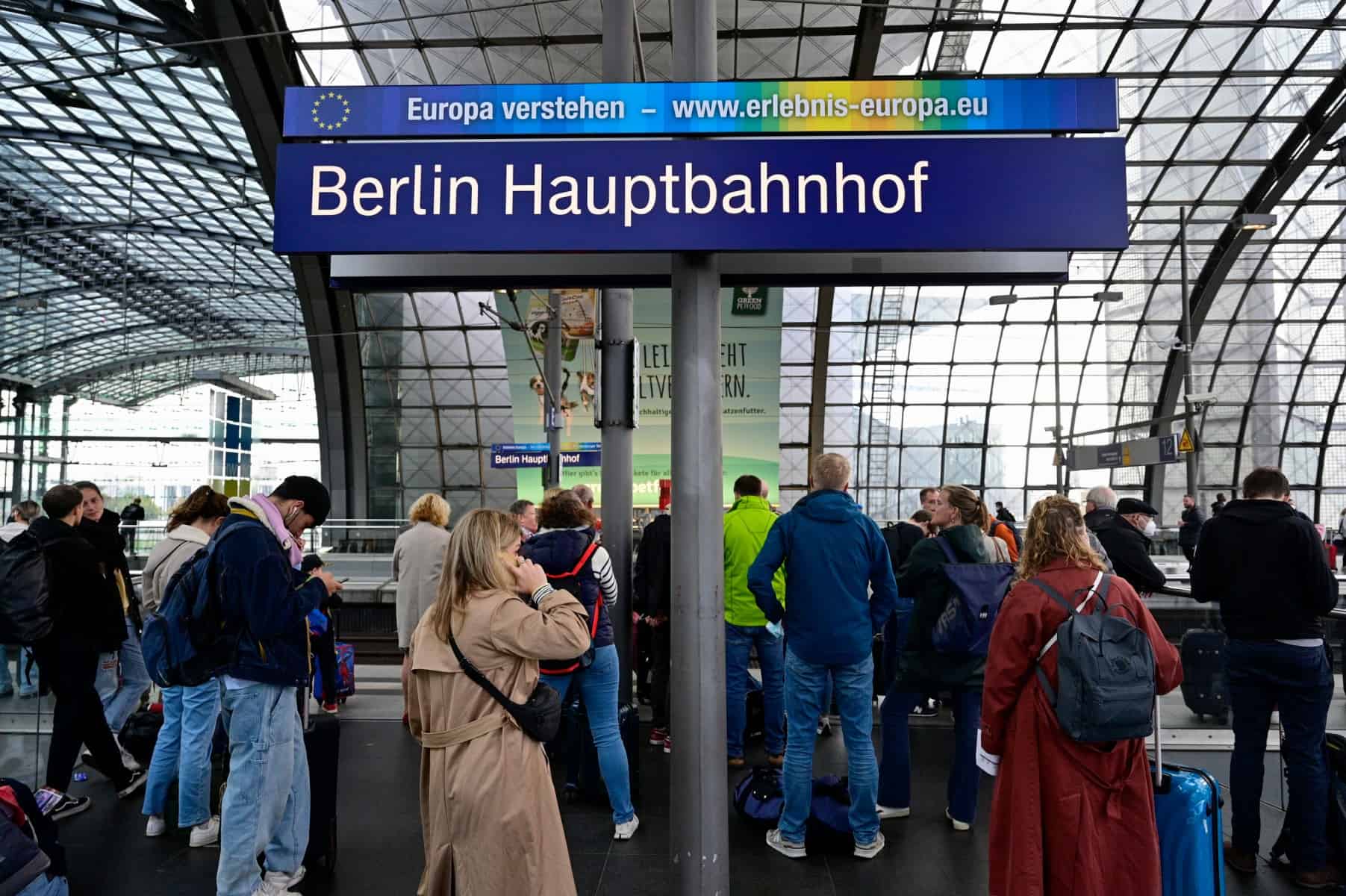

German police were on Sunday probing an act of “sabotage” on the country’s rail infrastructure, with some officials pointing the finger at Russia in the wake of the Nord Stream pipeline explosions.
Important communications cables were cut at two sites on Saturday, forcing rail services in the north to be halted for three hours and causing travel chaos for thousands of passengers.
Rail operator Deutsche Bahn blamed the travel disruptions on “sabotage”, while Transport Minister Volker Wissing spoke of “a targeted and deliberate action”.
Germany’s top-selling daily Bild cited an internal document from the Federal Criminal Police Office (BKA) as saying, in an early analysis of the incident, that an act of “state-ordered sabotage would be conceivable”.
The document pointed to the “widely separated crime scenes” where the cables were severed, in Herne in the western state of North Rhine-Westphalia and in Berlin in the east, some 540 kilometers (335 miles) away.
The BKA also noted that the incident comes not long after last month’s undersea blasts on Nord Stream 1 and 2 gas pipelines between Germany and Russia.
The pipeline sabotage further raised tensions between Russia and the West, already sky-high over the Ukraine war, but Moscow denies any involvement in the blasts.
Anton Hofreiter, a Green party lawmaker and chairman of the German parliament’s European affairs committee, said Russia could have been behind the train disruptions.
“To pull this off, you have to have very precise knowledge of the railway’s radio system. The question is whether we are dealing with sabotage by foreign powers,” Hofreiter told the Funke newspaper group.
Given that the Nord Stream leaks “pointed to the Kremlin”, “we can’t rule out that Russia could also be behind the attack on the rail services,” he said.
“Maybe both are warning shots because we support Ukraine.”
Police have said the investigation into Saturday’s incident is still wide open and they have not publicly mentioned any suspects. According to local media, authorities are also looking into whether far-left extremists could be to blame.
‘Hybrid threats’
With concern growing about the vulnerability of Germany’s critical infrastructure, Hofreiter called for 20 billion euros ($19 billion) to be invested in the coming years to boost security, including cyber security.
A senior German military official warned that further attacks were possible.
“Every power station, every energy transport pipe is a potential target,” Major General Carsten Breuer told Bild, speaking of growing “hybrid threats”.
Germany’s conservative opposition CDU party also called for closer monitoring of key infrastructure.
“We must rethink the security architecture of Germany and the EU,” senior CDU lawmaker Thorsten Frei told the RND media group. “The modern age of hybrid warfare requires us to adapt,” he said.