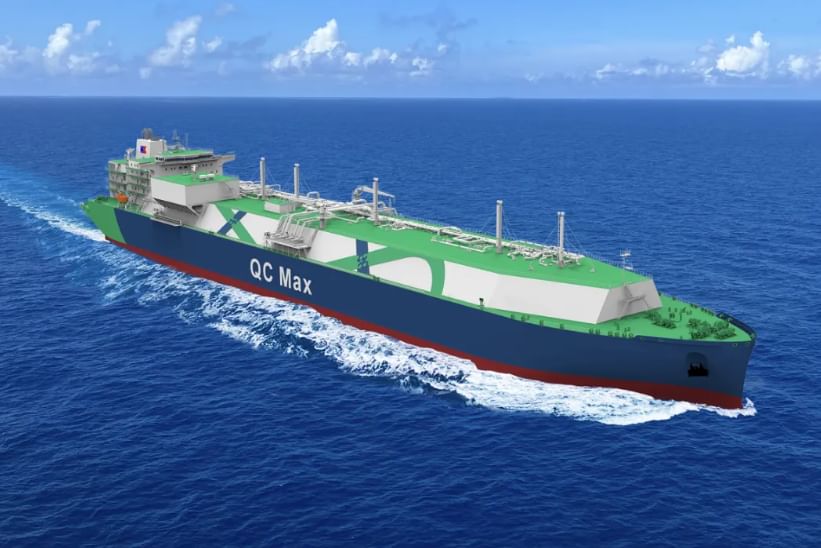

Dubai, UAE — On a sprawling shipyard along the Huangpu River, workers this week began assembling what China says will be the world’s largest liquefied natural gas carrier, a vessel that reflects the country’s growing influence in one of the most technically demanding corners of global manufacturing.
The 271,000-cubic-metre QC-Max vessel, being built by Hudong-Zhonghua Shipbuilding, is designed for a major Qatari LNG expansion project and is expected to enter service in 2028. At 344 metres long, it will carry substantially more cargo than conventional LNG carriers while reducing losses during transport.
The project marks another milestone for China’s shipbuilding industry, which has steadily expanded from bulk carriers and container ships into sophisticated vessels once dominated by shipyards in South Korea and Japan.
The ‘crown jewel’ of shipbuilding
LNG carriers are often described as the crown jewel of commercial shipbuilding because of their complexity.
The vessels must transport natural gas cooled to roughly minus 162 degrees Celsius while maintaining safety standards and minimizing evaporation losses over long ocean voyages.
According to industry data, the new QC-Max ships will feature advanced membrane containment technology, dual-fuel propulsion systems and environmental technologies designed to meet stringent emissions requirements.
Compared with standard 174,000-cubic-metre LNG carriers, the new design offers around 57% more cargo capacity, potentially improving shipping economics for large LNG exporters such as Qatar.
Qatar’s expansion fuels shipbuilding boom
The vessel forms part of a vast shipbuilding programme linked to Qatar’s efforts to expand LNG production from the North Field, one of the world’s largest natural gas reserves.
Industry reports indicate that Hudong-Zhonghua has secured orders for 36 vessels under the programme, including 24 QC-Max ships and 12 conventional LNG carriers. The broader Qatar expansion involves more than 120 LNG vessels globally, making it one of the largest shipbuilding campaigns in history.
The scale of the project reflects expectations that LNG will remain a critical component of the global energy mix even as countries pursue decarbonisation goals.
China’s growing market share
China’s emergence as a major LNG shipbuilder has accelerated in recent years through heavy investment, technological development and expanding production capacity.
The country now accounts for more than 30% of global LNG carrier orders, a significant increase from a decade ago when the market was largely controlled by South Korean yards.
Hudong-Zhonghua alone holds nearly 60 LNG vessel orders, with production stretching into the next decade, underscoring the strength of demand from energy producers and shipping companies.
Energy security and industrial strategy
For Beijing, LNG shipbuilding is about more than commercial success.
The sector sits at the intersection of advanced manufacturing, energy security and industrial policy, requiring expertise in cryogenic engineering, digital systems, materials science and complex supply chains.
As global demand for natural gas transportation grows and major exporters continue investing in production capacity, China’s ability to build some of the world’s most advanced LNG vessels could further strengthen its position in the global maritime industry.