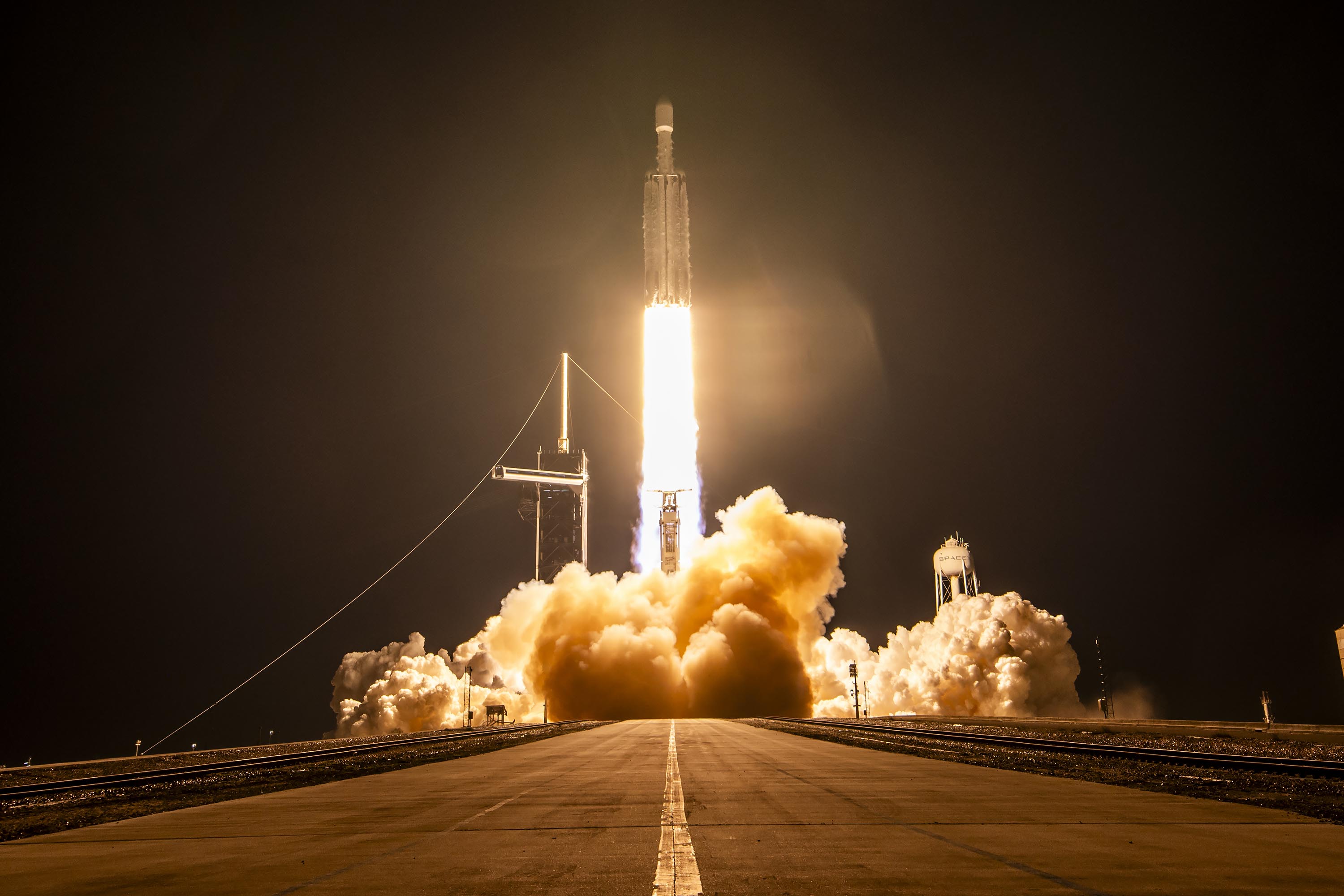

Washington, United States– SpaceX’s Falcon Heavy rocket blasted back into space on Thursday night to ferry the US military’s secretive X-37B drone to a research mission.
After weeks of delays, the rocket launched from NASA’s Kennedy Space Center in Florida at 8:07 pm Eastern Time (0107 GMT Friday) in a liftoff livestreamed on SpaceX’s website.
It is unclear where exactly the uncrewed and autonomously operating spacecraft is headed on its seventh mission.
The Pentagon has released little information about the space drone and its mission, which was initially scheduled for December 7, and SpaceX only cited the Pentagon’s mission code name — USSF-52 — in its statement on the launch.
“Falcon Heavy launched the USSF-52 mission to orbit from Launch Complex 39A,” SpaceX said.
Earlier, the Pentagon had said the X-37B’s seventh mission would entail “multiple cutting-edge experiments”.
“These tests include operating the reusable spaceplane in new orbital regimes, experimenting with future space domain awareness technologies, and investigating the radiation effects on materials provided by NASA,” the US Department of the Air Force Rapid Capabilities Office said in a statement last month.
It added that this is the first time the X-37B is lifting off on a Falcon Heavy, one of the most powerful operational rockets, capable of carrying payloads of up to 26,700 kilograms (58,900 pounds) deep into space.
About the size of a small bus, the X-37B US space drone looks like a mini version of the manned space shuttles retired in 2011. On previous missions, the X-37B has carried out tests for NASA on the impact of radiation on seeds and other materials.
The Falcon Heavy launch comes two weeks after China sent its own secretive robotic space plane, called Shenlong, into orbit for what state news agency Xinhua said would be a “period of time”.
“During this period, reusable technology verification and space science experiments will be carried out as planned to provide technical support for the peaceful use of space,” Xinhua said after the December 14 launch.
In operation since 2010, the X-37B Orbital Test Vehicle was designed for the Air Force by United Launch Alliance, a joint venture between Boeing and Lockheed Martin.
It is 30 feet (nine meters) long, has a 15-foot wingspan and is powered by solar panels.